Get Full Government Meeting Transcripts, Videos, & Alerts Forever!
Get email alerts on the Parks Recreation topic
No spam. Unsubscribe anytime.
Georgetown council reviews San Gabriel Park Phase 4 master plan; turf, water and cost trade‑offs take center stage
Summary
City of Georgetown City Council heard a presentation on a proposed master plan for San Gabriel Park Phase 4, including field layouts, access changes and an updated opinion of probable construction cost.
City of Georgetown City Council heard a presentation on a proposed master plan for San Gabriel Park Phase 4, including field layouts, access changes and an opinion of probable construction costs, during a council workshop.
The plan, presented by Eric Neuner, Assistant Parks and Recreation Director, and Chad Davis of consultant Park Hill, revises an earlier option and adds engineering detail on grades and storm routing, estimated capacities for additional parks and an updated opinion of probable construction cost (OPCC) for the full illustrated plan.
The park design shows a central ball complex with a loop road, distributed parking, restroom and pedestrian spaces, and a mix of field sizes (8U–18U). Davis said the OPCC for the plan as shown is about $58,000,000 and that the estimate “includes everything as illustrated in the master plan including full synthetic turf on seven baseball fields, the infield on one baseball field, and the soccer fields.”
Why it matters: Council and staff focused on practical tradeoffs — whether to use synthetic turf on some fields to increase playing hours and conserve water versus the higher capital cost and different ongoing maintenance profile. That decision affects how many people the existing parks can serve without building new sites, how the city budgets capital and maintenance dollars, and the park’s visual and operational impacts on nearby streets.
Most of the technical discussion centered on three matters: water demand, lifecycle cost and visual/topographic impacts.
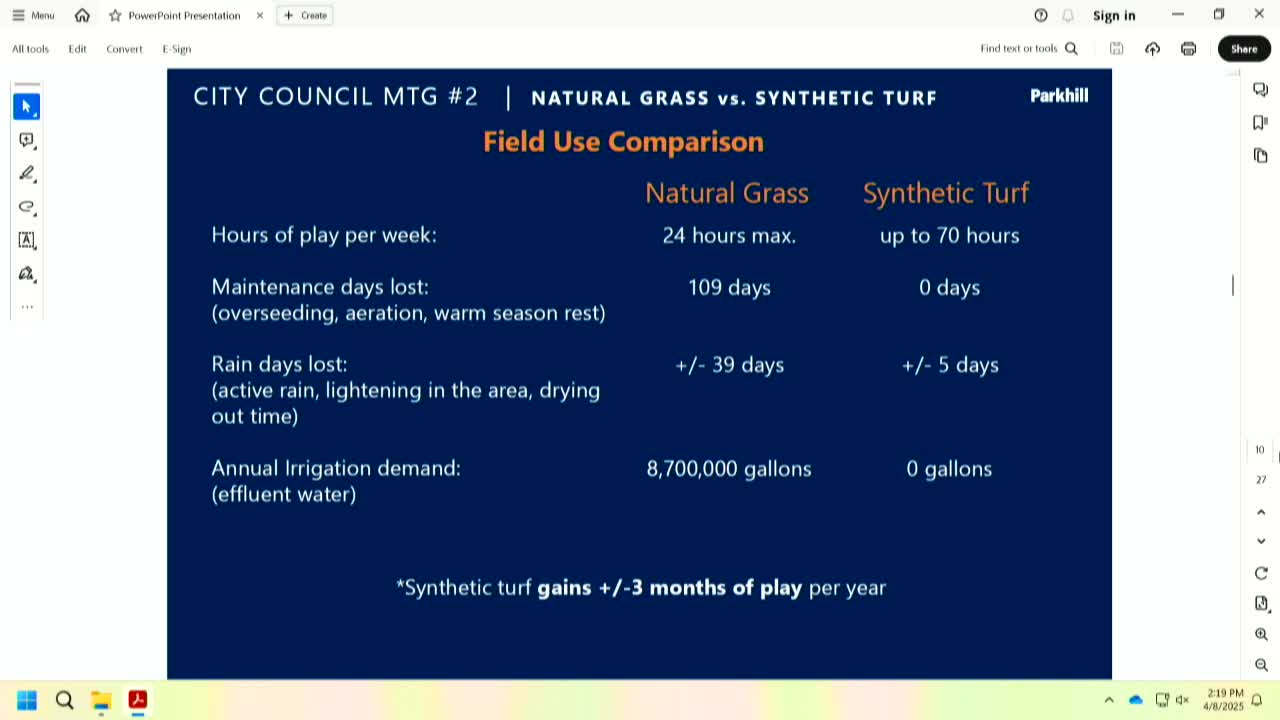
Davis presented modeled irrigation demand for the full master‑plan playing surfaces. He told the council the Penman‑Monteith–based model produced an average annual irrigation estimate of about 8,700,000 gallons for the plan’s natural‑grass playing surfaces and clarified that figure represents the entire master plan area (not per field). To make that number more tangible he said that 8.7 million gallons equates to roughly 209 four‑person households’ annual indoor water use.
The consultants contrasted natural grass and synthetic turf. They summarized a 10‑year operations and maintenance (O&M) comparison in which they modeled capital and recurring costs: a 10‑year O&M and replacement view showed natural grass installation costs roughly $1,400,000 and 10‑year O&M components that together produced a 10‑year total in the multimillion‑dollar range; the presentation listed an installation estimate for a synthetic approach of about $8,000,732 and higher capital but lower recurring water and chemical costs. On Davis’s slide the 10‑year combined capital plus O&M for the synthetic scenario was roughly $9,000,000 versus about $4,200,000 for the natural‑grass scenario; Davis noted that the synthetic option also requires another large replacement cost at the 10‑year mark.
Davis and Eric Neuner emphasized differences in usage capacity: natural grass is typically limited to about 24 hours of play per week per field before turf health declines, while synthetic turf supports substantially more hours (a figure Davis described as nearly triple). The consultants and staff flagged that in a fast‑growing community increased field capacity can reduce the need for new parks but requires carrying higher capital costs or long‑term replacements.
Council members and staff discussed secondary issues that would influence any future material decision: the loop road’s effect on views from Weir Road and North Austin Avenue, emergency‑vehicle access, stormwater routing and an embankment that places Weir Road roughly 15 feet above the proposed parking area. Davis said the loop roadway was partly intended to help divert additional stormwater flows produced by nearby TxDOT projects and to provide emergency access to the back of the park.
Heat and safety were raised in council questions. Davis noted synthetic surfaces can reach very high surface temperatures in Texas (he cited measured surface temperatures in some cases between 135 and 150 degrees Fahrenheit on hot afternoons) and said communities generally manage that by scheduling earlier or later activities rather than continuous irrigation to cool the surface. He also said advances in infill materials — for example blends that include cork instead of solely crumb rubber — and newer cushion systems have reduced some past safety concerns compared with older “astro‑turf” systems.
On maintenance, Davis presented 10‑year itemized estimates the team used in comparing options: fuel, equipment, herbicides, seeding, labor and irrigation were the largest recurring natural‑grass line items; synthetic fields carry lower irrigation and herbicide costs but have periodic replacement and brushing/infilling maintenance. The consultants also modeled storm and rain‑loss days — for example, they put average “rain days lost” for natural grass in the ballpark of 39 days per year versus about five days for synthetic fields (lightning and safety clearing still apply to both).
Council questions also covered revenue and program impacts if usage capacity increases, and whether partner organizations (like GYBA) or visiting teams would prefer turf or grass. Staff said programming demand has been growing (they cited year‑over‑year participation increases of about 10–15% in some recreational programs) and that public input received so far prioritized additional playable space; staff also said they are prepared to evaluate facility‑use agreements, fee structures and whether a partner group’s lease should be transitioned to a facility‑use model.
What council directed/next steps: staff and the consultants emphasized the council was not asked to select materials or begin construction; instead, council was reviewing a final master plan concept and the OPCC so the city can move forward with phased implementation when funding is available. The consultants noted that the plan can be built in phases and that grading and drainage design can be done to allow future conversion from grass to synthetic surfaces where desired.
Speakers quoted or referenced in this article were limited to those recorded in the council workshop: Eric Neuner, Assistant Parks and Recreation Director (City of Georgetown); Chad Davis, partner, Park Hill (consultant); and Councilmember Parry (Council member who asked questions during the discussion).
Ending: Staff said the master plan will remain a guide; any specific construction or material decisions would return to council later as funding and scheduling are resolved. Councilmembers asked staff to keep bringing detail on budgets, phasing and operational impacts as the city considers capital funding strategies.