Get Full Government Meeting Transcripts, Videos, & Alerts Forever!
Get email alerts on the Land Development topic
No spam. Unsubscribe anytime.
Replat at 819 Avenue K fails to gain required support amid alley-access concerns
Summary
A proposed replat to split one parcel into two at 819 Avenue K generated extended discussion about alley access, setbacks and emergency access; the Planning Commission vote failed to reach the four affirmative votes required and therefore did not pass at the meeting.
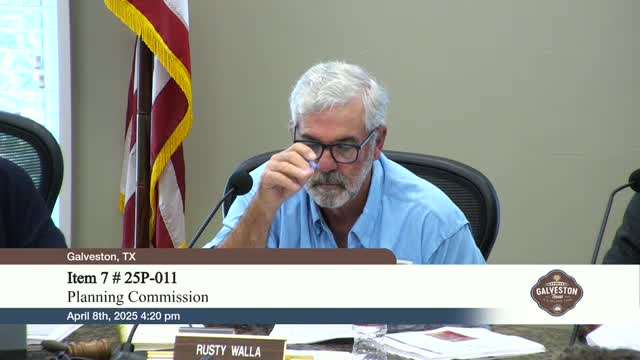
A proposed replat at 819 Avenue K (case 25P-011) produced sustained discussion at the Planning Commission meeting on April 8 about rear-lot alley access, setbacks, parking and emergency access. The commission did not reach the four affirmative votes required for approval, and the motion failed for lack of sufficient votes.
Planning staff Daniel summarized the request as a replat of one parcel into two, with the rear lot oriented to the alley and a zoning-board variance already granted to reduce the minimum lot area for the rear parcel. Staff noted the applicant had submitted a demolition permit for a rear garage so the accessory structure issue would be addressed prior to final recording.
Applicant representatives said the plan is to build a small rear house (described as a “tiny house” in the presentation) with a carport and alley access; they said they would provide parking on-site and a utility easement. Several commissioners raised concerns. One commissioner said: “No new business or new dwelling shall face or have its main entrance on an alley,” and expressed unease about a new dwelling with alley-only access; others questioned whether a 20-foot alley would reliably support vehicle access and emergency response and asked whether the applicant could provide setbacks to preserve turning radii and fire access.
Staff and other commissioners noted that platting is a ministerial process governed by state law and local regulations; planning staff said replats must meet the subdivision rules and that many facility-level concerns (setbacks, easements, building heights, parking design) are handled at later permit and plan-review stages. Commissioners said those downstream issues were important but not strictly under the commission's discretionary authority for a replat.
When the vote was called, the motion did not receive the required four affirmative votes; commissioners recorded three votes in favor and two opposed. Because the commission did not approve the replat at the meeting and state law creates a 30-day review window for plats, staff noted the applicant may receive administrative approval if time limits elapse without final action. The commission scheduled a workshop on alley-access lots and platting standards for April 22 to discuss policy-level changes.