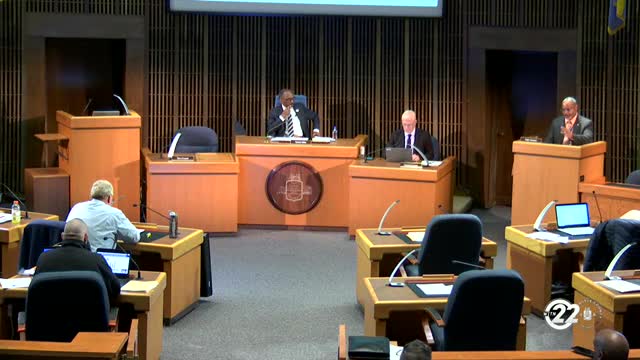
New Castle County executive committee hears workforce diversity report; HR recommends recruitment pipelines and tech upgrades
Loading...
Summary
New Castle County’s Executive Committee heard a countywide workforce diversity presentation from Chief Human Resources Officer Dr. Dustin Blakey on April 8, 2025, outlining demographic trends from 2019–2024 and recommending recruitment partnerships, an upgraded applicant-tracking system, updated job descriptions and a salary study.
New Castle County’s Executive Committee heard a countywide workforce diversity presentation from Chief Human Resources Officer Dr. Dustin Blakey on April 8, 2025, outlining demographic trends from 2019–2024 and recommending recruitment partnerships, an upgraded applicant-tracking system, updated job descriptions and a salary study.
The presentation, led by Dr. Blakey and data lead Yanni Floropoulos, provided a department-by-department snapshot of the county workforce. Floropoulos said total nonwhite representation rose to 33.98% in 2024 from roughly 27.2% in 2019—an increase of about 6.8 percentage points—and that males represented about 61.5% of employees (928 employees reported). He also said part-time roles skewed toward women, with about 60.58% of part‑time employees female, while large departments such as public works and public safety remained majority male.
Why it matters: Council members said workforce composition affects public service delivery and representation. Several asked for clearer benchmarks comparing county hires to working‑age residents and for data that distinguishes hires, applicants and promotions, not just head counts. Council members also raised concerns about recruitment and internal promotion pipelines in public works and public safety.
Major findings and context - Countywide trends: Floropoulos said the county recovered to and slightly exceeded pre‑COVID staffing levels, with an overall increase in hires since 2019. He emphasized that county totals mask substantial variation among work units and between full‑time and part‑time staff. - Department differences: Community Services is highly female‑skewed (Floropoulos described a roughly 3:1 female to male full‑time ratio), while Public Works and Public Safety skew male. Public Safety was described as having significant full‑time white employee representation but a greater balance in part‑time staffing. - Data limits: Presenters said the county’s Human Resources system (PeopleSoft) is an older iteration that does not track applicant demographics reliably. Floropoulos said the county lacks a modern applicant‑tracking/human capital management system needed to produce applicant pipelines, application rates by demographic group, and promotion/retention analytics.
Recommendations presented - Technology upgrades: Acquire a human capital management system with applicant‑tracking capabilities so the county can report applicant demographics, not just hires. - Recruitment pipelines: Build partnerships with local secondary and postsecondary institutions, create targeted pipelines for hard‑to‑fill roles (for example, CDL drivers), and pursue partnerships suggested by council members, including outreach to the Delaware National Guard. - Job descriptions and salary study: Conduct a comprehensive review and update of job descriptions and commission a salary study to compare pay with surrounding counties and industry benchmarks; presenters said they had engaged Blackwell HR Solutions and proposed hiring Global Compass to assist with job descriptions and the compensation review. - Diversity commission: Dr. Blakey said County Executive Henry seeks to restore the county’s diversity commission, originally established by ordinance 2100, and to produce annual reports through that commission.
Council response and follow-up requests Council members broadly praised the presentation but pressed for additional detail before the budget process. Key council requests and comments included: - Benchmarking: Councilman Smiley and others requested comparisons to New Castle County population benchmarks and to working‑age population cohorts; presenters said they are extracting working‑age data from census sources and will provide those comparisons in a later report. - Promotions and leadership diversity: Councilman Street urged the administration to address internal promotion pipelines, citing a lack of Black leadership in some departments, including a concern that the police department has not developed a pipeline for senior leadership roles. - Hiring timeline and process: Council members raised the length of the hiring process as a retention and candidate‑loss concern and welcomed consultant recommendations to shorten timelines. - Compensation context: Council members asked that the compensation analysis show how step increases and union negotiations affect midpoints and long‑term pay trajectories; presenters said the salary study will include comparisons with surrounding jurisdictions, but that union bargaining processes are separate and may affect implementation.
Procedural notes and next steps Dr. Blakey and staff said they would provide the committee with the presentation materials and follow up with more granular benchmarking (county total vs. working‑age population) and applicant‑tracking data once a new system is in place or data are extracted. The administration did not request new staff in the presentation but recommended reallocation of existing lines, technology upgrades and consultant support. The committee did not take formal policy action during this meeting; staff said a deeper dive would be scheduled before the budget cycle.
Votes and formal actions at the meeting were limited to procedural items: the committee approved the minutes of its Jan. 28 meeting by voice vote and later moved to adjourn. The presentation and subsequent discussion were informational.
Ending County HR staff said they will return with more detailed benchmarking, an updated technology plan and the results of consultant reviews and a salary study. Council members asked that the next presentation include comparisons to county population benchmarks and clearer data on pay grades and promotion levels for newly hired nonwhite employees. There were no public comments recorded during the meeting.