Get Full Government Meeting Transcripts, Videos, & Alerts Forever!
Get email alerts on the Property Tax Reassessment topic
No spam. Unsubscribe anytime.
Vision Government Solutions details table-driven reassessment; informal reviews continue through April 18
Summary
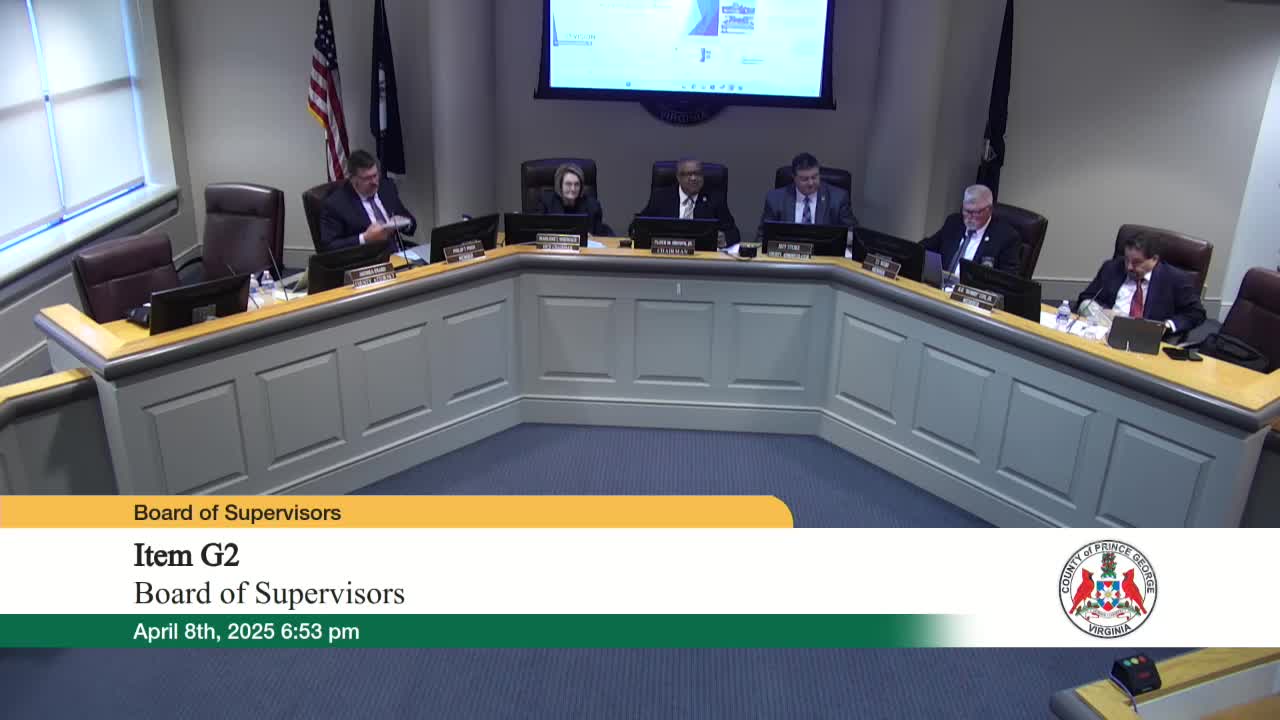
Prince George County officials and Vision Government Solutions provided a detailed briefing April 8 on a countywide reassessment and asked residents to schedule informal reviews before April 18 to correct factual errors such as parcel size, building characteristics and land influences.
Prince George County officials and Vision Government Solutions provided a detailed briefing April 8 on the countywide reassessment that produced preliminary values for about 14,200 parcels and is now in an informal review period through Friday, April 18.
The reassessment work used a “table-driven” computer-assisted mass appraisal (CAMA) system, Vision’s project managers said, meaning the same physical characteristics should generate the same value across parcels. Brian Cunningham, Vision’s project manager, told the Board of Supervisors the vendor removed subjective value overrides, restored land influence factors and reclassified vague building “styles” into more descriptive categories so the model would treat similar properties consistently.
The changes matter because they affect taxable assessments that feed the county’s fiscal plans. “Our goal was to deliver a table-driven CAMA system…that allows the calculation of valuation that’s equal and uniform across all the properties in Prince George County,” Cunningham said.
Why it matters: County officials and Vision emphasized that much of the work was corrective: restoring previously removed land influence factors (wetlands, easements, access, large-acreage price adjustments), fixing building-style classifications and updating the improvement inventory from aerial imagery and field checks. Randy Horn of the assessor’s office said the county and Vision had updated more than 11,200 parcels (about 75–80% of the tax roll) during the data cleanup.
Key facts and numbers - Parcels reviewed: ~14,200 total county parcels. - Parcels with updated improvement inventory: ~11,200. - Informal reviews held or scheduled as of late April 2025 (presentation figures): about 378 hearings affecting roughly 422 parcels; Vision reported the count later rose to 469 meetings covering 502 parcels during the week after the presentation. - Sales-ratio performance: Vision reported a median appraised-to-sales ratio near 100% across the two-year sales window used in the analysis and said coefficient-of-dispersion (COD) and price-related-differential (PRD) metrics met appraisal standards.
What residents can and cannot change in the review: Horn and Vision staff said the county’s informal review process can correct factual errors — for example, square footage, number of bedrooms or bathrooms, parcel size and land-characteristic errors. They stressed that valuation methodology (valuation tables, modifiers, and rates) is set by the contractor’s model and is not changed by county staff during the office review; if residents remain dissatisfied after the office review they may appeal to the Board of Equalization (BOE). Horn advised property owners to schedule their Vision informal review before the April 18 deadline to ensure the evidence can be considered before final modeling is completed.
What staff said about outreach and next steps: Vision said it has been sharing sales data, neighborhood-level sales analyses and median-change reports with county staff. Brian Cunningham and CJ (lead statistician) described neighborhood-level modeling (Vision said they divided the county into 92 appraisal neighborhoods) and repeated-modeling cycles to tune land- and improvement-tables. Horn said once informal hearings finish and any necessary model adjustments are made, final assessment notices will go to the printer about a week after April 18 and mailed a short time later — likely several weeks after that mailing date.
Concerns raised by board members and residents: Supervisors and speakers in public comment raised concerns about: missing or inconsistent land influence factors in some neighborhoods, how building styles were classified (for example, several parcels were marked “contemporary” and produced higher values), and whether citizens had enough advance notice to schedule reviews. Vision acknowledged earlier personnel and communications issues on some calls and said the vendor was reviewing callback logs and following up individually. Vision and county staff asked supervisors to encourage residents to call the assessor’s office or Vision to schedule an informal review if they have questions.
What the county advised residents: County staff and Vision urged property owners to schedule an informal review before April 18, and said that if a resident remains unsatisfied after the county’s office review they may appeal to the Board of Equalization (BOE) in the next appeals window. Horn said the assessor’s office maintains appeal forms and can email them to residents.
Ending: County staff offered to return with an updated briefing if the board requests it. Vision said it would continue to process informals, review any patterns that emerge, and apply targeted model adjustments where warranted.