Get Full Government Meeting Transcripts, Videos, & Alerts Forever!
Get email alerts on the Csbg Neighborhood Services topic
No spam. Unsubscribe anytime.
Neighborhood Services outlines CSBG-funded programs, rental-assistance totals and food-supply disruption
Summary
Austin Public Health's Neighborhood Services Unit reported on Community Services Block Grant-funded services, noting rental assistance provided, eviction prevention counts, public-health nursing hubs, and a large cancellation of federal food orders that could reduce available food by roughly 917,000 pounds.
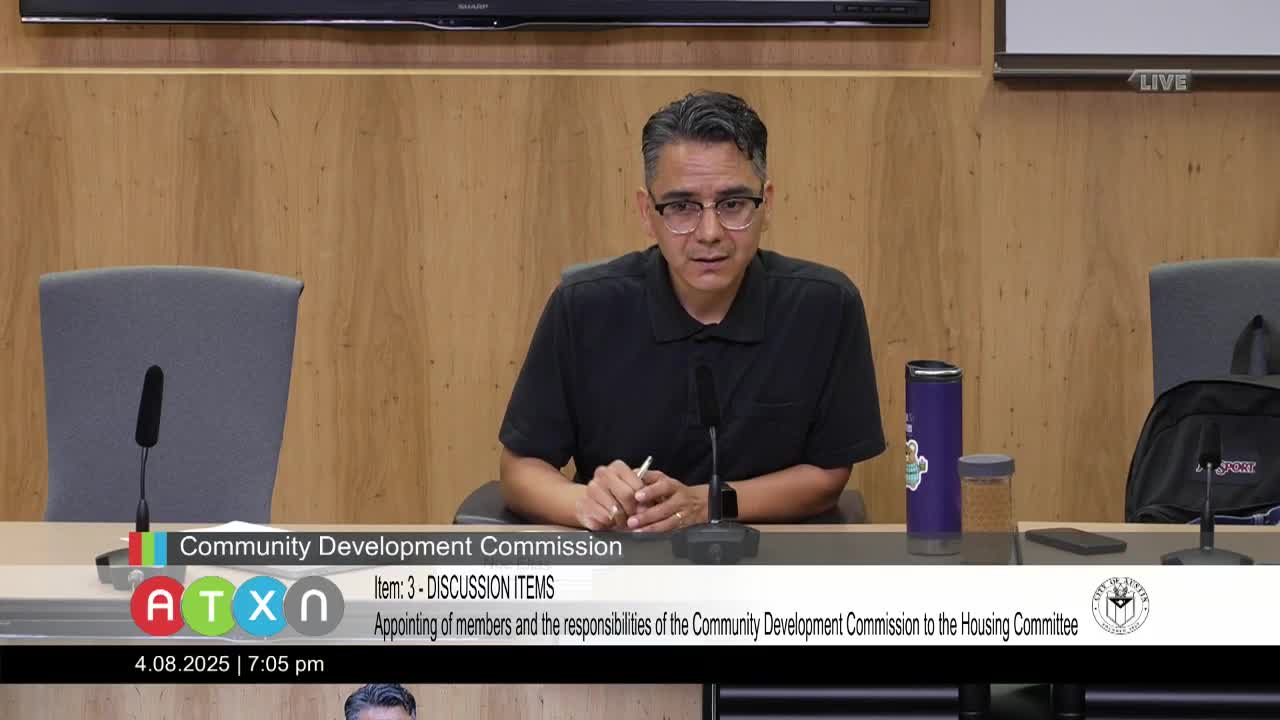
Angel Zambrano, manager of the Neighborhood Services Unit at Austin Public Health, presented the monthly report on the Community Services Block Grant (CSBG) and neighborhood center activities at the April 8 meeting.
Zambrano summarized CSBG's history and purpose, saying the program links to federal anti-poverty initiatives and funds local community action services. She told commissioners that about 90 percent of CSBG funds are used locally for services, with roughly 10 percent for administrative purposes; the Texas Department of Housing and Community Affairs administers the grant at the state level and retains a small portion for statewide use.
Program statistics: Zambrano reported several operational figures for January–March. She said the unit's target for households avoiding eviction this year is 1,000 and that the program had helped "a 74 households" avoid eviction so far using city rent-assistance funds. She also reported that "we assisted 252 people in a 18 households with rent assistance payments, and that amounted to about $310,000 in rent assistance." Zambrano told the commission that staff had assisted more than 20,600 people with basic needs during the January–March period.
Food supply disruption: Zambrano told the commission that the Central Texas Food Bank reported canceled federal orders that she said translated to roughly 917,000 pounds of food not arriving for local distribution, noting this creates additional strain across partner agencies and neighborhood centers.
Services described: The Neighborhood Services Unit provides food distributions (in partnership with Central Texas Food Bank), emergency rental and utility assistance (with Austin Area Urban League acting as fiscal agent for rental assistance payments), public-health nursing hubs at neighborhood centers, case management for self-sufficiency, bus passes for clients in need of transportation, and referrals to other agencies. Zambrano also noted a recent household-goods giveaway and that neighborhood centers vary in age; most are older (1970s–1980s) while Dove Springs and Montopolis have newer facilities.
Why it matters: CSBG-funded services deliver basic needs and wraparound supports to very low- and extremely low-income residents in Austin and Travis County. Staff highlighted increasing demands for rental and food assistance and flagged supply-chain and funding pressures.
What the commission asked and next steps: Commissioners asked about follow-up on whether clients who transition out of poverty remain stable after program exit; Zambrano said follow-up is not a formal metric and staff face contact barriers. Commissioners also asked about landlord acceptance of rental-assistance payments and about transportation and facility-renovation funding sources. Zambrano said rental payments are typically accepted by landlords through the Austin Area Urban League-managed process and that facility capital work comes from other budgets, not CSBG.
Ending: Zambrano recommended continued advocacy for funding and invited commissioners to raise needs and collaborate on outreach; she said staff would share program links and flyers for commissioners to use in community outreach.