Get Full Government Meeting Transcripts, Videos, & Alerts Forever!
Get email alerts on the Municipal Finance topic
No spam. Unsubscribe anytime.
Derby council receives 2024 financial review; officials flag sales-tax formula and future utility debt
Summary
City finance director reported stronger-than-expected 2024 revenues and investment income, discussed upcoming utility capital needs and debt pressure, and council voted 8-0 to receive and file the report.
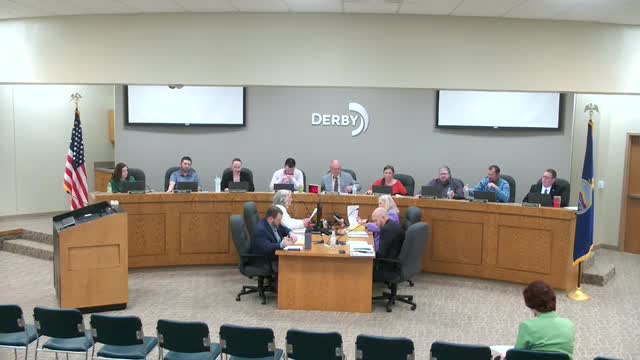
Megan Sneller, Derby's finance director, told the City Council on April 8 that the city ended 2024 in strong fiscal position, with general fund revenues of about $27 million and higher-than-expected investment income that boosted total funds.
Sneller said the city recorded roughly $2.6 million in general-fund investment income in 2024 and about $3.6 million across all funds, and that total revenues came in about $775,000 above budget. She also reported expense savings — about $1.25 million below the revised budget — driven largely by approximately $800,000 in salary savings.
The report matters because it frames the city's near-term capacity to fund large capital projects and to absorb future debt service. Sneller said the city is preparing for a 30-plus million dollar water treatment facility planned for 2026–27 and that utility debt service will rise as board-authorized projects come online.
"We entered 2024 in great financial shape," Sneller told council members, adding that the city lowered its mill levy to about 45.498 — its lowest in more than 20 years — and that some revenue sources (building permits, franchise fees) showed improvement from 2023.
Council members and staff used the hearing to outline risks and monitorable items. Sneller said sales tax — which makes up roughly 23% of general fund revenue — is subject to a countywide allocation formula now under review. She described a proposed change that Sedgwick County drafted this year as potentially harmful to Derby’s share and said county leaders intend to convene an interim committee to study the formula.
Council member Coleman and others warned the council is watching several state-level proposals that could limit property-tax growth or change revenue distribution; Sneller and the mayor said those bills remain unresolved after the legislative session. Sneller also reported that the city’s statutory direct debt stood at about 9.15% of assessed valuation at year-end 2024 and could rise toward the mid-teens with upcoming bond issuances, though city policy targets keeping the ratio under 20%.
Sneller outlined additional near- and mid-term capital items: Market Street water-line work, water tower coatings, phased wastewater plant construction already under way (bonded in 2023–24), planned stormwater modeling and projects, and pavement rehabilitation. She said the water fund is budgeting for a major treatment plant in 2026–27 and the city has about $11 million in water-fund ending balance to help cover upcoming debt service.
Mayor Mark Statz and City Manager Kyle Mangus joined the discussion on the implications for the 2025–26 budget process, including staffing needs tied to new facilities and how Derby Difference sales-tax receipts (a local option sales-tax split for parks/public safety/streets) will affect project funding. Sneller said the city will update the CIP and present revised projections during the May/June budget workshops.
Council member Webster moved to receive and file the 2024 financial report; the motion passed by voice vote, 8-0.
Looking ahead, staff said they will continue monitoring sales-tax receipts (which show a lag of about two months), watch interest-rate-driven declines in investment yields, and follow state legislative activity that could alter revenue-sharing or property-tax limits. The finance director will present the audit and financial report at the May 27 meeting and the city’s budget timeline will include two workshops in May and June, a recommended budget in July and public hearings in August.