Get Full Government Meeting Transcripts, Videos, & Alerts Forever!
Get email alerts on the Housing Rezoning Displacement topic
No spam. Unsubscribe anytime.
Community group warns DB 90 rezoning could displace 290 affordable units at Acacia Cliffs
Summary
Community Powered ATX asked the Austin Community Development Commission to support tenants of Acacia Cliffs Apartments facing a DB 90 rezoning case at City Council; speaker said 290 deeply affordable units are at risk and rents there run about $860–$1,350.
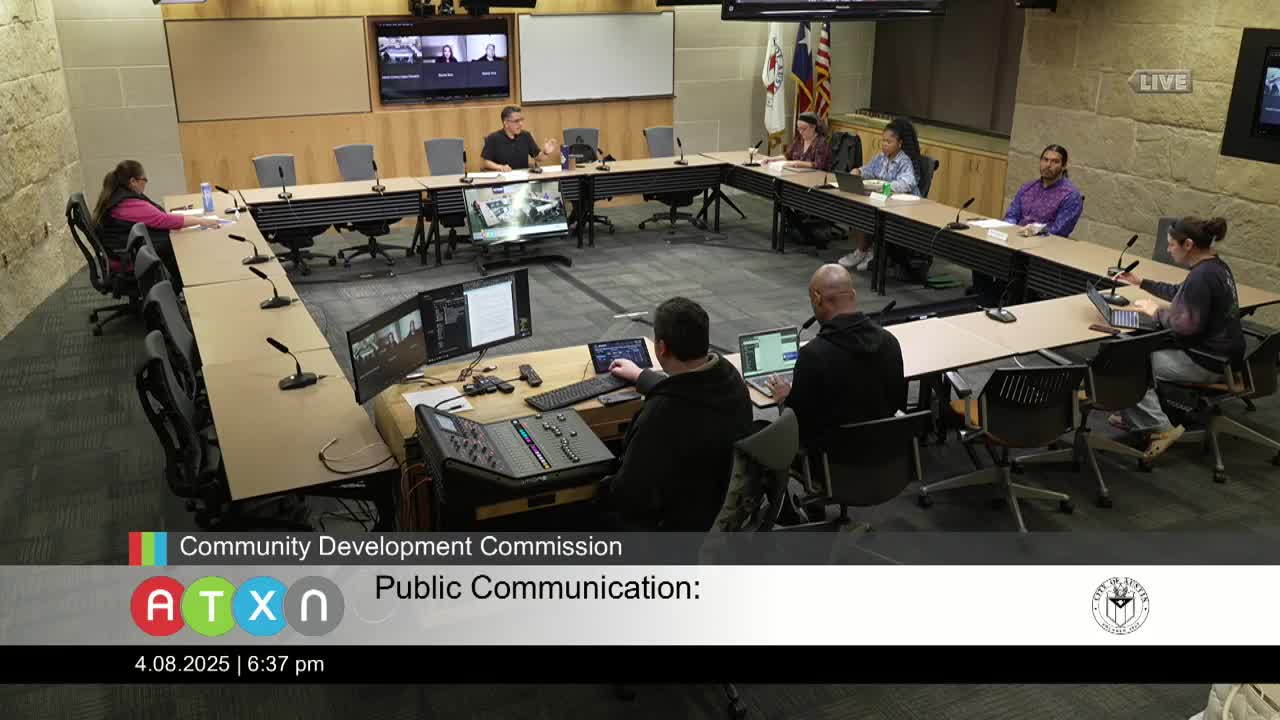
Celine Rendon, a community organizer with Community Powered ATX, told the Austin Community Development Commission on April 8 that tenants at Acacia Cliffs Apartments in northwest Austin face displacement if a DB 90 rezoning case before City Council moves forward without protections. "Renters at the Acacia Cliffs Apartments, most of these are low income families, students, and seniors are currently at risk of being displaced for a DB 90 rezoning case that's happening this Thursday at City Hall," Rendon said during the commission's public-communication period.
Rendon said the development would remove one of the last remaining lower-cost housing options in District 10. She summarized rents at Acacia Cliffs as ranging from $860 to $1,350 and said the property contains 290 "deeply affordable" apartments. Rendon asked the commission to support tenants and offered to provide the CDC with more information and materials.
Why it matters: The CDC advises City Council on programs that affect low-income residents and federally funded services. Changes to zoning that accelerate redevelopment can increase displacement pressures in neighborhoods with limited deeply affordable housing. Rendon framed the Acacia Cliffs case as part of a broader set of policy changes in 2023—including references she made to "home phase 1 and 2," Equitable Transit-Oriented Development (eTOD) and DB 90—that she said favor investment over low-income renters.
What was said and what happened: Rendon requested CDC support and offered follow-up materials; the commission did not take a formal vote on the request at the April 8 meeting. City Council was listed by Rendon as scheduled to consider the DB 90 case on the forthcoming Thursday; she did not state the specific council docket number.
Context and next steps: Rendon connected this case to wider concerns about who benefits from recent zoning changes and asked commissioners to follow up. The commission did not record a formal directive or motion in the meeting minutes; Rendon was told she could email any presentation materials to staff, who would share them with commissioners.
Ending: The commission logged Rendon's comment during public communication and continued with its agenda. Rendon said she would provide additional details to CDC staff if requested.