Get Full Government Meeting Transcripts, Videos, & Alerts Forever!
Get email alerts on the Land Use Church Expansion topic
No spam. Unsubscribe anytime.
Benton County planning commission keeps record open in Saint Martin Orthodox Church appeal amid road and water concerns
Summary
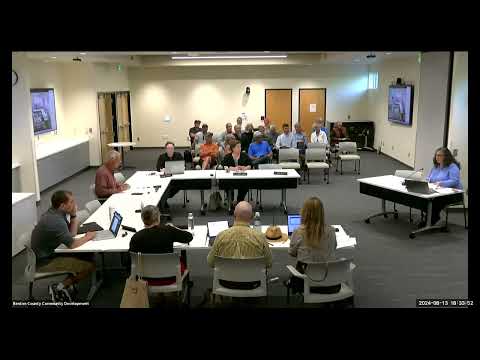
The Benton County Planning Commission on Aug. 13 kept the public record open for seven days in an appeal of the planning official's decision on LUD-23-051, the conditional-use permit sought by Saint Martin, the Merciful Orthodox Church, Inc., to expand its chapel, add a parish hall and a parsonage and to change the site's zoning status.
The Benton County Planning Commission on Aug. 13 kept the public record open for seven days in an appeal of the planning official's decision on LUD-23-051, the conditional-use permit sought by Saint Martin, the Merciful Orthodox Church, Inc., to expand its chapel, add a parish hall and a parsonage and to change the site's zoning status.
The action allows neighbors and other parties to submit additional written evidence through Aug. 20; the commission set a related deadline for the applicant's final written argument for Aug. 27 and said it will deliberate and decide the appeal at its Sept. 3 meeting. The motion to hold the record open was approved unanimously.
The commission's decision came after hours of testimony that focused on a small, narrow gravel loop road that serves the church property — Camellia Drive and Wildrose Drive — and on on-site water and septic capacity. Neighbors said the planned expansion could increase traffic on single-lane sections of the loop and exacerbate groundwater and drainage problems; the applicant and county staff said the proposal includes parking, stormwater and septic work and that many issues would be reviewed in detail at building‑permit stage.
Why it matters: Commissioners must weigh whether the applicant has met Benton County Development Code criteria for conditional uses, and neighbors say several of those criteria — impacts on adjacent property, road safety and water supply — are at issue. The commission paused a decision to allow additional written evidence rather than closing the record and proceeding to deliberation.
Staff presentation and legal context
Planning staffer Ina Williams opened the staff report and described the application as a conditional use permit for an expansion of an existing church structure that had been made “conditional” in 2014 when the code changed. Williams told the commission the proposal includes expanded parking, a proposed new on-site sewage disposal area and building-permit requirements for water testing and other measures.
Williams also outlined the applicable criteria the commission must apply, citing portions of the Benton County Development Code and related Oregon administrative rules. She noted staff had recommended maintaining many of the existing conditions of approval and had not found the appellant's suggested new conditions compelling in the staff review.
Public-works and road discussion
Gordon Kirk (associate engineer, Public Works) and a Public Works representative identified in the hearing as Mr. Kurtz described how the county treats road improvements where developments increase demand on local access roads. Kurtz said the county often allows improvements to be deferred and secured by an agreement and a financial guarantee, and that it calculates developer responsibilities using a proportional-share approach rather than a simple trips-per-day threshold. "We do not require that road improvements are required, and they must be secured, if they're going to be deferred," Kurtz explained, adding that when an expansion triggers work, the county typically asks the applicant to enter an improvement agreement and provide security.
Public Works staff said upgrading the loop to full county paved standards would be a substantial undertaking: a typical county standard would require roughly a 24-foot wide traveled way (two 10-foot lanes plus shoulders) with new drainage — work that can require removing vegetation and modifying existing front yards and that can cost tens of thousands of dollars depending on the length and scope of the improvements.
Applicant and consultant statements
William Reynolds, a senior planner with Vario Design representing the applicant, said the church supports working with Public Works to locate and scale any required street improvements and emphasized flexibility in the proposed condition language. "We are more than happy to work with Public Works to determine the appropriate location and scale of street improvements," Reynolds told the commission.
A project architect who spoke described the existing chapel as very small and said the proposed additions are intended to bring the facility into compliance with modern stormwater, septic and fire‑access standards while providing indoor space that reduces outdoor gatherings and street parking.
Neighbors' testimony and concerns
Residents who live along Camellia and Wildrose Drive told the commission they oppose or want stricter conditions on the expansion because of the loop road's narrowness, existing pedestrian use and repeated delivery and service truck traffic. Appellants and neighbors submitted photographs and counts they said show congestion on Sundays and Saturday evening services.
Several neighbors described long-term concerns about groundwater. Testimony included requests that county staff or the state watermaster measure nearby wells again; witnesses said multiple wells in the neighborhood have needed redrilling in recent years and asked the commission to consider potential impacts on private wells when evaluating the permit.
Water, septic and occupancy questions
Scott Prueter, the county environmental health program manager, and staff noted the proposal triggers additional septic and water testing as part of the building-permit review. Staff explained that the church's classification under Oregon's very small water system rules depends on average daily population counts; changing the assumptions (for example, 60 vs. 80 persons) could alter sampling requirements but would not necessarily change broad permitting conclusions. Staff and the applicant also said that final occupancy limits are set during building-permit review and by the fire marshal's calculations, not by this conditional-use approval alone.
What the commission did
After testimony and a wrap-up question round, one commissioner moved that the record be held open for seven days for written testimony only. The motion passed unanimously. The commission set the written‑testimony deadline at 5 p.m. Aug. 20 and gave the applicant until Aug. 27 to file a final written argument. The commission said it will close the hearing record and hold deliberations at its Sept. 3 meeting (no further public testimony will be taken then).
Next steps and context
The commission's next steps are (1) accept any written evidence submitted by Aug. 20, (2) accept the applicant's rebuttal brief until Aug. 27 and (3) deliberate and vote Sept. 3 on whether the application as conditioned meets the county’s code standards. If the commission approves, opponents can appeal to the Land Use Board of Appeals (LUBA) under Oregon law; staff cautioned that issues not raised with sufficient specificity during the hearing can be precluded on appeal.
Ending note
The record will remain open for seven days; members of the public and the applicant may file documents as directed by the county notice. The commission said it expects to receive the additional material in time to include it in the Sept. 3 deliberation packet.