Get Full Government Meeting Transcripts, Videos, & Alerts Forever!
Get email alerts on the Housing Finance topic
No spam. Unsubscribe anytime.
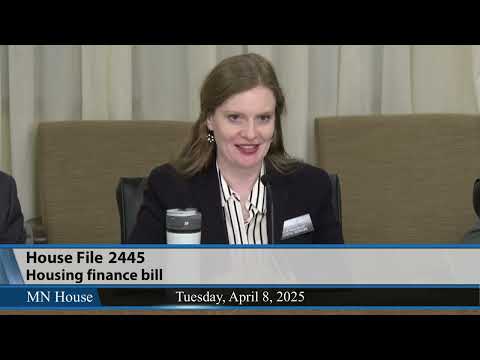
House committee hears overview of House File 2445, housing finance bill with $75 million general‑fund target and $100 million in housing bonds
Summary
The House Finance and Policy Committee took testimony and technical briefings on House File 2445, the committee’s housing finance bill, during a committee hearing where nonpartisan staff and Minnesota Housing officials outlined the bill’s spending and policy provisions and advocates urged additional support for homelessness prevention, manufactured‑home communities and homeowner assistance.
The House Finance and Policy Committee took testimony and technical briefings on House File 2445, the committee’s housing finance bill, during a committee hearing where nonpartisan staff and Minnesota Housing officials outlined the bill’s spending and policy provisions and advocates urged additional support for homelessness prevention, manufactured‑home communities and homeowner assistance.
The bill (DE2) in the committee’s packet is built around a $75 million general‑fund target for the fiscal 2026‑27 biennium and includes authorization for $100 million in housing infrastructure bonds, according to the House Fiscal Analysis spreadsheet presented to the committee. Nonpartisan staff said the DE2 timestamp on the spreadsheet is April 4 at 11:22 p.m.
Key appropriations and changes described by House Fiscal Analysis and House Research staff include one‑time and ongoing funding across several programs: one‑time $10 million each for a Challenge program and the Greater Minnesota Workforce Housing Development Program (fiscal 26‑27); $30.6 million for the Family Homeless Prevention and Assistance Program (FHPAP) in fiscal 26‑27 with $900,000 ongoing in fiscal 28‑29; a $20 million one‑time Greater Minnesota Housing Infrastructure Grant; $3 million one‑time for a Workforce and Affordable Homeownership Development Program (fiscal 26); and $2 million one‑time for Manufactured Home Park Community Redevelopment infrastructure grants (fiscal 26‑27). The spreadsheet also lists a $100,000 appropriation to Minnesota Housing for policies to stabilize affordable housing and a $500,000 one‑time appropriation for a statewide tenant education and hotline service.
Minnesota Housing Commissioner (testifying) and multiple housing advocates told the committee that the proposed mix of funds would expand production, preserve existing affordable homes and help renters avoid eviction. Testimony emphasized FHPAP’s role in preventing homelessness and the program’s current undersupply: multiple witnesses and nonpartisan staff cited a biennial funding need far larger than the amounts in the bill, and Minnesota Housing staff said the agency estimates hundreds of millions of dollars would be required annually to meet statewide emergency assistance needs.
Advocates for manufactured housing and resident‑owned park conversions supported the bill’s Manufactured Home Community Redevelopment (MHCR) funding and asked that housing infrastructure bond proceeds be allowable to support manufactured‑home infrastructure. Witnesses said stabilizing existing manufactured‑home communities is cost‑efficient: witness testimony cited roughly $25,000 per unit to stabilize and preserve homes in resident‑owned communities and described these investments as far cheaper than building new units.
Other policy provisions in the bill discussed by House Research include: repeal of a Housing Support Account transfer (with the balance moving to the general fund), a requirement that Minnesota Housing annually report on affordable‑housing financial stability (including operating expense‑to‑revenue ratios and late rental payments), a requirement to convene interagency meetings on homelessness and housing needs, and provisions to modify and expand a Community‑Based First‑Generation Homebuyer Down Payment Assistance program (including changing an income limit to a home‑buyer limit of 100% statewide median income and increasing the maximum assistance to 10% of median sale price beginning fiscal 2027). The bill also would establish an accessible housing task force to study housing for people with disabilities.
Committee members and staff said the committee will return the next day for member discussion and to consider amendments; the chair laid the bill over for continued work. No final committee vote on the bill was recorded during the hearing.
Ending: The committee hearing combined a technical fiscal walkthrough from House Fiscal Analysis with a series of public and organizational witnesses who urged greater funding and program changes. Committee staff and Minnesota Housing said they will be available to support implementation language and that the bond authorization would create a pipeline of capital that the agency could allocate during the calendar year if enacted.