Get Full Government Meeting Transcripts, Videos, & Alerts Forever!
Get email alerts on the Agriculture.food Safety.labeling topic
No spam. Unsubscribe anytime.
Committee approves bill requiring cultivated‑meat products to be labeled as imitation meat product; debate centers on terminology and federal labeling
Summary
House Bill 1425 would require processors of cell‑cultivated meat products to label those products as imitation meat product; supporters described it as a consumer‑protection measure while industry groups warned the language may conflict with federal labeling and raise legal issues.
House Bill 1425 would add a statutory definition for "cultivated meat product" and require that packages containing such products carry a clear label indicating they are imitation meat products. Sponsors described the measure as a consumer‑protection and labeling bill; industry groups and some senators warned about federal preemption, terminology and the potential effect on interstate commerce.
Senator Glick, who introduced the bill in committee, said the measure "prohibits the labeling of those products as meat" and insisted the goal is to prevent consumer confusion by clearly distinguishing products originating from animal carcasses from products produced in laboratories. The bill defines cultivated meat product in part as "animal protein grown in a facility from extracted animal stem cells arranged in a similar structure as animal tissues to replicate the sensory or nutritional profiles of meat products." Senator Glick said the Board of Animal Health would administer the statutory chapter if the bill becomes law.
Representative Dan Culp and Representative Baird (original sponsor in the House) described the proposal as a consumer‑protection and jurisdictional measure; they noted that another pending bill addresses retail labeling and that HB 1425 focuses on labeling at the processor/manufacturer level. Senator Baird, the House author who later attended committee, told members he would prefer to ban the product but said this bill is meant to set standards now. In testimony he described the laboratory production process and expressed health and safety concerns, saying the cells are grown in a bioreactor and the product is processed into a "cellular slurry" that requires plant fibers to form a finished product.
Jeremy Elts of the Good Food Institute, which represents alternative‑protein interests, opposed the bill as drafted. Elts told the committee that cultivated meat has been reviewed by federal regulators and that USDA‑approved labels reading "cell cultivated" or "cell cultured" have been used for approved products. He testified that "labeling cultivated meat as imitation meat is simply inaccurate" and warned the committee the bill may raise First Amendment and federal preemption concerns and could prompt litigation; he argued that state‑specific labeling different from USDA requirements could chill investment and interstate commerce.
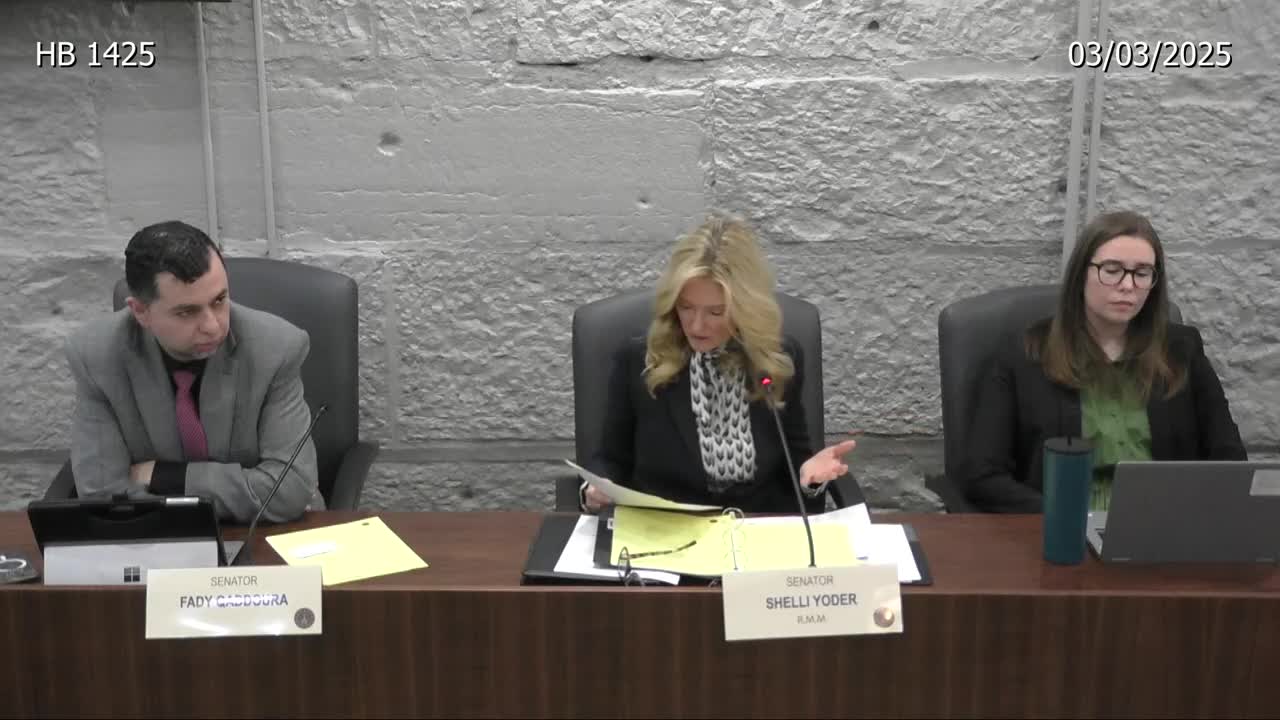
Board of Animal Health counsel Sarah Simpson testified the board favored language that would preserve the product within the statutory definition of meat product so the state inspection and enforcement authorities remain able to regulate production; she said the board worked to align the draft with federal inspection frameworks and that imitation‑label language is a state‑specific requirement that could be added on top of federal labeling. Committee members debated several alternative label terms—"imitation," "fake," "cultivated," and "cell cultured"—with senators expressing different views on which would be clearest to consumers. Several senators said they favored moving the bill while leaving room for amendment: the committee approved HB 1425 on a roll call of eight yeas and one no (Senator Yoder voted no and explained she wanted more time to refine labeling language).
The committee vote moves the bill forward; sponsors and agency counsel said they would consult with one another and with the author of a companion retail‑labeling bill to reconcile terminology and avoid conflicts with federal labeling rules before later amendment.