Get Full Government Meeting Transcripts, Videos, & Alerts Forever!
Get email alerts on the Noise Enforcement Consolidation topic
No spam. Unsubscribe anytime.
Portland committee forwards ordinance to consolidate noise enforcement under Title 18, citing fairness concerns
Summary
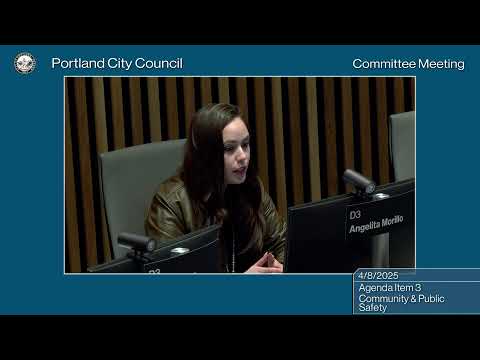
The Community and Public Safety Committee voted 5‑0 on April 8 to forward an ordinance to the full council that would repeal city nuisance noise sections and consolidate enforcement under Title 18, aiming to create objective standards and reduce biased enforcement of live music venues.
The Community and Public Safety Committee voted 5‑0 on April 8 to refer to the full City Council an ordinance that would repeal parts of Title 14 (14a‑30.01 and 14a‑30.02) and consolidate municipal noise enforcement under Title 18, which uses technical measurement standards and due‑process procedures.
Councilor Jamie Dunphy, who introduced the ordinance, told the committee the change responds to repeated complaints that an older provision — known as 14a‑30 — allowed “plainly audible” enforcement by police with subjective judgment. Dunphy said the duplicate enforcement regimes had been used inconsistently and, he argued, disproportionately affected music enjoyed by Black and Brown Portlanders.
“My office has met with the chief, the police policy team, the entertainment division, the police union, the Multnomah County District Attorney's Office, and the permitting bureau staff about this proposal,” Dunphy said. He described the proposed repeal as “a thoughtful step in using tools that we already have on the books” and asked the committee to refer the ordinance to full council with a recommendation to adopt.
Why it matters: supporters said Title 18’s measurement‑based standards provide consistent, objective enforcement and procedural safeguards that 14a‑30 lacks, and they cited the closure of Soleil’s — a Black‑owned jazz club on Alberta — as an example where complaint‑driven enforcement under 14a‑30 led to regulatory penalties and liquor‑license conditions.
Supporting evidence and testimony
Evan Hoffer, a board member of Music Oregon and a technical production professional, told the committee a Music Policy Council review found two separate noise‑code regimes, different enforcement actors and no consistent criteria for which code would be applied. Hoffer said the structure enabled “jurisdictional shopping” by complainants and limited the city’s ability to do disparate‑impact analysis. He said Title 18 allows an ear test only when measurements are not available and places priority on technical measurement when it is.
Mary Sipe, chair of the city Noise Review Board, supported consolidating enforcement under Title 18 but urged the council to address staffing: she noted the noise office “employs 3 full time people” and processed more than 600 code variances for fiscal year 2023–24, with recorded music accounting for 40–50% of complaints and live music 6–10%.
Council action and vote
Councilor Zimmerman moved to forward the ordinance to full council with a recommendation to adopt; Councilor Smith seconded. The roll call recorded ayes from Mario, Novick, Zimmerman, Smith and Chair Kanal and the motion passed 5–0. The committee’s referral includes repeal of code sections 14a‑30.01 and 14a‑30.02 and amendments to related code sections; the item will now be scheduled for full council consideration.
What the ordinance would change
Supporters said repealing the blunt nuisance provision in Title 14 would remove a subjective “plainly audible” enforcement option that could be used without measurement, and instead place city enforcement under Title 18’s professional noise‑control standards. Councilor Dunphy and presenters said police are still empowered to enforce Title 18, including an audibility standard when measurement is not feasible, but Title 18 provides a documented, measurable process and civil penalties where appropriate.
Next steps and outstanding concerns
Councilors praised the proposal but several asked staff to track the positions and preferences of stakeholders that Dunphy listed in meetings. Mary Sipe’s testimony also raised a budget and staffing question: consolidating enforcement under Title 18 would likely require additional night‑time or after‑hours staffing if the council wants to reduce reliance on sworn officers for nighttime responses. Dunphy said those operational staffing conversations can proceed separately and that the ordinance itself does not carry a budget request at this time.
Ending note
By referring the ordinance with a recommendation to adopt, the committee set the item up for a full council vote; supporters urged the council to consider funding the noise office to ensure enforcement can be timely and equitable if the legal standard is consolidated.