Get Full Government Meeting Transcripts, Videos, & Alerts Forever!
Get email alerts on the Residential Solar topic
No spam. Unsubscribe anytime.
North Smithfield zoning board approves ground-mounted solar array at 100 Mendon Road
Summary
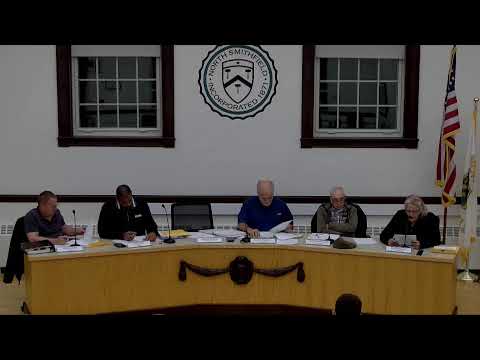
On April 8, 2025, the North Smithfield Zoning Board of Review voted 5-0 to grant a special-use permit for a 30-panel ground-mounted solar array at 100 Mendon Road. The board reviewed site access, setbacks, screening and fencing requirements and discussed planting as a potential mitigation but did not make landscaping mandatory.
The North Smithfield Zoning Board of Review voted 5-0 on April 8, 2025, to approve application ZBR2501, a special-use permit for a ground-mounted residential solar array at 100 Mendon Road, owned by Jimin and Parianka S. Patel.
The approved plan calls for a 30-panel array arranged six panels wide by five panels high, with a 6-foot leading edge and an anticipated rear height of about 12 to 12.5 feet. "This array when it's operational and producing energy is expected to make about $4,500 worth of electricity every year," Brad Camille, lead project manager and cofounder of Isaacson Solar and a North Smithfield resident, told the board. Camille described a helical-pile foundation (eight ground screws), a crushed-stone pad requiring about 6–8 inches of scalp, a mast roughly 8–10 feet tall for conduit and a trench to the home for the electrical tie; inverters and other hardware will be mounted at the house rather than at the array.
During deliberations board members reviewed the special-use criteria in section 9.2, covering ingress and egress for emergency response, glare, noise and general compatibility with neighboring properties. The board found the site plan shows adequate emergency access and that noise and glare are unlikely to be significant given the array orientation and proposed screening. The zoning official and members noted that abutters did not attend the hearing.
Board members discussed the ordinance requirement for fencing around ground-mounted arrays and the applicants' proposal to use a steel mesh under the panels instead of a full fence. Camille said the mesh is commonly used in nearby towns and would run across the top to prevent contact with panel undersides. The board said it lacked authority, absent a formal variance request, to waive the fence requirement and that the decision about a fence or any variance would be resolved with the zoning official or building inspector during permitting. Members suggested, but did not require, planting a line of arborvitae between the array and the nearest abutting structure; the applicants had indicated a willingness to landscape.
Other details discussed included setbacks (the applicant reported roughly 42 feet to the rear setback, about 90 feet to the north and 104 feet to the south), an approximate 34-by-18-foot array footprint, and the applicant's statement that no exterior lighting will be installed at the array. Camille also said technicians will access equipment at the house and that no permanent equipment will be sited at the array location.
After deliberation Gail Burlinghoff moved to approve the special-use permit (motion text read into the record as ZBR2501). The board voted by roll call: Mr. Najarian — yes; Mr. Marcantonio — yes; Gail Burlinghoff — yes; Mr. Gill — yes; Mr. Savini — yes. The motion passed 5-0.
At the same meeting the board recorded the earlier withdrawal, by letter dated April 2, of application ZBR2402 (a variance request for 44 Railroad Street) and approved minutes from a previous meeting. The zoning official told the Patel applicants that, once the decision is recorded, they may proceed at their own risk but must address any fence or variance compliance with the inspector if required.
The board did not attach a mandatory planting or fencing condition to the approval; it left any modifications or formal variance requests to the permit stage with the zoning official or for a future return to the board if a variance is formally sought.