Get Full Government Meeting Transcripts, Videos, & Alerts Forever!
Get email alerts on the Labor And Public Safety Staffing topic
No spam. Unsubscribe anytime.
Unions tell Portland committee behind‑the‑scenes workers are public‑safety staff and need contract, staffing and overtime fixes
Summary
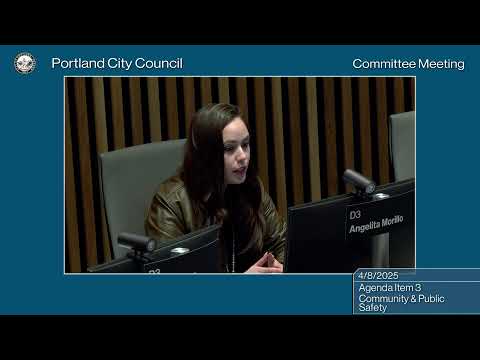
A panel of five labor unions told the Portland City Council’s Community and Public Safety Committee on April 8 that many city employees who do not wear badges nonetheless perform essential public‑safety work, and that budget and contract problems are driving uncompensated on‑call work, turnover and staffing shortfalls.
A panel of five labor unions told the Portland City Council’s Community and Public Safety Committee on April 8 that many city employees who do not wear badges or turnouts nonetheless perform essential public‑safety work, and that budget and contract problems are driving uncompensated on‑call shifts, turnover and staffing shortfalls.
The panel included leaders from the City of Portland Professional Workers (CPPW), AFSCME Local 189, the Portland Police Association (PPA), ProTech 17 and the Portland Firefighters Association (PFFA). Carrie Coe, president of the City of Portland Professional Workers, told the committee that “CPPW members perform essential services across nearly every bureau of the city” and described administrative coordinators, analysts and communications staff as part of public‑safety infrastructure.
Why it matters: panelists said budget choices and contract delays are creating operational gaps — from reduced noise‑office hours to understaffed dispatch and patrol — that affect response reliability and worker retention, and that some responses now rely heavily on overtime as a stopgap.
Panel testimony and key claims
Carrie Coe, president of the City of Portland Professional Workers (CPPW), said CPPW members are “the glue or the screws that help hold everything together,” citing coordinators in the Bureau of Emergency Management, victim‑advocate coordinators in the police bureau, and communications staff who notify Portlanders during emergencies. Coe said some CPPW members do “hundreds of uncompensated hours” of on‑call work and that the union is pressing the city in contract talks to address those inequities.
Rob Martineau, president of AFSCME Local 189 and first vice president of the Northwest Oregon Labor Council, described records clerks, forensic ID staff, parking enforcement and vehicle inspection teams as public‑safety roles that help prevent harm and connect people to services. “We have a way to be out ahead of the needs of our community,” Martineau said, noting roles at the Port of Portland, utilities and county agencies that intersect with safety.
Aaron Schmalz, president of the Portland Police Association, said the bureau is “critically understaffed,” citing a staffing ratio he said is about 1.26 officers per 1,000 residents and saying the bureau spends roughly 3–3.6% of the city budget. Schmalz argued overtime is “a crutch” being used to plug gaps and that hiring more officers is the long‑term solution; he also said the union supports integrated response models and warm handoffs to social‑service partners.
Elliot Levin of ProTech 17 spoke for Portland Street Response (PSR), an alternative response program that sends interdisciplinary teams to behavioral‑health calls. Levin urged stability, depoliticization and training investment for PSR, and said members have asked for “essential life‑sustaining supplies, particularly during emergency weather conditions.” He supported discussion of 24‑hour PSR service but warned expansion carries costs for current staff and training capacity.
Isaac MacLennan, president of the Portland Firefighters Association, said the union represents about 760 members, including roughly 45 at the Port of Portland and 580 who work rotating suppression shifts. He said firefighters average about 50.4 hours of straight time per week in suppression roles and that much of what the public calls “overtime” is callback to maintain minimum staffing: “Without the staffing in those stations, we cannot do our job effectively.” MacLennan described three two‑person rescue units stationed in Montavilla (Station 19), Station 9, Station 11 and Station 31 (Rockwood, in cooperation with Gresham) and said those rescues provide rapid response and affect reliability across neighborhoods. He also described the city’s training pipeline, saying the department hires about 16 firefighters every six months and uses a training station where recruits complete probationary training in a cohort model.
Questions from councilors
Councilors asked about depoliticizing Portland Street Response, a possible truth‑and‑reconciliation process with the police union, and the operational impact of potential budget cuts. Schmalz said he was open to “the hard conversations” and described police officers as “human beings” who should be part of community engagement and reconciliation efforts but stopped short of committing the union to a specific truth‑and‑reconciliation plan. MacLennan warned that proposed cuts to rescue units or community health assess‑and‑treat funding would ripple across response reliability and that closing a rescue unit can leave neighboring areas with fewer immediate resources.
Union and contract issues
Coe and other panelists said CPPW and some other represented workers remain without a settled contract and that the lack of a contract has increased fear among employees during reorganization and budget discussions. Coe said the union is negotiating to secure compensation and protections for mandatory on‑call responsibilities and that communications, community engagement and equity workers have faced particular scrutiny and instability.
What was not decided
The committee heard testimony and asked questions but did not take formal action on budgets, rescues, PSR expansion, or contract settlements at the April 8 meeting. Councilors signaled interest in further data from bureau directors on overtime types and amounts.
Ending note
Panelists asked the committee to consider investments that reduce reliance on overtime, expand training and retention, stabilize PSR staffing and recognize non‑sworn public‑safety work in budget and contract negotiations. Councilors asked staff to provide additional numbers and follow‑up on options raised during the discussion.