Get Full Government Meeting Transcripts, Videos, & Alerts Forever!
Get email alerts on the Elections Policy topic
No spam. Unsubscribe anytime.
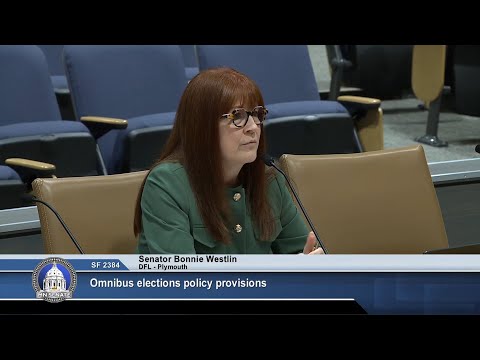
Senate elections committee adopts transparency amendments to elections omnibus, lays bill into budget; several high-profile proposals fail
Summary
The Senate Elections Committee on April 8 advanced a broad elections‑policy omnibus (Senate File 2384), adopting multiple technical and transparency amendments and directing staff to prepare the bill as an amendment to the committee’s budget bill; several high‑profile measures — including a ban on private election grants and a shift of many local elections from odd to even years — were rejected by roll call votes.
The Senate Elections Committee on April 8, 2025, advanced a broad elections-policy omnibus, Senate File 2384, adopting a series of amendments intended to boost disclosure and clarify existing anti‑bribery and conflict-of-interest language, and directing staff to prepare the bill as an amendment to the committee’s budget bill. Committee members adopted several technical and transparency changes but rejected amendments that would have barred private grants to local election administrators and that would have required many school and local elections to move from odd- to even-numbered years.
The committee chair laid over Senate File 2384 for continued work and asked staff to prepare the contents as an amendment to Senate File 3096, the committee’s budget bill. That procedural motion passed on a roll call, 6–5.
Why it matters: The omnibus contains a package of pro‑democracy and election-administration reforms the author said are intended to strengthen disclosure, prevent corruption and fraud, and modernize aspects of Minnesota election law. The measure includes provisions addressing financial-disclosure thresholds, clarification of anti‑bribery language, rules for updating voter registration records, and targeted changes to how municipalities may staff some special elections.
What the committee did
- Adopted a delete‑everything amendment (A8) that serves as the bill’s basis and moves the committee’s previously circulated language forward. The amendment was adopted, 9–0, by roll call.
- Adopted A43 (10–0), described by its sponsor as primarily technical: adding language about expert witnesses, extending an existing county exemption on party‑balanced election judges to cities for certain special or nonpartisan standalone elections, clarifying that registration updates for address/name changes are updates (not new registrations), and adding a tiered disclosure threshold for stock and stock‑option holdings to improve accuracy around conflicts of interest.
- Adopted A11 (10–0), which clarified anti‑bribery language and adjusted wording on what hospitality or minor nonalcoholic refreshments are excluded from the statutory prohibition; the amendment did not change the existing $5 de minimis cap that appears in the bill’s underlying language.
- Adopted A10 (7–3), which expands the listed conflict-of-interest form requirement from political subdivisions with populations over 50,000 in the metropolitan area to all political subdivisions statewide, the sponsor said, to provide uniform transparency.
Defeated and withdrawn amendments
- A20 (prohibiting non‑municipal/private grants to local election administrators that assist election administration) failed on a roll call, 5–6, after extensive debate. Supporters said the amendment would prevent outside influence and preserve the appearance of impartial administration. Opponents cautioned the language was overbroad and would bar certain grants that historically funded operational needs (for example, emergency grants during the 2020 pandemic). Committee members also discussed whether federal and state funding gaps could leave jurisdictions short of necessary cybersecurity or other election administration resources.
- A32 (a proposal to move many city and school district elections from odd years to even-numbered years, with specified exemptions for cities of the first class and municipalities with ranked‑choice voting) was offered, distributed in corrected three‑page form, debated, and then defeated on a roll call, 5–6. Testimony cited tradeoffs between higher turnout in even‑year cycles and the argument that local voters following school‑district races in odd years are more informed about down‑ballot issues such as referenda.
- Several other offered amendments did not prevail, including an amendment to remove the word “incumbent” next to judicial candidates on ballots and one to create employment carve-outs for temporary election‑season hires; both failed on roll calls (each 5–6).
Committee discussion and context
Sponsors and supporters framed the omnibus as a bipartisan package that increases disclosure around independent expenditures and potential conflicts of interest, tightens anti‑bribery protections, and clarifies technical elements of election administration—for example, when a voter updating an address is treated as an updated registration rather than a new registration.
Opponents of certain amendments highlighted operational realities: several members pointed to the 46‑day absentee and early voting season that can require local governments to hire short‑term staff and noted federal and state funding fluctuations for cybersecurity and other election supports. Members also raised practical concerns about unintended consequences from broad bans on outside support—for example, whether a private entity printing nonpartisan signage for a changed polling site would be prohibited by a blanket ban on outside contributions to election administration.
Officials from the secretary of state’s office cautioned the committee that some proposals—especially proposals that would alter whether election judges are classified as employees—could raise federal tax and employment issues and complicate the ability of appointing authorities to manage and, if necessary, remove workers who do not perform statutory duties.
Votes at a glance
- A8 (delete‑everything baseline amendment to SF 2384): Adopted by roll call, 9–0. - A43 (technical updates; expanded disclosure thresholds; limited city exemption from party‑balanced judge requirement): Adopted by roll call, 10–0. - A11 (anti‑bribery clarifications; wording changes around small refreshments): Adopted by roll call, 10–0. - A10 (expand conflict‑of‑interest form requirement to all political subdivisions): Adopted by roll call, 7–3. - A20 (ban on private grants to local election administration): Not adopted (failed by roll call, 5–6). - A32 (move many local elections from odd to even years, with targeted exemptions): Not adopted (failed by roll call, 5–6). - A (remove “incumbent” label for judges on ballot): Not adopted (failed by roll call, 5–6). - A19 (narrow employment carve‑out for short‑term election hires): Not adopted (failed by roll call, 5–6). - Motion to direct staff to prepare the contents of SF 2384 as an amendment to SF 3096 (budget bill) and make technical corrections: Adopted by roll call, 6–5.
What remains next
The committee laid the bill over for further work and directed staff to draft the omnibus as an amendment to the budget bill; the chair indicated the committee will take up budget provisions and additional work later in the week. Several members requested follow‑up conversations with staff and interested stakeholders on targeted items—specifically the scope of permitted outside assistance to election administrators, employee classification of short‑term election hires, and the scope of disclosure thresholds for financial interests.
Speakers quoted or paraphrased in this report include committee members who sponsored or debated amendments and staff from the Office of the Secretary of State who advised on employment and federal tax implications for election workers. No formal judicial or court interpretations were referenced during the meeting.
Ending note: The committee’s action moves a large, technically detailed elections package forward but left several contested policy questions unresolved; the omnibus will be folded into the broader budget measure for further negotiation.