Get Full Government Meeting Transcripts, Videos, & Alerts Forever!
Get email alerts on the Environment Budget Policy topic
No spam. Unsubscribe anytime.
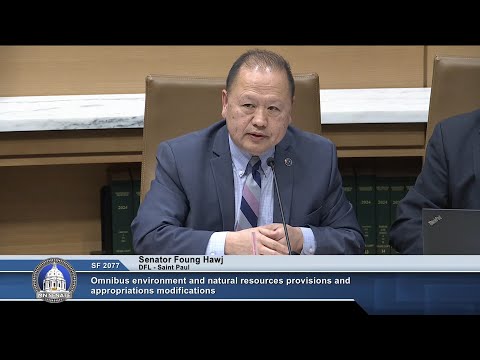
Senate committee advances environment omnibus; agencies raise concerns about parks, legal costs and CWD funding
Summary
The Minnesota Senate Environment Committee adopted the A4 delete-all amendment to Senate File 2077 on April 8 and heard extensive testimony on budget and policy changes across natural resources and pollution-control agencies, including funding moves, e‑waste stewardship, permitting reforms and a new outdoor-schools appropriation.
The Senate Environment, Climate and Legacy Committee adopted the A4 delete-all amendment to Senate File 2,077 on April 8, advancing the omnibus environment and natural resources bill while hearing detailed budget and policy presentations from staff and agency leaders.
A fiscal staff member working from a spreadsheet summary said the committee bill makes a range of changes across the Pollution Control Agency, Department of Natural Resources and other agencies. "The total for PCA…is about $31.7 million over forecast, but about $900,000 less than the governor," the staff member said while walking members through line items. He described a $2.68 million permitting-efficiency initiative for the PCA, a $736,000 general‑fund increase to PCA in fiscal 2026‑27, and an environmental‑fund increase in the first biennium of roughly $13.6 million tied to program shifts and new items such as a proposed e‑waste program.
The Department of Natural Resources also drew attention. "We appreciate the inclusion of many of the governor's budget recommendations," DNR Commissioner Sarah Strom said, but warned the bill omits elements the agency regards as critical. "State Park permit fee increases are necessary to keep pace with rising costs and without this additional revenue, the DNR will be forced to make publicly visible reductions to State Park services," Commissioner Strom said. She also said the bill does not include dedicated funding for legal costs and public-safety preparedness for conservation officers and expressed concern about reduced funding for private forestry assistance and chronic wasting disease response.
Minnesota Pollution Control Agency Commissioner Katrina Kessler told the committee the bill contains several agency priorities, including operating adjustments and permitting reform, the battery and e‑waste stewardship program, and community engagement funding to support work in diverse languages. "We appreciate inclusion of the MPCA's operating adjustment and permitting reform that will allow our agency to continue to protect air, land and water and improve efficiency and services for local governments and businesses," Kessler said. She asked the committee to continue discussions on sustainable aviation fuel, remediation statutory changes, and access to the closed landfill investment fund.
Other funded items described by committee staff include: DNR park operating backfills where the senate bill does not adopt the governor's proposed parks fee increase; a groundwater fee and aquatic invasive species (AIS) fee that replace some general‑fund support; reappropriations for stalled projects such as the Silver Bay trailhead and Redhead Mountain Bike Park; and a $28.18 million first‑year appropriation from the trust fund community grants program contained in Article 3. The spreadsheet also showed fee changes across multiple funds totaling roughly $12 million in 2026‑27 and $18 million in the tails.
Testimony from local and regional officials addressed provisions in the bill. Lisa Barrajas of the Metropolitan Council thanked the committee for language allowing tribal governments to be direct grantees under the council's tree‑planting grant program and for funding regional parks and trails operations. Representatives of the Minnesota Zoo warned the committee that the agency's modest state share of revenue leaves it vulnerable to a multiyear shortfall if state funding falls short, affecting admissions, programs and staffing. Conservation, boating, and ATV stakeholders spoke to specific program adjustments included in the bill, including abandoned‑watercraft language, ATV appropriations, and concerns about how an extended producer responsibility (EPR) e‑waste program could affect small businesses and consumers.
Committee action: Committee chair moved adoption of the A4 delete-all amendment to Senate File 2,077; a voice vote was recorded as "aye" and the motion prevailed. The committee also laid the bill over for additional work and scheduled further discussion for Thursday; members were told amendments would be considered at that time.
Why it matters: The delete‑all A4 carries operating, fee and programmatic changes that affect multiple state agencies and local partners. The bill shifts some program funding off the general fund to dedicated environmental accounts, creates new program appropriations, and includes policy provisions on permitting efficiency, e‑waste stewardship and the establishment of the Outdoor Schools for All grant program.
What’s next: Committee staff and agency representatives said they will continue to refine statutory language and answer member questions at a follow‑up committee meeting. Members and witnesses were asked to return Thursday for amendment consideration and additional Q&A.
Ending note: The bill combines finance and policy across many divisions; committee staff posted a detailed spreadsheet tied to the DE amendment to assist members in comparing Senate and governor proposals.