Get Full Government Meeting Transcripts, Videos, & Alerts Forever!
Get email alerts on the Fire Ambulance Special District Aid topic
No spam. Unsubscribe anytime.
House Tax Committee advances bill to establish annual aid for fire and ambulance special districts
Summary
The House Tax Committee approved an author's amendment and laid over House File 526, which would create an annual state aid program for fire and ambulance special districts, after testimony from Cloquet Area Fire District and the Fond du Lac Band.
Representative Jeff Dotseth, author of House File 526, won committee approval for an author's amendment and secured a procedural layover after testimony that said special districts face funding gaps that threaten long-term sustainability.
Dotseth told members of the House Tax Committee that House File 526 would "establish annual fire and ambulance special district aid." He said the bill responds to challenges in Greater Minnesota where combining services into special districts has reduced duplication but created new capital and operating funding needs.
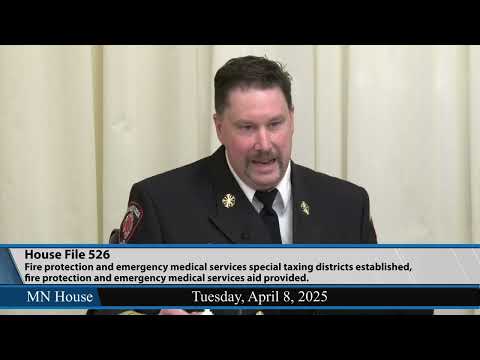
The Cloquet Area Fire District and the Fond du Lac Band of Lake Superior Chippewa provided testimony supporting the bill. Jesse Bews, fire chief of the Cloquet Area Fire District, said the district has reduced needed apparatus by consolidating services and that the entire area served now has an ISO rating of 3, down from ratings that in some places ranged "all the way up to a 9." Bews testified the district provides ambulance service across about 275 square miles and fire and rescue response over about 70 square miles and serves cities, rural townships, heavy industry, the Fond du Lac reservation and the I-35 corridor through Carlton County.
Bews told the committee that special districts formed under Minnesota statute 144F.1 face limited access to some funding streams. "None of the $300,000,000 in public safety aid made its way to us as a special district," he said, noting the aid was distributed to cities. He also said the district received emergency ambulance aid last year, which was helpful, but that long-term, recurring state support is needed to ensure sustainability for operations and major capital expenses such as facility replacement.
Bruce Blackner Jr., emergency management director for the Fond du Lac Band, told the committee Fond du Lac does not field a structural fire team and contracts with the Cloquet Area Fire District for structural fire protection. "Fond du Lac works closely with all of our state, local and regional partners," he said, and urged lawmakers to advance the bill to "assure fire protection [and] EMS services especially in rural, tribal, and other underfunded areas, receive the support they need to save lives." He closed his remarks by saying, "miigwech."
Committee members asked about the bill's scope and consequences. Representative Kelly Hewitt cautioned that some areas may lack the tax base to support newly formed districts and said legislative funding options must be considered carefully. Chair Gomez said the proposal is a specific tool for a broader statewide problem and urged lawmakers to seek comprehensive solutions rather than many small, ad hoc fixes. Representative Kozlowski, a co-author, described cross-jurisdiction cooperation that already exists in the region and noted the role of bonding and other funding pressures on local governments.
Procedural actions: the committee chair moved the H0526A1 (author's) amendment, members voted by voice — "Aye" — and the amendment was declared passed. Representative Dotseth renewed his motion that House File 526, as amended, be laid over for possible inclusion in the omnibus tax bill; the motion was accepted for further consideration.
Next steps: House File 526 will be considered later in the process (laid over for possible inclusion in the omnibus tax bill). No roll-call votes were recorded in the transcript for either the amendment or the motion to lay the bill over.
Why it matters: Testimony portrayed special districts as a regional approach that can lower costs and improve service consistency, but witnesses and legislators emphasized that forming a district creates immediate capital and operational funding obligations that current aid structures may not cover without new, targeted state support.