Get Full Government Meeting Transcripts, Videos, & Alerts Forever!
Get email alerts on the Higher Education Budget topic
No spam. Unsubscribe anytime.
Senate A‑4 walk‑through lays out $4.07 billion higher‑education biennial ask, reallocations and several program cuts
Summary
Nonpartisan staff walked the Minnesota Senate Higher Education Committee through the A‑4 amendment to Senate File 2,483, showing a $4.071 billion general fund request for the 2026–27 biennium, program transfers, several eliminations and a set of policy placeholders in Article 2. No committee votes were taken.
Nonpartisan budget staff on the Minnesota Senate Higher Education Committee detailed the A‑4 amendment to Senate File 2,483 and its associated spreadsheet, saying the amendment proposes a total general fund budget of $4,071,092,000 for the 2026–27 biennium and $3,995,156,000 for 2028–29.
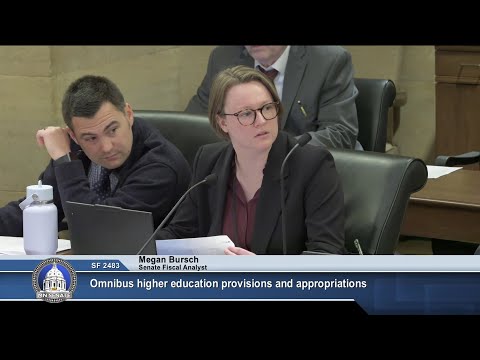
The walkthrough, led by nonpartisan staff member Miss Bursch and her colleague Tom Watson, presented the amendment's Article 1 appropriations and noted the document lists amounts in thousands and summarizes changes from the February forecast and the governor's revised recommendations. "All dollars in this spreadsheet are in thousands," staff said, and the committee was asked to treat changes from base as the reference for the committee's target of $100,000,000 for fiscal years 25–27 and $25,000,000 for fiscal years 28–29.
Why it matters: the A‑4 sets the committee's spending and program priorities for higher education heading into negotiations with the House and the governor. The amendment both increases funding for some statewide priorities and eliminates or consolidates others; several policy changes in Article 2 are tracked in the spreadsheet as fiscal placeholders.
Major budget and program items highlighted
- Office of Higher Education (OHE): A proposed direct general fund total of $827,791,000 in 2026–27, a $102,650,000 increase over base. Staff noted several reallocations and net‑zero technical moves: some program line reductions reflect changes in how funds are appropriated rather than cuts (for example, emergency assistance and hunger‑free campus funds were moved from OHE to direct appropriations for Minnesota State and the University of Minnesota). Staff said, "there appears to be a $6,058,000 per biennium decrease for emergency assistance for post secondary students grants. But there's just been an adjustment to how the existing base funding is appropriated. So that is also a net 0 change."
- State grant program: The A‑4 shows a $104,520,000 increase in 2026–27 for the state grant program (above the governor's recommended per‑biennium $15,000,000 increase), coupled with parameter changes in Article 2 that staff said Tom Watson would describe.
- Minnesota State Colleges and Universities (Minnesota State): The A‑4 proposes $1,759,089,000 in direct general fund appropriations for 2026–27, a $7,700,000 increase over base. Staff noted several consolidations (for example, student tuition relief and several student support riders were consolidated under operations and maintenance and described as net zero when statutorily required).
- University of Minnesota: The A‑4 proposes $1,488,526,000 in direct appropriations in each biennium and reorganizes the university section, unrolling some previously consolidated riders into subject‑area special appropriations and creating new subdivisions for research and innovation, medical training and care, and other categories.
- Mayo Clinic: The amendment proposes eliminating all general fund support for the Mayo Clinic School of Medicine and family medicine residency programs, a reduction of $3,598,000 per biennium compared with base.
Other noted changes and technical points
- Consolidations: Several statutorily required items (for example, assault reporting, menstrual product access) were consolidated under larger line items; staff emphasized statutory requirements remain in force even without session‑law riders.
- Transfers and cancellations: Staff called out cancellations and reappropriations used to create one‑time offsets (for example, canceling certain special revenue balances to offset a one‑time PFAS remediation appropriation at Lake Superior College).
- Placeholders: The spreadsheet includes budget placeholders for provisions in Article 2 that do not yet have complete fiscal notes (for example, the College Financing Literacy Act), with staff noting ellipses where fiscal notes were incomplete.
No decisions or votes were taken during the hearing. Staff repeatedly asked committee members to save detailed questions for the committee's next meeting when the panel will consider additional amendments and potential referral to the finance committee.