Get Full Government Meeting Transcripts, Videos, & Alerts Forever!
Get email alerts on the Pfas Settlements topic
No spam. Unsubscribe anytime.
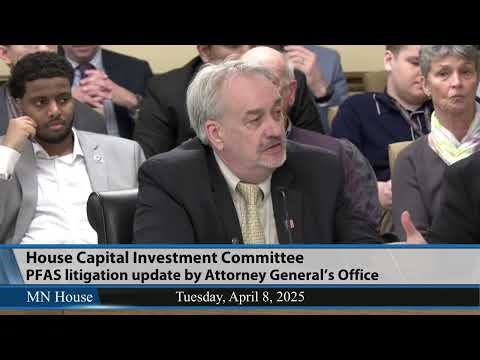
Attorney General, MPCA brief committee on PFAS settlements and limits for local water projects
Summary
State Attorney General and Minnesota Pollution Control Agency officials told the House Capital Investment Committee that national and state PFAS settlements will provide funds to water systems but are unlikely to cover most project costs; Minnesota's 3M settlement funds are projected to be fully committed by fiscal 2027.
An update to the Minnesota House Capital Investment Committee on April 8 made clear that multi-billion-dollar PFAS settlements at the national level and the state-level 3M settlement will produce some money for public water systems, but that the awards will cover only a small share of most projects.
Assistant Attorney General Oliver Larson of the Minnesota Attorney General's Office told the committee the two national settlements — one involving 3M and another involving DuPont — together made available roughly $12 billion to $13 billion for eligible water systems, and that the claims administration process will be complex and prolonged.
"The first checks probably won't be cut until 2026," Larson said, describing a claims-administration timeline that will allocate funds over roughly 10 years. He said about 12,000 water systems were eligible under the national settlements and that roughly 900, or about 7 percent, opted out of the settlement process.
Larson cautioned legislators not to expect the settlements to be a primary source of capital for large infrastructure projects. "I would be shocked if there's any community that's going to get more than about 10% of what they need to build the projects that they're contemplating," he said, adding that a more typical recovery he expects is closer to "3 to 5%." He gave an example: a $50 million project might recover roughly $1.5 million to $2 million under those distributions.
Committee members pressed Larson on how to verify whether local governments had opted into the national settlement. He said the claims administrator had previously declined to share a list, and that his office will request it again, but recommended asking individual communities when they apply for state assistance.
Kirk Adelka, who identified himself as assistant commissioner at the Minnesota Pollution Control Agency (MPCA), told the committee MPCA projections from last fall estimate the MPCA-administered portion of the 3M settlement will be exhausted by fiscal year 2027 because of existing capital and operational projects. Adelka said the agency will present updated numbers to its community work groups in May.
Adelka provided a list of communities and sites tied to Minnesota's 3M settlement funds that are driving demand: Maplewood, Oakdale, Lake Elmo, Woodbury, St. Paul Park, Newport, Cottage Grove; townships including Lakeland and Denmark; the Prairie Island Indian Community; and four landfill/disposal sites in Washington County tied to 3M wastes in Oakdale, Woodbury and Cottage Grove. He said roughly 15 communities were directly involved in the Minnesota allocation effort he described.
MPCA staff and the Attorney General's Office described other policy options under consideration. Adelka and committee members noted MPCA, Department of Health and the Pollution Free Agencies (PFA) have proposed statutory language that would allow the state to fund urgent projects and later seek cost recovery from responsible parties if they are identified and successfully pursued. Adelka described the approach as a partial safeguard for taxpayers but cautioned it will not address long delays in identifying and litigating responsible parties.
Larson added that establishing liability for PFAS releases can be legally complex and that manufacturers' solvency is a material factor in settlement negotiations: "The amount of money that will be spent to deal with this issue by several times exceeds the net worth of the parties that manufacture these products," he said, noting the risk that further litigation could push manufacturers into bankruptcy and not create more recoverable funds.
Why this matters: committee members said local governments are coming to the legislature seeking state help for urgent drinking-water projects tied to PFAS contamination. Both the Attorney General's Office and MPCA told the committee the national settlements will provide some funding to water systems, but committee members and agency officials warned those dollars are unlikely to be sufficient to fully fund large capital projects and that state or local funds will remain necessary.
The committee did not take any formal action during the briefing. MPCA said it will present updated fall projections to community work groups and continue coordination with the Attorney General's Office.