Get Full Government Meeting Transcripts, Videos, & Alerts Forever!
Get email alerts on the School Funding topic
No spam. Unsubscribe anytime.
Senate advances bill to change distribution of countywide school taxes; Baldwin County speakers warn of local impacts
Summary
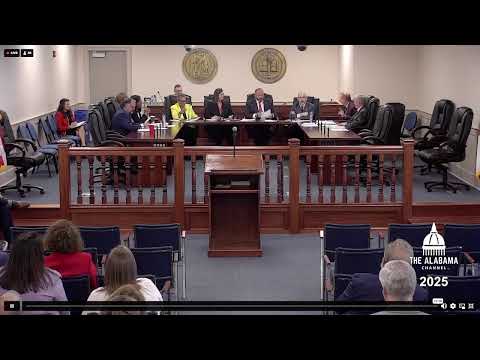
Senate Bill 270 would direct certain countywide taxes used for school-related purposes to be distributed to school systems based on where the taxes are collected; the Senate committee adopted narrow amendments and advanced the bill after a contentious public hearing largely focused on Baldwin County.
Senate Bill 270, presented to the committee and explained by Senator Elliott on behalf of Senator Weaver, would alter how certain countywide taxes levied for school-related purposes are distributed: funds would be allocated to school systems based on where the taxes are collected rather than by building location or other measures. The committee held a public hearing, adopted amendments to limit the bill’s reach and then gave the bill a favorable report.
Senator Elliott said the bill (as amended) applies only to "any county sales and use tax originally levied prior to 1985" and seeks to prevent future disputes by ensuring tax revenues "follow the student" in counties with multiple school systems. He told members the amendment before them responded to concerns from Jefferson County lawmakers and other colleagues.
In the public hearing, Andy Craig, a former deputy state superintendent for finance who has worked at the State Department of Education, described the State Department’s prior approach to dividing countywide education taxes and urged that the money "follow the public school students who reside in that county and are served by districts that have boundaries in that county." Craig said distributing funds based on building location had created inequities in the past and the State Department had clarified the distribution to follow students.
John Wilson, chief financial officer for the Baldwin County School System, strongly opposed applying the measure statewide to the particular Baldwin County tax at issue. Wilson said the Baldwin tax at hand had been amended as recently as 2017 and is not an education-only tax; he described the revenue as earmarked for capital construction and maintenance and said some of it was pledged to bond payments, including for Baldwin Preparatory Academy. Wilson said applying the bill to Baldwin County could create an annual loss for the county system of "between 6 and $7,000,000," and he warned of "likely litigation" if pledged revenues were repurposed.
Kevin Corcoran, president of the Gulf Shores City Board of Education, supported the statewide approach and said the bill would "ensure that all public school students benefit from taxes collected in their communities." Mayor Bob Wills of Bay Minette and other local officials urged the committee to respect locally negotiated agreements and warned of disruption to bonded debt service if revenue pledges were altered.
Committee members debated a narrow amendment offered by Senator Coleman that excluded class 1 municipalities and limited the bill’s application to county taxes levied prior to 1985. After a voice and roll-call sequence on competing motions and a later amendment adopting the Coleman language, the committee ultimately adopted the amendment clarifying pro rata distribution "based upon the amount of taxes collected within the areas served by each local board of education" and then gave the bill a favorable report.
Senators asked follow-up questions about how bonded obligations would be treated, and Senator Elliott suggested offline discussions with Baldwin County officials to address existing indebtedness concerns. The committee’s action advances the bill; members emphasized the amendment’s narrow construction and requested additional fiscal clarity for affected counties.