Get Full Government Meeting Transcripts, Videos, & Alerts Forever!
Get email alerts on the District Wellness Step topic
No spam. Unsubscribe anytime.
School District outlines wellness, STEP teams and discipline guidance; says code will discourage collective punishment
Summary
School District Chief of Student Support Services described ongoing programs — STEP teams, IBHS, enrichment funding — and said the district is revising its wellness and code-of-conduct policies to discourage collective punishment and to include clearer recess guidance.
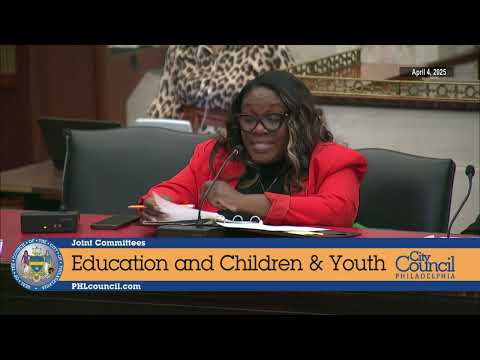
The School District of Philadelphia told a City Council joint committee on April 4 that it is advancing a set of student-wellness initiatives, expanding school-based mental-health partnerships and revising discipline guidance to discourage practices parents call collective punishment.
Dr. Jamie Banks, the district’s Chief of Student Support Services, testified the district’s work draws on its Accelerate Philly strategic plan and includes expansion of school-based mental-health teams and a push to standardize rest, movement breaks and recess practices. Banks told council the district is updating the wellness policy to state a 20-minute daily recess minimum as a written procedure and that the code of conduct will use stronger language to say schools “shall not” penalize an entire class for the actions of a few.
Banks detailed several existing and expanding programs. She said the district’s Support Team for Educational Partnership (STEP), launched in 2017 with partners including the mayor’s office, Community Behavioral Health (CBH) and the Department of Behavioral Health (DBH), now operates in 45 schools. Each STEP team can include up to four roles — a clinical coordinator (master’s-level clinician), a school behavioral consultant (master’s-level clinician), a case manager and a family peer — and 24 of the 45 STEP sites are fully staffed with those four positions while the remainder have partial staffing because funding streams vary.
Banks also said the district partners with CBH and DBH to offer intensive behavioral health services (IBHS) in every school and that the district provides approximately $9 million annually for vendor-led after-school enrichment in roughly 40 schools. She noted the district is expanding trauma-informed and healing-centered engagement professional learning, and that it has increased access to on-site emergency asthma medication (stock albuterol) in schools.
On collective punishment, Banks said the district’s current code of conduct already includes language advising school-level leaders not to penalize entire classes for individual behavior and that the revised code for next year will use stronger, more explicit language. She said school leaders should be informed and accountable when instances occur and central office will follow up when patterns are identified.
The district acknowledged implementation challenges including funding limitations and workforce shortages of qualified mental-health professionals. Banks said some STEP sites are fully funded through partner agreements while others depend on district budget choices at the school level; principals may allocate dollars or seek grant funds to support full STEP staffing.
Ending: Banks invited continued collaboration with parents and community partners and said the district would return to the council with more detailed staffing and program numbers at scheduled follow-ups.