Get Full Government Meeting Transcripts, Videos, & Alerts Forever!
Get email alerts on the School District Chief Of Joy topic
No spam. Unsubscribe anytime.
Parents, students and advocates urge School District to create ‘Chief of Joy,’ end ‘dirty dozen’ discipline practices
Summary
Parents and advocacy groups pressed Philadelphia City Council committees to back two resolutions: one to create a School District Chief of Joy and another to investigate exclusionary discipline practices parents call the “dirty dozen,” citing the use of silent lunches, canceled recess and denial of bathroom access.
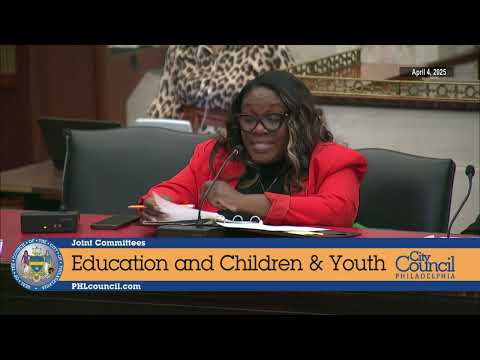
Parents, students and community advocates urged Philadelphia City Council’s Joint Committees on Education and Children and Youth on April 4 to support two resolutions authorizing hearings on a School District “Chief of Joy” (Res. 240632) and on exclusionary discipline practices (Res. 240642), citing widespread punishments they say deprive students of basic dignity and learning conditions.
The testimony in Committee highlighted what advocates called the “dirty dozen” — a set of commonly observed practices they said strip joy from classrooms, including silent lunches, collective punishment such as canceling recess for an entire class, restricted bathroom access, curtailed arts and field trips, and overly punitive responses to typical childhood behavior. Parents asked city council to press the district to adopt enforceable standards, fully staff mental-health teams, and create a senior-level chief of joy to audit and coordinate districtwide improvements.
Why it matters: speakers said the practices disproportionately affect Black students, students with disabilities and LGBTQ+ students, worsening educational and health outcomes and undermining attendance, engagement and long-term opportunity.
Lift Every Voice Philly, a Black-led parent membership organization, led the appeal. Keisha Nicholson, a Lift Every Voice parent and its first member, outlined organizing that she said forced a near-citywide improvement in school nursing coverage after parents publicized chronic nurse vacancies. "Within months, we cut the nurse vacancy by 80%," Nicholson said, and she credited parent organizing for securing full-time nurses across schools she represents. She told the committee parents want a “bold, shared vision for schools that help, not hurt, our students and families.”
Amy Follering, also a Lift Every Voice member, said enrichment — art, music and field trips — is treated as an extra rather than an essential, producing striking inequities between nearby schools. "If we have figured out how kids at Masterman can access this enriching curriculum, then we can figure out how every single school in the district can get it," Follering said. Jamila Carter, a parent and educator, described classroom incidents she said involved staff who humiliated students and urged the council to press the district to remove demeaning practices.
Councilmember Kendra Brooks, sponsor of the hearing resolutions, framed the chief of joy concept as a policy and accountability tool: "Joy is a serious intervention. Joy is not a luxury. It's a necessity," she said, calling for a senior district official to conduct a districtwide “joy audit,” set standards for recess and enrichment, and dismantle dehumanizing discipline.
Council members of the joint committee generally expressed support for holding the hearings and for the concerns raised. Committee Chair Councilmember Isaiah Thomas thanked parents for organizing and noted the council’s budget role; Councilmember Ahmad linked joy to public health impacts; and Councilmember Rue Landau encouraged concrete standards and data collection.
Advocates asked the council to use budget authority during the upcoming budget cycle to require the district to adopt minimum standards for recess and bathroom access, expand school-based mental-health teams and fund a chief of joy position. They also asked the council to hold the district accountable at the district’s scheduled appearances before council on April 29–30.
Ending: The hearing proceeded to panels with district officials, educators, unions and student organizations to explore specific policy and funding options the council might press the district to adopt. The committees did not vote or take formal action on either resolution during the hearing.