Get Full Government Meeting Transcripts, Videos, & Alerts Forever!
Get email alerts on the Budget topic
No spam. Unsubscribe anytime.
Oroville council workshop highlights roads, public-safety costs and housing projects as budget pressures mount
Summary
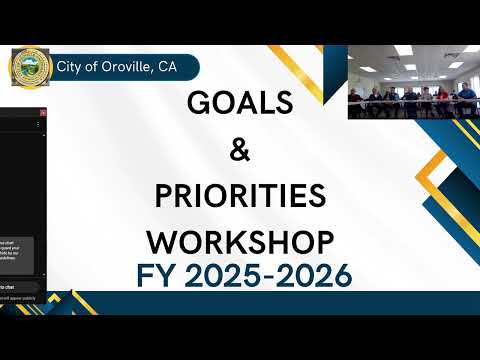
City staff and department heads summarized last year’s work and a long list of priorities for fiscal 2025–26, emphasizing road repairs, rising public-safety costs tied to a new Cal Fire staffing schedule, and housing programs while urging the council to set spending priorities.
Oroville’s city manager and department directors told the City Council on Tuesday that budget requests for fiscal 2025–26 exceed available resources and asked the council to prioritize spending on roads, storm drainage and public safety.
City Manager Ring told the council the city’s reserve remains intact and that departments have submitted a long wish list. “The city has a very, very healthy reserve. $9,000,000 reserve has not been touched,” Ring said, adding that more than $5,000,000 was budgeted for road work in the current year.
Council members and department heads said the city faces two near-term budget hits: a full year of increased Cal Fire contract costs tied to the 66-hour staffing schedule and the winding down of a state grant program that had previously bolstered revenue. Ring and Finance staff described the combined effect as roughly $1.8 million in recurring reductions and new expenses that must be absorbed.
Why it matters
City staff presented a long list of capital and program needs that outstrips available funds. Officials said they want council direction on priorities so staff can prepare a balanced budget for formal review in June. Many of the largest line items—complete road reconstructions, drainage upgrades and facility work—depend on outside grants or Caltrans coordination, adding schedule and implementation risk.
What the council heard and directed
- Roads and Caltrans projects: Staff described the Highway 162/Main Street corridor work as a major near-term project. Caltrans is expected to advertise the project for bid this year; city officials said they have been negotiating interim “band-aid” repairs to keep the road passable through the next winter. Public Works Director Alyssa said some sections will require full rebuilds, not just grind-and-overlay work.
- Drainage and culverts: Public works flagged recurring culvert and storm-drain failures that caused basement and street flooding; staff recommended a citywide drainage plan to model flows, prioritize repairs and improve grant competitiveness.
- Public safety costs: Fire Chief described implementation of a 66‑hour schedule and the addition of three firefighter positions (one captain and two firefighter-2s) that increase personnel costs. Staff and council discussed planning for a second fire station on the city’s west side; an assessment of a candidate site at Challenger/Norton was under way and will inform cost estimates and feasibility this summer.
- Housing, development and community programs: Community development staff reported conditional awards and resubmitted grant applications for a new engine and a fire truck, and said the department has $500,000 budgeted for first-time homebuyer loans and ongoing work on projects including Lincoln Street Village Phase 1, Mission Esperanza and a convention-center partnership. Staff said the city is working to finalize complex loan documentation to meet tax-credit and funding deadlines.
- Code enforcement and clean-streets work: Code enforcement reported more than 1,300 opened cases and high compliance rates, grant-funded trash-can and park improvements paid largely with state grant funding, and continued demolitions of unsafe structures with cost recovery from property owners and lenders. Staff described a proposed re-structuring that would move one community-navigator position into a community enhancement coordinator who would mobilize clean-streets crews and coordinate multi-department responses to quality-of-life issues.
- Police: The police chief described a new community strike team (CST) intended for proactive foot and bike patrols, continued recruitment efforts and plans to expand camera coverage at parks and problem locations. The department reported using license-plate-reader (LPR) systems and in-car cameras as investigative tools and said a recently hired detective will bring digital-forensics capability.
Public comment and community priorities
Residents used public comment to press for local beautification, volunteer programs and a new bocce club. One speaker, Janice White, said the group is forming a nonprofit to build bocce courts and is seeking seed funding and volunteer help. Another speaker, Dorinda Scofield, urged improved landscaping and cleanup of “ugly” corridors and the riverfront.
Decisions and next steps
Council returned from closed session with no reportable action. City Attorney Trick said, “No reportable action of council during closed session. Directions given to staff.” Council adopted the meeting agenda at start of the session by motion.
Staff will return in June with a balanced 2025–26 budget proposal and a schedule that reflects the council’s priorities; staff also asked the council for direction on which capital projects and programs to pursue this year so grant applications and contracts can be matched to council priorities.
Ending
Council members repeatedly emphasized roads, storm drainage and public safety as foundational needs, with beautification, housing and downtown activation following if resources allow. Staff said they will use the council’s guidance to refine the budget and present final proposals at the June council meetings.