Get Full Government Meeting Transcripts, Videos, & Alerts Forever!
Get email alerts on the Public Safety topic
No spam. Unsubscribe anytime.
Senate committee advances bill to train local police on transnational repression amid heated testimony
Summary
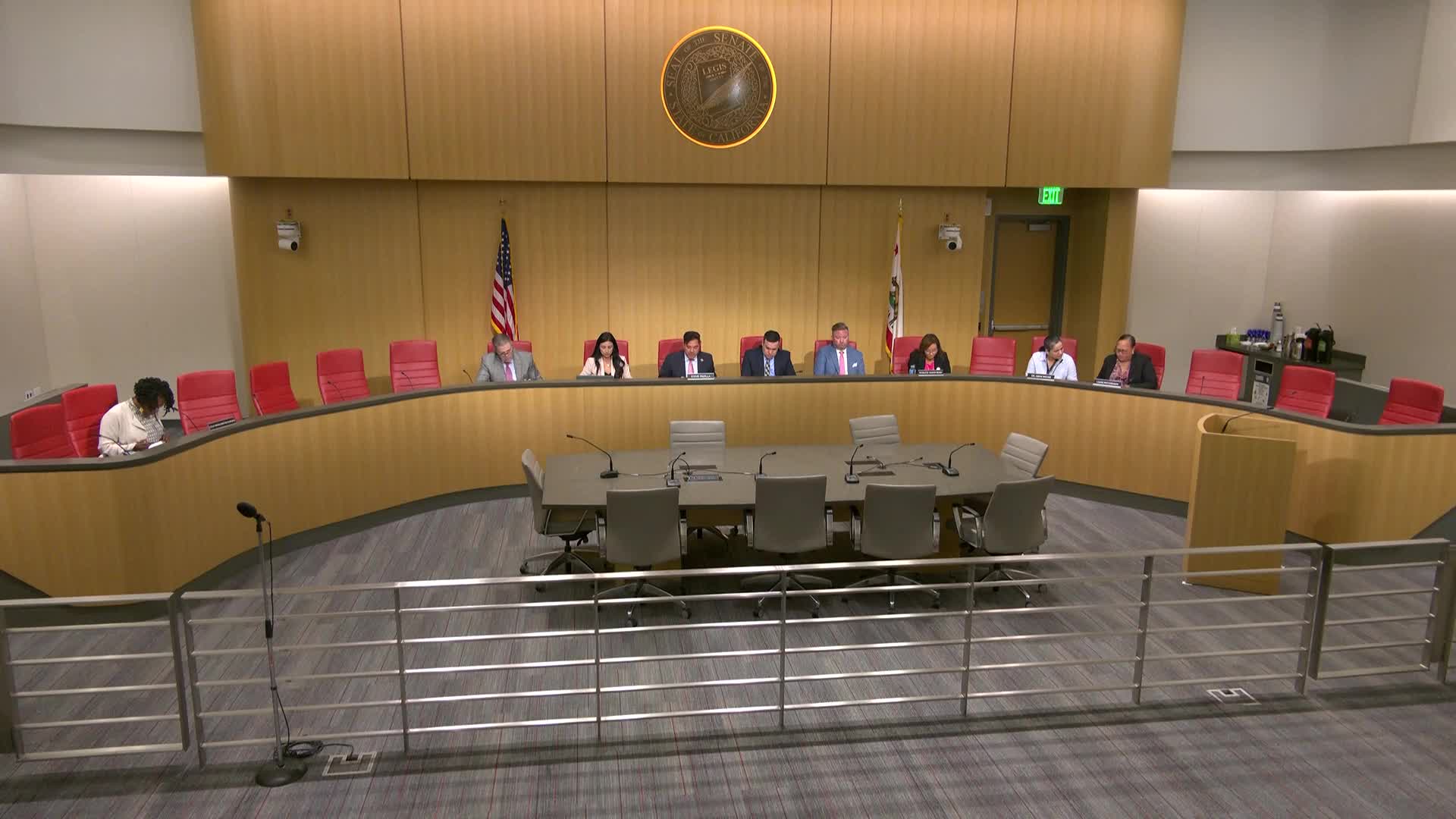
A California Senate committee voted unanimously to send SB 509 to the Appropriations Committee after testimony from the bill's author and advocates for immigrant victims, and opposition from several Indian American groups who said the measure could be politicized or weaponized against diaspora communities.
A California Senate committee voted to pass SB 509 out of committee to the Appropriations Committee after a public hearing that included both supporters urging better protection for diaspora communities and opponents warning the law could be used to stigmatize minority groups.
Senator Anna Caballero, the bill's author, said SB 509 would authorize the California Commission on Peace Officer Standards and Training (POST) to develop specialized training so local law enforcement could recognize and document transnational repression'the intimidation, threats and violence that some foreign governments direct at dissidents and asylum seekers living in the United States. "This bill ensures that law enforcement officers receive the specialized training needed to recognize and respond to unique threats posed by foreign governments targeting individuals on U.S. soil," Caballero said.
Supporters told the committee they have seen threats follow immigrants to the United States and that local police often lack the training to identify or document those threats. Hamid Yazdan Pana, executive director of Immigrant Defense Advocates and a refugee from Iran, said victims often do not report threats because they fear immigration consequences or do not trust authorities; he urged support so local agencies can properly document incidents and pass them to federal partners such as the FBI.
Opponents, led by Sameer Kalra of the Hindu American Foundation and speakers from Coalition of Hindus of North America (KONA) and other Indian American groups, said the bill's definitions are vague and risk politicizing training content. "SB 509 lacks the adequate guardrails and safeguards necessary to prevent POST trainings on transnational repression from being politicized or from institutionalizing biases against diaspora communities," Kalra said, arguing the measure could be used to label ordinary speech or community advocacy as state-sponsored or "soft" repression.
Senators pressed the author on implementation details during committee questioning. Caballero and other supporters repeatedly said the bill does not create new crimes, will not authorize local prosecution, and contains no list of named countries; rather, they said, POST would develop neutral training focused on patterns of behavior and consistent reporting practices so local law enforcement can forward credible reports to federal agencies. "No countries are mentioned in the bill," Caballero told the committee, and she said the bill was intentionally neutral on national origin.
The committee produced no statutory changes to federal jurisdiction; the author and several senators emphasized that federal investigators would still handle criminal prosecutions. Senator Archuleta, who moved the bill, said the training would help build trust between immigrant communities and local law enforcement so residents will report threats.
Action: Senator Archuleta moved SB 509 out of committee to the Appropriations Committee; the motion carried by recorded voice roll call and the committee list of ayes, with a final committee tally recorded as 15-0 in favor.
The bill drew sustained public comment spanning nearly an hour and a half. Supporters emphasized victims' safety and the need for documentation; opponents emphasized vagueness, possible political bias in training sources, and potential chilling effects on free speech and community advocacy. Committee members said POST has an existing public process for developing and vetting training content and that local reporting could aid federal analysis of transnational threats.
SB 509 now goes to the Senate Appropriations Committee, where fiscal and implementation questions could be addressed.