Get Full Government Meeting Transcripts, Videos, & Alerts Forever!
Get email alerts on the Consumer Protection Ticketing topic
No spam. Unsubscribe anytime.
Assembly committee approves measure to ban speculative ticketing and require reseller transparency
Summary
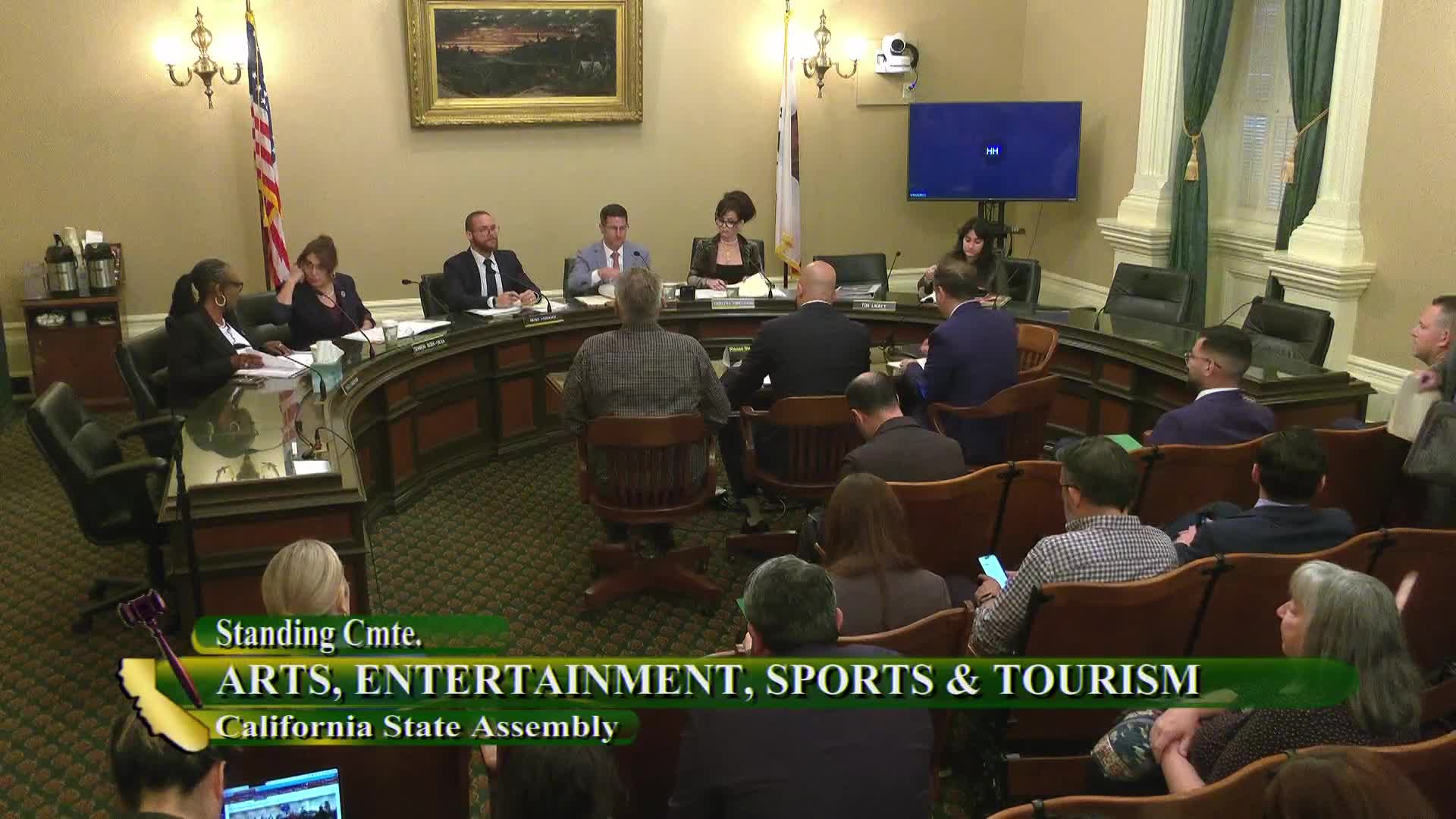
AB 1349 passed out of the Assembly Arts, Entertainment, Sports, and Tourism Committee as amended and will be referred to the Assembly Privacy and Consumer Protection Committee; the bill bans speculative ticketing and requires broader transparency from secondary ticketing platforms.
The committee voted to pass AB 1349 as amended to the Assembly Privacy and Consumer Protection Committee after extensive testimony from artists, independent venues, ticketing platforms and consumer groups.
The bill’s author described speculative ticketing as a practice in which sellers list tickets they do not own — leaving consumers to pay upfront for tickets that may never be delivered — and said the bill would prohibit resale listings unless the seller owns, possesses or has a contractual right to sell the ticket before listing. The author said the measure also would require resellers to disclose seat locations, require secondary platforms to retain records of sales, deposits and refunds for at least 12 months, prohibit deceptive sites that mimic official sellers, increase penalties for violators, and require refunds for postponed or canceled events.
The bill drew a broad coalition of supporters. Ron Gubitz, executive director of the Music Artist Coalition, said the legislation protects fans and artists by preventing a secondary market that “acts like a futures market” and inflates prices. Venue operators, including Joe Rinaldi of the Music Box in San Diego and Jim Cornette of Harlow’s/Starlite Room, said the bill addresses routine consumer complaints at venue box offices where customers arrive with secondary-market tickets and no recourse. Rinaldi described situations where customers had paid hundreds of dollars on secondary sites for $25 shows and then sought help from venue staff upon arrival.
Several major venues, promoters and sports franchises submitted support or neutral statements and said they were willing to work on operational details. Representatives for Live Nation and other large promoters indicated support for the author’s intent while noting implementation details needed additional work.
Opposition testimony focused on three main concerns: (1) the bill’s potential to sweep too broadly and unintentionally bar legitimate resale practices (for example, sales placed before ticket transfer windows open for season-ticket holders), (2) the risk that the measure would advantage dominant primary-ticketing platforms, and (3) the need to preserve lawful concierge or ticket-acquisition services. Robert Harrell, executive director of the Consumer Federation of California, said the statutory language went “far beyond” the author’s stated intent and could serve the interests of the market’s dominant firm. James Jack, for the Coalition for Ticket Fairness, said the bill’s definition of speculative ticketing could prevent resellers from serving season-ticket holders whose tickets cannot be transferred until a specified period before the event.
After discussion and assurances from the author that technical refinements would be made, the committee passed the bill as amended. The clerk recorded six ayes; the roll was held open for absent members.
Quotes used in this report come from witnesses on the committee record.