Get Full Government Meeting Transcripts, Videos, & Alerts Forever!
Get email alerts on the Cte Oversight topic
No spam. Unsubscribe anytime.
Lawmakers probe funding, duplication and metrics in career technical education oversight hearing
Summary
The Legislative Analyst’s Office, Department of Education, Community Colleges and Department of Finance told the Assembly subcommittee about state CTE investments, program overlap and the need for outcome measures; officials and members discussed CTIG, K–12 strong workforce, Perkins and historic ROCP funding
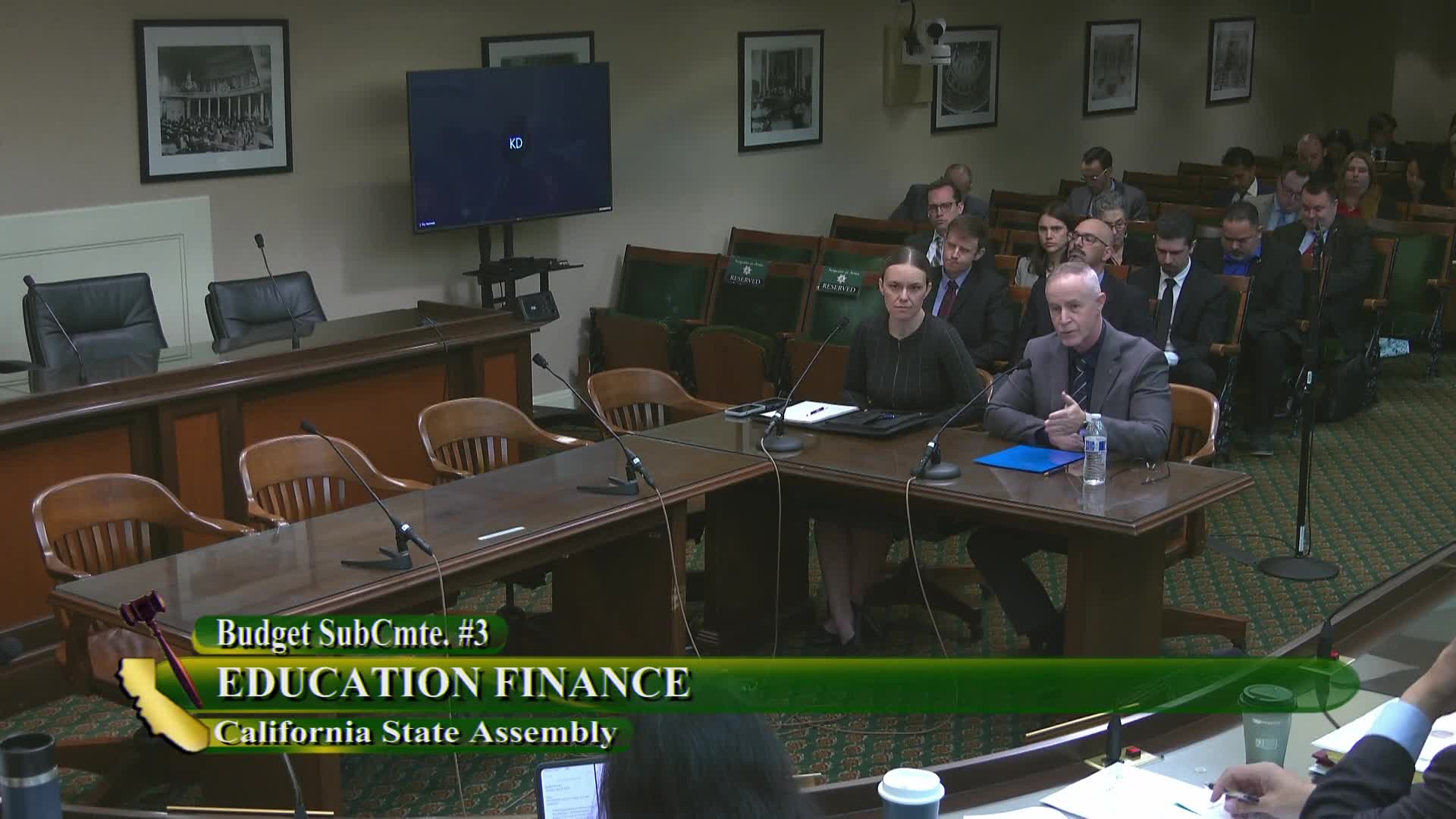
The Assembly Budget Subcommittee on Education Finance heard an overview of the state’s career technical education (CTE) investments and asked agency officials whether programs overlap, how success is measured, and whether funding can better promote regional coordination.
Michael Alferz of the Legislative Analyst’s Office told the committee the LAO published an overview of K–12 CTE programs, one-time initiatives and the data the state collects on courses and accountability. The Department of Education described grant rounds, consolidation of applications for 2025–26 and the Golden State Pathways rollout. The California Community Colleges Chancellor’s Office summarized the Strong Workforce and Perkins programs and noted roughly $290 million ongoing for the community college Strong Workforce program plus a carve-out for nursing rebuilding grants.
Key issues discussed - Funding history and overlap: Committee members and LAO staff noted that before the Local Control Funding Formula (LCFF) there were categorical programs and that the regional occupational centers and programs (ROCP/ROP) received about $400 million annually. LAO and other witnesses described several remaining categorical programs, including the CTE Incentive Grant (CTIG), the agricultural incentive grant and California Partnership Academies. Officials said the CTIG was made an ongoing program (initially $150 million) and increased to $300 million in 2021–22, while other CTE funding streams such as Perkins and K–12 Strong Workforce also provide substantial support. - Duplication and regional coordination: LAO and CDE staff acknowledged overlap between some grant uses and urged the legislature to focus on outcomes rather than program inputs. Committee members argued funding incentives shape provider behavior and encouraged funding designs that favor regional collaboration and scale rather than local fragmentation. - Matching and audits: Finance staff said some grants require local matching funds and that the Department of Education audits grantees to confirm matches. A Finance representative described local match rules and said the department would verify matches as part of grant awards. - Outcomes and metrics: Witnesses agreed the state has been input-focused (funding programs) and lacks a consistent statewide set of outcome measures for CTE. The Department of Education said the college and career indicator in the school accountability dashboard incorporates some CTE pathway completion measures, but LAO staff recommended the legislature consider a broader set of outcome-focused measures to track statewide progress.
Specific figures cited in the hearing - $400,000,000: cited as historical ROCP funding prior to LCFF consolidation. - CTIG: described as converted to an ongoing program (initially $150 million, increased to $300 million in 2021–22). - Community College Strong Workforce: described by the chancellor’s office as receiving roughly $290,000,000 ongoing, with part directed to nursing infrastructure grants.
Why it matters: committee members said funding design and measurement matter because districts and colleges follow incentives. Several members proposed multi-year grant cycles and aligned reporting to reduce burden on local education agencies and encourage sustained regional work.
Ending: The subcommittee left the item open for further work on aligning grants, reporting, and outcome measures and signaled follow-up in later hearings and the May revision.