Get Full Government Meeting Transcripts, Videos, & Alerts Forever!
Get email alerts on the Pesticides And Product Liability topic
No spam. Unsubscribe anytime.
Tennessee committee hears hours of testimony on bill that would limit failure‑to‑warn suits tied to EPA labeling
Summary
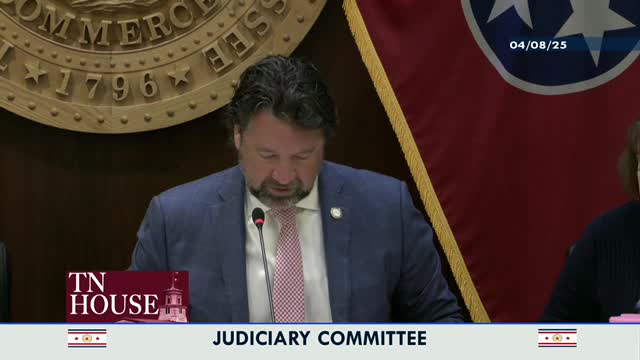
The House Judiciary full committee spent more than an hour Monday taking testimony and questions on House Bill 809, a measure that would treat a pesticide label registered with the U.S. Environmental Protection Agency as a sufficient warning for state civil cases and narrow the circumstances under which manufacturers can be sued for failure to warn.
The House Judiciary full committee spent more than an hour Monday taking testimony and questions on House Bill 809, a measure that would treat a pesticide label registered with the U.S. Environmental Protection Agency as a sufficient warning for state civil cases and narrow the circumstances under which manufacturers can be sued for failure to warn.
The bill’s sponsor and industry supporters told the committee the proposal is narrow and intended only to address situations in which federal regulators prevent a manufacturer from adding a warning to a federally registered label. "This is literally about labeling when they're prevented from labeling by the federal government in this situation," Representative (Chairman) Grills said during debate, describing the bill as intended to preserve product availability for Tennessee agriculture.
Opponents — including an expert on the Federal Insecticide, Fungicide, and Rodenticide Act (FIFRA), several farmers, public‑health advocates and family members who say they have been harmed — argued the amendment adopted during the committee’s consideration (House Amendment 6945) does not protect negligence claims and could remove a meaningful avenue for injured Tennesseans to seek relief in state court.
Mr. Llewellyn, who described himself in committee discussion as knowledgeable about FIFRA procedures, told members that federal pesticide registrations are a "living registration" and that registrants and EPA both have responsibilities to bring new adverse information to light. He also said EPA investigates outside the registrant's submissions. "The regulatory authority also has the ability to go on its own and look for information that the registrant has not provided," he said in response to a question about whether missing studies can be discovered by EPA.
Farmers who testified said losing access to commonly used herbicides would be devastating for no‑till and conservation farming. John Litz, who identified himself as a row‑crop farmer, said: "My row cropping operation would drop to probably 25% of what I'm doing now," if those products were unavailable.
Public commenters who opposed the bill described personal and family health impacts they or neighbors associate with pesticide exposure. Veteran Matthew Hinton told the committee he received a cancer diagnosis soon after his marriage and urged members to reject the bill: "House Bill 809 strips away the ability for people to seek justice when they are harmed. It grants legal protection to billion‑dollar corporations that profit from chemicals," he said.
Committee staff and the Office of Legal Services confirmed the amendment would apply to pesticides registered with the Tennessee Department of Agriculture and the EPA under FIFRA. Michelle Fogarty of the Office of Legal Services told members the Department’s published registry lists more than 15,000 registered products; she cautioned that her office had not reviewed each product’s paperwork to determine which are also registered under FIFRA.
During questions Representatives pressed witnesses on whether the draft language would amount to immunity for manufacturers; attorneys for proponents repeatedly said the amendment focuses on cases in which a manufacturer is prohibited by federal law from changing an EPA‑approved label and does not strip away claims for manufacturing or design defects.
After extensive testimony, the committee adopted House Amendment 6945 earlier in the session and later voted to roll House Bill 809 to the second calendar of 2026 for further consideration. That procedural vote means the committee took no final action on the bill itself Monday and will return to it at a later date.
Why it matters: The bill lies at the intersection of federal pesticide regulation and state tort law. Supporters argue it prevents courts from second‑guessing EPA labeling and preserves access to agricultural products; opponents say it could remove a state civil remedy for people harmed when label warnings are inadequate. Legal experts warned the change could implicate whether county and state courts remain a venue to pursue certain failure‑to‑warn claims if the language becomes law.
What’s next: Chairman Grills rolled House Bill 809 to the second 2026 calendar, giving members time to gather more evidence and amendments. Interested parties — including farm groups, public‑health advocates, state agencies and manufacturers — indicated they expect to continue lobbying and to supply additional technical and legal materials in the interim.
"If someone is harmed by this product, there are other avenues in Tennessee's court system to bring those cases," a Farm Bureau representative said in the hearing, while public‑health speakers urged more caution and documentation before any change to state law.
Votes and formal actions recorded in committee on HB 809
- House Amendment 6945: adopted (voice vote). - Final procedural action: House Bill 809 rolled to the second calendar of 2026 (voice vote).