Get Full Government Meeting Transcripts, Videos, & Alerts Forever!
Get email alerts on the Higher Education Food Security topic
No spam. Unsubscribe anytime.
Committee advances bill to create 'hunger-free campus' grants but moves funding consideration behind budget talks
Summary
Senate Bill 172 would create a 'hunger free campus' classification and grant program to help Tennessee higher-education institutions mitigate student food insecurity. The committee adopted two finance amendments and agreed to move funding decisions behind budget negotiations.
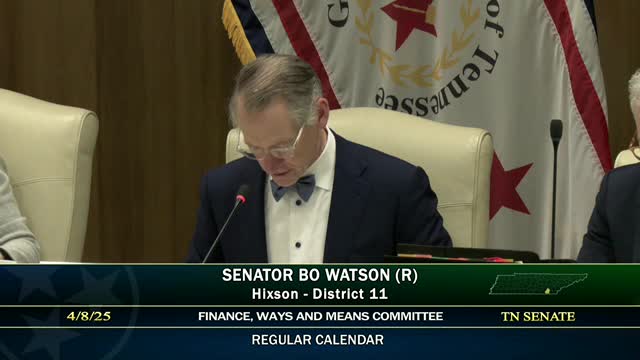
The Senate Finance, Ways and Means Committee heard Senate Bill 172 on April 8, a measure from the Education Committee that would create a “hunger-free campus” classification and a grant fund to help colleges and universities address student food insecurity.
Sponsor Sen. Jon Massey explained the bill would require a qualifying campus to operate a physical food pantry or partner with a local pantry and establish a food-insecurity task force that includes at least two student members. The grant money could be used to establish or expand campus food pantries, create meal voucher programs for dining halls and support other campus-led mitigation strategies. The bill directs the Tennessee Higher Education Commission (THEC) to administer the grant and is explicitly subject to legislative appropriations.
The committee considered two finance amendments. Finance Amendment 1 harmonized language with the House version and was adopted by unanimous voice vote. Finance Amendment 2 clarified legislative intent that appropriations are not included in the general appropriations act for the fiscal years specified, and it too passed. After the amendment votes, the sponsor asked the committee to “move this behind the budget” so funding could be considered during House–Senate budget negotiations; the chair and committee agreed with no objection.
Sen. Massey noted a recent THEC report indicating roughly 30% of Tennessee higher-education students report experiencing food insecurity and described the grant program as intentionally flexible so each campus can design responses suited to local needs.
What’s next: SB172 was amended and placed behind the budget for funding consideration during appropriations negotiations.