Get Full Government Meeting Transcripts, Videos, & Alerts Forever!
Get email alerts on the Board Rules Governance topic
No spam. Unsubscribe anytime.
Multnomah County commission begins updating board rules; work session highlights agenda, conduct and time-management proposals
Summary
A work session on board rules introduced a consultant's draft and a staff-drafted alternative that would clarify agenda control, meeting order, time-certain slots, presiding-officer powers and a code of conduct; commissioners asked for more time to review and slated a follow-up session before budget season.
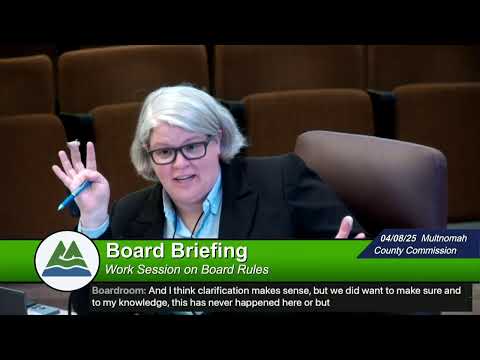
The Multnomah County Commission held a work session to begin revising its board rules, hearing an initial draft from consultant Mary Hall Caballero and a supplemental proposal from commissioners' staff that aim to clarify agenda-setting, order of business, time-certain items, motions and expectations for member conduct.
"The board's ability to work together and communicate effectively and transparently will be improved with updated board rules and practices," Caballero told the commission as she introduced a set of recommended changes drawn from interviews with current and former commissioners, model rules and practices used by other jurisdictions.
Caballero said the Phase 1 findings, developed from interviews, centered on four areas: setting a tone at the top for policy achievement, managing time for deliberation, taking ownership of meeting conduct, and making room for meaningful input as policies evolve. Her draft rules revise agenda procedures (Rule 14), make agendas draft until formally adopted at the start of meetings (Rule 16), add clearer definitions and terminology, and establish a stated expectation that the presiding officer's decisions are subject to review by a majority of commissioners.
The consultant's draft also recommends that the clerk administer agenda placement for eligible submitters (elected officials and departments), that the board adopt its rules at the first meeting of each year, and that the board explicitly state Robert's Rules of Order as the procedural standard for guidance. Caballero said those changes are designed to reduce friction caused by unclear agenda control and to provide predictable procedures for departments and commissioners.
Commissioners discussed several operational questions. They asked how the clerk would balance items when agendas fill, how many time-certain slots to permit in a session, and whether the presiding officer should be required to relinquish the gavel to participate in debate. Caballero said the rules allow flexibility but suggested the board decide in advance how long it will meet on Thursdays and to give the clerk clearer guidance about available meeting real estate.
Commissioners also considered a proposed code of conduct and sanctions in Rule 35 intended to set behavioral expectations and provide a process for response if a member breaches agreed norms. Several commissioners said they supported a visible set of conduct expectations but wanted to examine how and where the code should live and how sanctions would be implemented.
Brendan Finn and Reagan Gray, chiefs of staff for Commissioners Jones Dixon and Moyer, presented an alternative rules package and asked for a follow-up work session; Gray said the timing is urgent because the board will enter budget season and would benefit from shared procedural rules before major decisions. Chair Vega Peterson and staff agreed to schedule a dedicated session to continue the work.
No formal actions or votes were taken at the work session. Commissioners asked staff and the consultant to return with revised drafts that respond to questions about agenda real estate, time-certain mechanics, presiding-officer responsibilities, and the relationship between the rules and any separate code of conduct or policy. Several commissioners emphasized transparency for the public and protections to ensure items are not moved in ways that disadvantage members of the public who plan to testify.
The meeting recessed after the work session and commissioners indicated they will reconvene the discussion at a future, longer work session.