Get Full Government Meeting Transcripts, Videos, & Alerts Forever!
Get email alerts on the Economic Development topic
No spam. Unsubscribe anytime.
Yamhill planning commission focuses on downtown identity, code updates and economic opportunity analysis
Summary
At its March 17 meeting the Yamhill Planning Commission met with city staff and a new associate planner to discuss City Council priorities — notably downtown beautification, defining an "authentic Yamhill," code updates, and pursuing an economic opportunity analysis to guide business recruitment and land use decisions.
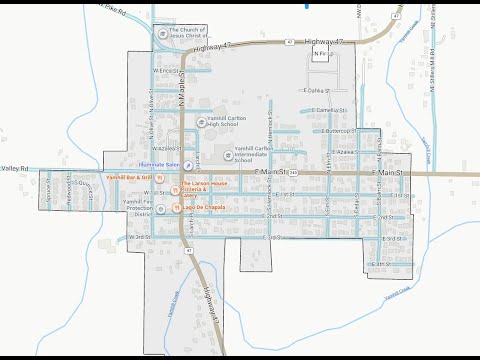
The Yamhill Planning Commission on March 17 discussed how to translate recent City Council priorities into planning work, with a primary focus on downtown beautification, defining an "authentic Yamhill" and pursuing an economic opportunity analysis to inform business recruitment and potential development on an industrial parcel east of town.
Commission chair Sean Freilinger said the meeting was intended to align the commission’s work with council goals and to identify topics the commission could take on. Freilinger introduced a proposed joint work session with city council and the Economic Development Committee to coordinate downtown design and code changes.
A resident who identified herself only as Patty urged officials to study why businesses have left Yamhill, saying, "There's been a whole lot of businesses over the last, I'm going to say 10 years, that have come to town or they've been here, and for whatever reason, they leave." Patty asked the commission to seek information that could help retain and attract businesses.
Shelly, a city staff member who read City Council priorities to the commission, recited the council’s mission and its list of priorities, saying the council’s priorities include "economic development, water stability, financial sustainability, emergency management, public safety, communication, parks, and livability." She reported that the council’s top economic-development goals include "beautification and restoration of the Central Business District" and a project to "identify authentic Yamhill" by reviewing historic photos and documents and considering whether a historic designation is desired.
The commission met the city’s new planning contact, Kurt Fisher. "My name's Kurt Fisher. I'm an associate planner with the Council of Governments, Mid Willamette Valley Council of Governments," Fisher said, describing his background in private-sector land-use applications and his recent work on long-range planning, comprehensive-plan updates and code changes.
Fisher and commissioners discussed the status of several planning documents that will either be updated or inform future updates to the comprehensive plan. Shelly summarized current plan dates: the comprehensive plan was last updated in 1999; the water master plan dates to 2018; the wastewater master plan is from 2015; and the transportation system plan (TSP) is in the process of being updated via a grant. Fisher confirmed that each of these supporting documents would be incorporated into an updated comprehensive plan as those updates are completed.
Commissioners and Fisher discussed code options for achieving a consistent downtown appearance. Fisher noted downtown design standards commonly require buildings to be positioned near the sidewalk and for entrances and windows to face the street, and that more specific aesthetic themes could be added to code following public engagement. "There are basic elements that most design standards in downtowns have ... But then there's more specific design themes that you can add in as well," Fisher said.
As part of economic development work, the commission reviewed the role of an economic opportunity analysis (EOA). Fisher described the EOA as a study to "identify the industries that Yamhill is particularly positioned to attract," including an analysis of workforce, commuting patterns, proximity to nearby towns and local access characteristics. He said the EOA would cover commercial and industrial lands (including the industrial parcel east of town) and include a buildable lands inventory component.
Fisher contrasted the EOA with a housing capacity analysis: the EOA can serve as policy guidance without immediate mandatory implementation, while a housing capacity analysis can trigger requirements to adopt measures (such as rezoning or density changes) before the analysis can be adopted. He added that the statewide housing needs analysis projects a need for 109 new housing units in Yamhill’s urban growth boundary over the next 20 years.
Commissioners discussed next steps: scheduling a joint work session with city council (the commission noted the council’s March 17 meeting offered an April 9 council meeting as an available date) and partnering with the Economic Development Committee on a downtown "walkabout" to inventory existing businesses. Freilinger and staff agreed to follow up on scheduling and outreach. No formal motions or votes were taken at the meeting.
The commission confirmed its next regular meeting is scheduled for April 21 and discussed possible dates and times for a joint council/EDC work session before the April 21 meeting.