Get Full Government Meeting Transcripts, Videos, & Alerts Forever!
Get email alerts on the Sheriff Funding And Grants topic
No spam. Unsubscribe anytime.
Cochise County supervisors review sheriff's grant portfolio, funding risks for jail operations
Summary
At an April 8 work session the Cochise County Board of Supervisors heard a staff briefing on the sheriff's office grants portfolio and jail-related funding, including advance versus reimbursement grants, staffing risks when grant-funded positions end, and investments of advanced grant balances.
Cochise County Board of Supervisors members met in a work session on April 8 in Bisbee to review the sheriff's office financial position, focusing on federal and state grants that pay for patrol details, equipment, forensic software, detention operations and temporary staff.
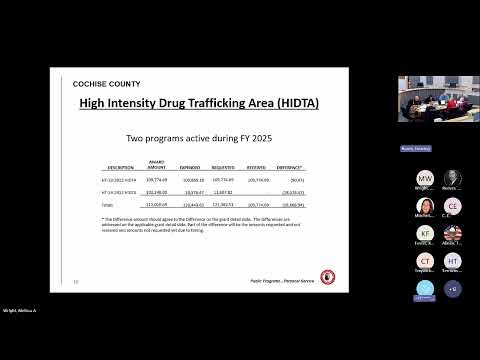
The briefing, led by John Boswell, Cochise County grants administrator, and supplemented by budget and finance staff, gave supervisors an account-level view of dozens of active grants, how some are paid (advance versus reimbursement), what remains unspent and which programs require local matches.
The review matters because many sheriff's programs rely on a mix of federal, state and local funding, and changes to grant rules or late reimbursements can shift costs to the county's general fund. Supervisors asked about programs that fund overtime and benefits, grants that act as pass-throughs to other local providers, and how partially grant-funded employees would be handled if awards end.
Most important findings
John Boswell described grants that directly fund sheriff's activities and equipment, including National Forest Service detail funding, Governor's Office of Highway Safety DUI and speed-detail grants, and Arizona Criminal Justice Commission awards such as Edward Byrne programs and a $240,000 allocation under HB 2650 for a major-incident task force covering multiple jurisdictions. Boswell said the HB 2650 money is used for training and investigating serious incidents, including officer-involved shootings.
Staff reiterated that some grants are reimbursements (the county pays first and seeks reimbursement) while others are advanced payments that sit in county accounts until spent. Treasurer Kathleen Trawick told the board that when grants are advanced she pools allowable funds for conservative investment, noting, "Every penny that I possibly can invest for the county without breaking the law, I do," and cautioned that some grants cap or require reporting of interest earned and excess interest may have to be returned.
Match requirements and local offsets
Several state grants require the county to cover a portion of employer-related expenses (ERE) or salaries. For example, some Governor's Office of Highway Safety programs cover a portion of wages and ERE but leave the county to cover the remainder; staff said Arizona Smart and Safe funds (marijuana tax revenues) have often been used to cover required local matches.
Boswell and budget staff told supervisors that Arizona Smart and Safe revenues fluctuate and that the county uses those funds to cover matches for some public-safety grants.
Equipment, software and capital purchases
The briefing listed specific purchases under grants: license-plate-reader software tied to a Stone Garden award (about $201,000 awarded, roughly $12,000 spent from that award), ballistics-analysis equipment paid from Project Safe Neighborhoods funds, purchase and upfitting of patrol vehicles under BIMA-related awards, body scanners for jail intake funded by an opioid/victim program that still had roughly $560,000 remaining, and multi-level satellite communications kits funded by a Department of Justice community policing grant.
Staff and pension implications
Supervisors pressed staff on positions partially funded by grants. Boswell and budget staff explained the county typically hires individuals into established county positions and applies grant funding to those positions; if a grant share ends, the remaining salary obligation falls to the general fund unless another funding source replaces it. The board discussed the long-standing practice that grant-funded percentages are tracked and the county controls position and FTE counts centrally.
Jail and incarceration funding
County staff described grant support for jail operations, including jail enhancement funds (restricted to jail-related uses), and a major incarceration reimbursement award the county treats as a near-fixed agreement: the award listed $5,680,000 and a reimbursement rate of $78.70 per inmate per day for qualifying detainees. Staff noted the county has relied on a mix of these awards and general-fund resources to cover detention costs.
Border and BIMA funding
Border-related grants were a substantial part of the discussion. Staff summarized several Department of Public Safety and BIMA awards that have funded Border Strike Task Force operations, vehicles, equipment and infrastructure; one BIMA award of about $3.7 million covered salaries, ERE and equipment and had roughly $1.058 million remaining at the time of the briefing. Local border support grants were identified as near-term funding sources but some awards were not being extended, leaving portions of advanced balances subject to return if not spent by contract end dates.
Timing, extensions and reimbursement risk
Multiple grants were noted as ending in mid-2025 and supervisors were warned that some state or federal programs may not be extended. Stone Garden in particular was described as having an uncertain future tied to FEMA or federal program choices. Staff said reimbursements can be slow and that delayed federal or state reimbursements shift cash pressure to county accounts.
Treasurer and investment practice
Treasurer Kathleen Trawick joined remotely and described the county's conservative investment strategy for pooled cash and allowable advanced grant funds, emphasizing statutory limits on investment duration and types (government-backed securities such as Fannie Mae, Freddie Mac and Farmer Mac). She cautioned that some grant agreements limit earning or require reporting small amounts of interest back to the grantor.
Questions and next steps
Supervisors asked for clearer accounting of carry-forward and advanced funds, the split of jail and sheriff general-fund versus grant-funded dollars, and the county's process for covering pension and other ERE obligations when grants pay only a portion of wages. Staff said they would continue to monitor reimbursements, pursue extensions where possible and provide additional breakdowns in future meetings.
The board adjourned after the briefing and scheduled a 2 p.m. work session to review the Emergency Management Department's financial position.