Salem Public Schools proposes $78.2 million FY26 budget with 56.5 position reductions; public and unions urge alternatives
Loading...
Summary
Superintendent presented a $78,173,061 proposed FY26 budget that closes a $4.9 million gap through 56.5 position reductions, non-personnel cuts and one-time offsets; public commenters, library director and AFSCME urged the committee to preserve student-facing roles.
Salem Public Schools proposed a $78,173,061 fiscal year 2026 budget April 7, asking the School Committee to approve a 4.8% increase in the district appropriation while closing a roughly $4.9 million budget gap through recurring revenue, nonpersonnel reductions and elimination of 56.5 full-time equivalent positions.
The proposal, presented by Superintendent Zreich and Assistant Superintendent Elizabeth Pauley, would hold class-size caps in most grades, preserve prekindergarten and early-college and CTE programming, and prioritize student-facing roles where possible. Pauley said the district expects the appropriation to be voted by the School Committee on April 28 and then reviewed by City Council in May.
The budget matters because Salem’s enrollment and student needs are rising while key one-time pandemic funds have ended, officials said. Pauley reported October 1 enrollment at 3,831 (the DESE baseline) and current enrollment of 3,958, with marked growth among multilingual learners (up 9% to about 1 in 5 students) and special-education students (up 8.4%, about 1 in 4 students). Those increases, plus rising transportation, utilities and out-of-district tuition costs, are major cost drivers, officials said.
“Chapter 70 has not increased at a rate that keeps pace with inflation,” the superintendent told the committee, citing the state funding formula as a long-term constraint. Pauley added that state Chapter 70 revenue for the district is projected to increase about $396,000, and that local appropriation from the city is proposed at a 4.8% increase.
Key cost pressures and offsets
- Personnel will account for about $60 million (roughly 76% of the budget). The district said it built in recent collective-bargaining increases and remains committed to competitive pay. - Nonpersonnel costs are budgeted at $18.6 million, up primarily because of transportation, utilities and tuition for specialized out-of-district placements. - Electricity costs are projected to rise about 30% after usage, from roughly $1.2 million to $1.6 million, the presentation said, despite prior investments in energy conservation. - Homeless student transportation funding that previously offset costs is ending; homeless transportation is budgeted at about $1.1 million next year. - Out-of-district tuition costs are rising because tuition rates at specialized placements increased 8–14% in the past two years, Pauley said. - The district plans to close the remaining $825,000 gap after reductions by (1) prepaying some out-of-district tuition where allowed and (2) maximizing grants and revolving-fund revenue and administrative charges to grants.
Position reductions and impact
The recommended budget includes elimination of 56.5 positions. Pauley described how the reductions were prioritized to minimize displacement: 34% of the eliminations come from retirements or known vacancies; 27% are expected to be filled by staff moving to other roles in the district; the remaining 21.5 positions are eliminations where it is not yet known whether incumbents will remain in the district. The district emphasized it will attempt to use vacancies and retirements first where possible.
Public comment and union responses
Several public commenters and staff urged the committee not to cut student-facing positions.
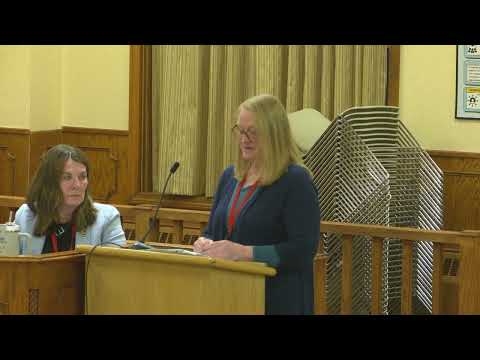
A public commenter identified in the record as a resident and paraprofessional said: “While I understand the need to be fiscally responsible as a district, that the loss of many of the positions that you're planning on discussing this evening and possibly cutting in the next couple of weeks are going to be detrimental to our students, and the function of our schools. I fear that we're not going to be able to staff appropriately as a district.”
Jody Kinkade Tomayoshi, director of digital learning and library services for Salem Public Schools, described expansion of library and digital skills services and asked the committee to “please commit to continuing your full and unwavering support of our library program.” She cited district-level gains including a nearly 10% growth in one Spanish collection and a 30% increase in circulation for that collection; she also said in second grade “75% of our students are now proficient in using at least one digital tool.”
An AFSCME Local 294 representative, identified as the union’s local president in the transcript, said the proposed cuts could affect more positions than the two AFSCME roles singled out because of contract obligations, urged proper impact bargaining and requested collaborative discussions on alternatives.
Transportation and other operational changes
The presentation proposes reducing regular-day bus service by one vehicle (from 13 to 12 buses), saving about $100,000 but likely creating wait lists at some schools. The district plans to enforce bus swipe-on technology more consistently to free seats and manage capacity.
The district is also planning an expansion of library/digital services (two additional elementary schools to receive library/digital specialists), increased athletic coach stipends (details to be set by a joint labor-management group), and continued support for the Collins Middle School–Saltonstall merger (Collins’ budget shows an increase because of the merger; Saltonstall’s budget shows a corresponding reduction).
Process and next steps
Pauley reminded the public of a dedicated budget hearing April 14 at 7:00 p.m. in the same room and said the School Committee is scheduled to vote April 28; if approved, the budget will go to City Hall for a City Council hearing and final vote in May/June. The superintendent and staff asked the public to submit comments via spsbudget@salemk12.org.
Discussion among members emphasized that this budget is the first year of a projected three-year structural deficit the superintendent estimated at about $17 million over three years; members discussed the need for continued advocacy on the state Chapter 70 formula and other long-term remedies.
Ending
The committee did not finalize the budget on April 7; the proposed FY26 appropriation will be the subject of the April 14 public budget hearing and the committee vote scheduled for April 28.