Get Full Government Meeting Transcripts, Videos, & Alerts Forever!
Get email alerts on the Separation Appeal topic
No spam. Unsubscribe anytime.
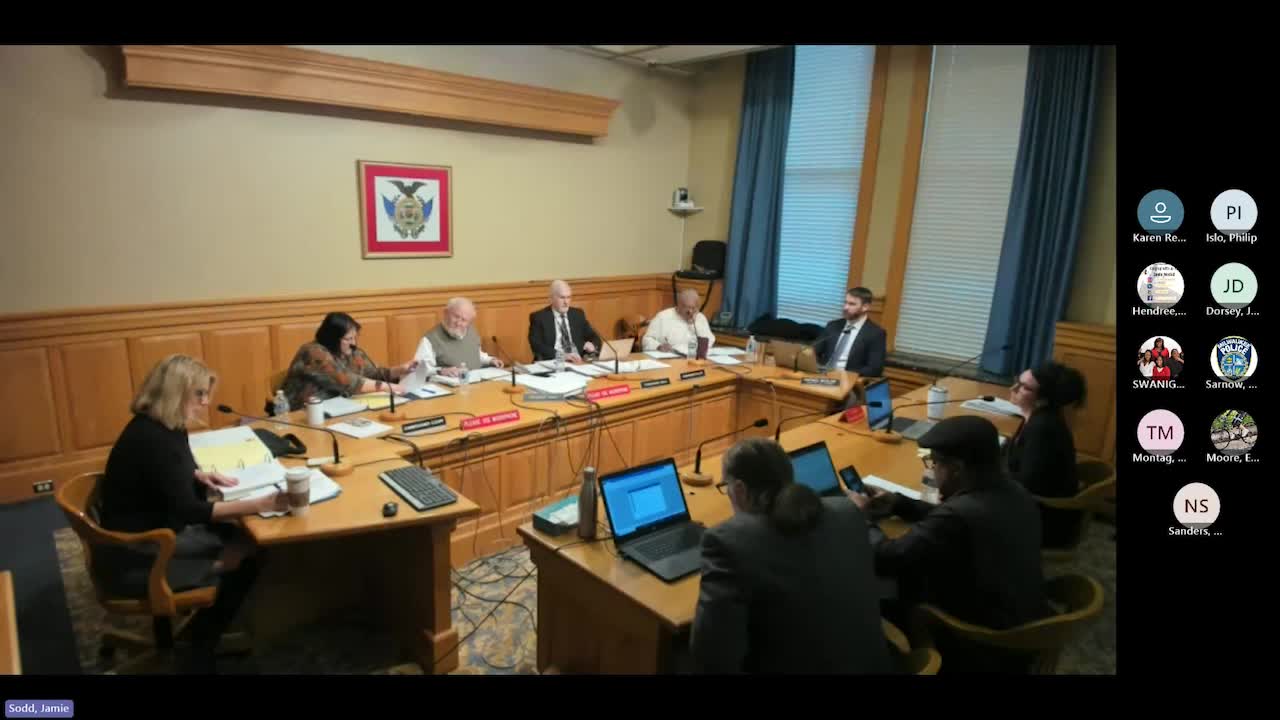
Milwaukee civil service commission hears appeal of city attorney aide separated over CJIS clearance
Summary
The Board of City Service Commissioners in Milwaukee spent much of its April 7 hearing reviewing whether the city attorney’s office acted reasonably when it separated business systems coordinator Antoine Young after officials said he could not obtain CJIS (Criminal Justice Information Services) clearance required to access police administration systems.
The Board of City Service Commissioners in Milwaukee spent much of its April 7 hearing reviewing whether the city attorney’s office acted reasonably when it separated business systems coordinator Antoine Young after officials said he could not obtain CJIS (Criminal Justice Information Services) clearance required to access computers and records in the Police Administration Building.
The case matters because the Office of the City Attorney prosecutes municipal violations at the Police Administration Building’s Ordinance Enforcement Division (OED) and relies on direct access to law‑enforcement databases; losing that access or permitting unauthorized access can trigger federal CJIS audits, witnesses told the commission.
Assistant City Attorney Catherine Headley opened the department’s case by telling the commissioners that “the determination that you must make today is whether or not the separation from employment was reasonable.” She said testimony and documents would show Young was not qualified for the position because he “was not able to get proper security clearance” necessary for OED software and for unescorted access to the Police Administration Building. Attorney Ben Hitchcock Cross, representing Young, called the separation a pretext and said the employee “was able to do the job” for years and should be reinstated.
The panel heard testimony from Assistant Chief Craig Sarnow of the Milwaukee Police Department, who described how the department sponsors non‑police personnel for CJIS access and explained the three tiers of access used at the Police Administration Building, including the physical, unescorted access required for some OED functions. Sarnow said the department treats convictions for theft or fraud as red flags and that, after reviewing Young’s record, he would have denied sponsorship because of the volume and nature of offenses that appeared on Young’s criminal background.
Deputy City Attorney Mary Schanning (sworn as a witness during this hearing) described her office’s separate role and said the City Attorney’s Office concluded it could not have Young serve as the office’s internal IT person for OED while passing a CJIS audit. Schanning testified she and the city attorney consulted the Department of Employee Relations and concluded the office’s only viable option before the upcoming audit was to separate Young; the record shows Young was placed on paid administrative leave Nov. 20, 2024, a pre‑discharge meeting occurred Dec. 2, 2024, and the separation was dated Dec. 11, 2024.
Both sides introduced documents and disputed some evidentiary uses. The department offered the FBI CJIS security policy (a multi‑hundred‑page document) and a 2024 administrative hearing decision involving the Milwaukee Police Department; the defense objected to highlighted versions of the policy and contested some out‑of‑record materials. The commission admitted the CJIS policy exhibits (DU1 / DU1A) and allowed a Wisconsin Equal Rights Division hearing decision (marked in the record as D11) as background evidence, noting administrative decisions are not binding but may be considered as context.
The hearing also included contested procedural rulings. The appellant asked that witnesses be sequestered; the commission granted sequestration for witnesses who would testify later and ordered that those who planned to testify not listen to other testimony. Commissioners and attorneys discussed witness lists, contact information for remote participants, and how hybrid participation affects sequestration; staff and counsel agreed to call Assistant Chief Sarnow first and then Deputy City Attorney Schanning.
At the meeting’s start the commission unanimously approved the minutes of the March 25, 2025 meeting. No final decision on Young’s appeal was announced April 7; the chair told parties the commission typically deliberates in closed session and would announce any decision in open session. The hearing was left open and scheduled to resume the following day if necessary; the chair said if the hearing were still in progress at 12:30 p.m. it would be adjourned and resume the next afternoon around 1:30–1:45 p.m.
The commission’s record shows the appeal centers on whether Young’s inability to obtain CJIS clearance made him unable to perform an essential job function for which the office required unescorted access and database access at OED. Commissioners heard competing arguments about whether the separation was nondisciplinary and required because of security obligations, versus whether the prior years Young performed the work without issue undercut the department’s rationale. The commission did not render a final ruling on the appeal at the April 7 meeting; commissioners set additional witnesses and evidence to be heard when the hearing resumes.