Get Full Government Meeting Transcripts, Videos, & Alerts Forever!
Get email alerts on the Transportation Impact Fees topic
No spam. Unsubscribe anytime.
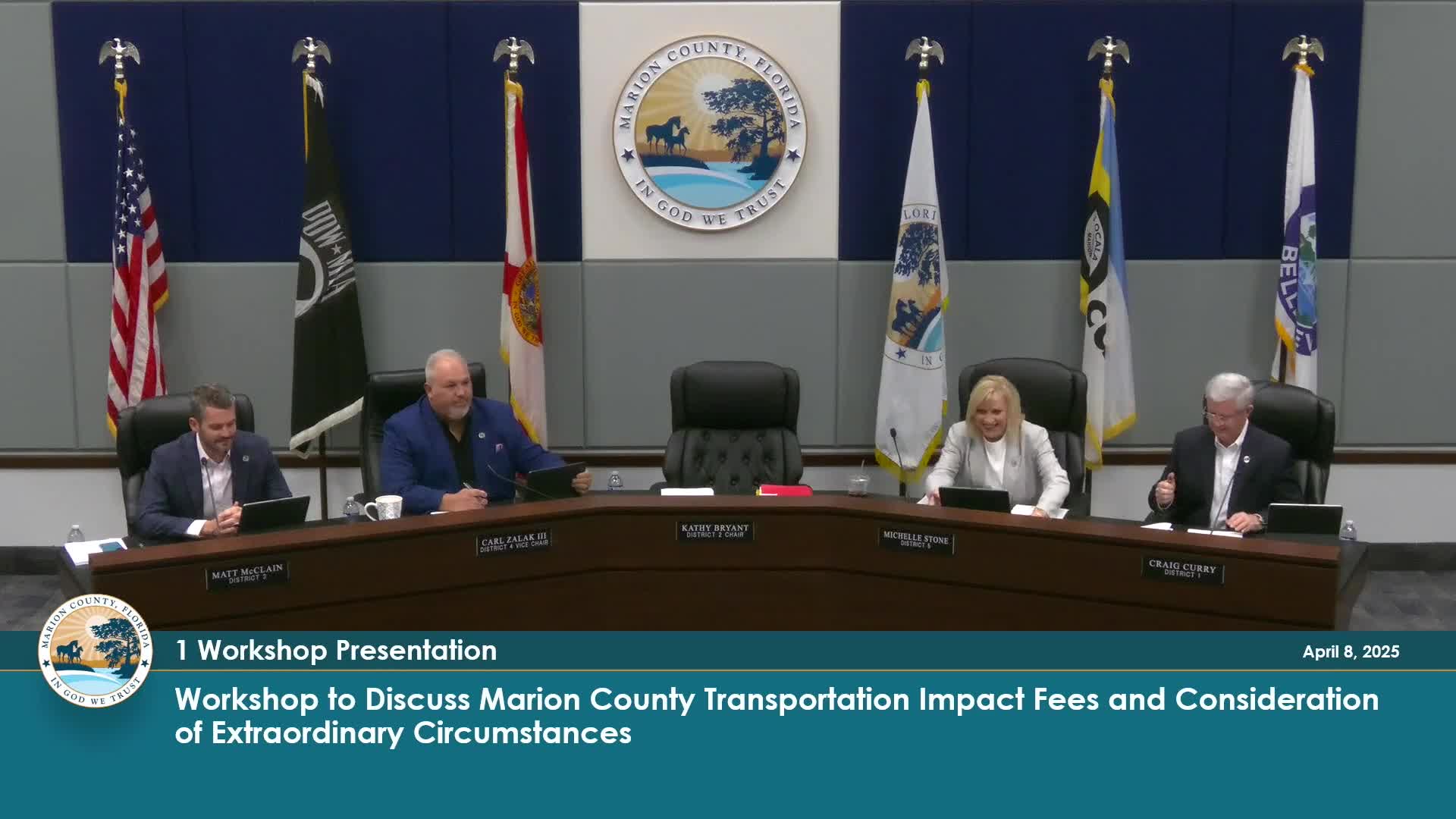
Marion County officials review transportation impact fee study, project shortfalls and bond needs ahead of May hearings
Summary
County consultants told commissioners that rising costs and high permitting have produced a projected $490 million shortfall for 20-year capacity projects unless impact fees are raised above the state'mandated 50% cap; staff proposed additional workshops and a May 23 public hearing.
Marion County Commissioners on Tuesday reviewed a consultant'led update to the county's Transportation Impact Fee Study that shows rising construction costs and sustained high permitting have created a multihundred'million'dollar shortfall in funding for 20'year capacity projects.
The study, presented by consultant Nielgenkamp of Banish and county staff member Tracy Straub, found that a 2021 state law limiting impact fee increases to 50% unless extraordinary circumstances are demonstrated has constrained the county's ability to keep fees aligned with current costs. "If there is a study demonstrating extraordinary circumstances and it is discussed at 2 public workshops and the increase is approved by 2 third of the governing body, then it can be more than 50% and phasing does not have to happen in the way that is described," Nielgenkamp said during the workshop.
The presentation said Marion County ranks among the faster'growing Florida counties: projected annual population growth of about 1.1% over the next 10 years and roughly 18% absolute growth in that period. Residential permitting rose from roughly 360 units in 2011 to more than 7,000 in the most recent year, the consultant said. Construction cost indices showed increases ranging from about 53% to 173% since 2015, with sharper rises after 2021.
Those cost increases, combined with the county's list of capacity projects, produced the revenue gap. The county identified 36 capacity improvement needs totaling about $800 million; adding capacity to an estimated 336 lane miles projected to be deficient raises the estimated cost to roughly $1.6 billion, the study said. The county expects about $900 million from sales tax and about $200 million from current impact fee revenue over the 20'year planning window, leaving a shortfall of about $490 million.
Under updated fee calculations, the study estimates transportation impact fee revenue could increase to about $23 million to $28 million per year if the county adopts full calculated rates. If increases are limited by the 50% cap, the county would generate about $9 million to $11 million per year. Over 20 years, those scenarios yield roughly $184 million to $578 million in new fee revenue. Using the most recent five years of permitting (2019'24), the consultant said the county could generate $630 million to $680 million over 20 years; in that scenario, adoption levels in the 70% to 75% range could close the projected shortfall. At the study'base permitting level, the consultant said an adoption rate near 84% would be needed to eliminate the shortfall.
Commissioners and staff also discussed projects not fully captured in the fee analysis. Commissioner Zalick asked whether recent higher local cost estimates and proposed enhancements (including possible bridge or flyover work) were included; the consultant and staff said the capacity project list in the supplemental document (the Marion County Transportation Impact Fee Supplement: Demonstration of Extraordinary Circumstances) includes identified capacity projects but does not reflect every recent bid or separately considered corridor alternative. "Those are I don't believe those are included in any of our evaluations," one speaker said of certain corridor alternatives; the consultant added that the 20'year plan reflects what is known today and that bids and future revisions will change cost estimates.
The county engineer, Steven Cahoon, discussed near'term bonding needs to accelerate high'priority projects. "Worst case, we were talking to looking at about $170,000,000 worth of bond potential need next fiscal year if we're gonna keep everything prioritized the way that it is," Cahoon said. He said a best'case estimate could be about $100 million to $115 million depending on bid results and project sequencing. Cahoon and staff said they planned to return to the commission in January with a revised TIP (transportation improvement program) and financial analysis if bonding is pursued.
Staff asked commissioners to set a second public workshop for May 6 at 3:00 p.m. and to schedule a public hearing on proposed changes for May 23 beginning at 1:30 p.m.; staff said an implementing ordinance would be drafted following the workshops and that any adopted increases would take effect nine days after adoption. Tracy Straub noted the presentation materials include an added slide ("added slide 11B") and a supplemental Word document with a table of capacity projects (Table 2) that commissioners can review.
No formal motion or vote to change rates was taken during the workshop. Commissioners asked for additional detail on the supplemental materials, potential bonding impacts, and inclusion of alternate corridor projects before a final decision on fee increases.
The workshop adjourned after commissioners scheduled the follow'up workshop and discussed next steps toward the May public hearing.