Get Full Government Meeting Transcripts, Videos, & Alerts Forever!
Get email alerts on the Ihss Pay Negotiations topic
No spam. Unsubscribe anytime.
IHSS caregivers ask Yolo County supervisors to back 20¢ raise as contract talks near conclusion
Summary
Dozens of in‑home supportive services providers told the Yolo County Board of Supervisors during public comment that a 20¢ increase would make a meaningful difference as statewide bargaining nears a deal; the board said negotiations cannot occur in public and are working to conclude talks in closed session.
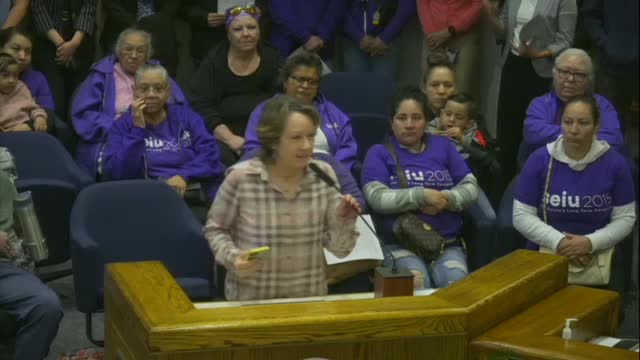
Dozens of in‑home supportive services (IHSS) providers and family caregivers urged the Yolo County Board of Supervisors on April 8 to support a small wage increase — roughly 20 cents an hour — the providers said would materially affect household budgets as a statewide bargaining agreement nears completion.
Speakers described round‑the‑clock caregiving duties and financial strain. "I'm a skilled worker, and I'm just asking for a fair wage," said Michelle Russell, who identified herself as an IHSS provider and the full‑time caregiver for her son, who suffered a traumatic brain injury in 2018. "I work 24/7. My son takes, like, around‑the‑clock care. Of course, I don't get paid for that amount of work."
The request for 20¢ came up repeatedly. "We are only 20¢ away from a difference," said Elizabeth Cruz, speaking through an interpreter; she described caring for an eight‑year‑old nephew with autism and hip paralysis. Lucero Pantoja, a parent of two children who receive IHSS, and Rosalia Rodriguez, who said she formerly worked as an IHSS provider, also urged support. Patricia Ornelas, who identified herself as a member of the county's bargaining committee, told supervisors she represents "more than 3,000 providers in the county" and said negotiators are close to finalizing a three‑year contract that would raise pay by modest amounts.
Speakers gave concrete examples of care and cost pressures: Maria, who described caring for her 17‑year‑old son who underwent recent spine surgery and requires 24‑hour care, listed daily tasks including dressing, bathing, medication administration and operating a chest‑mounted neural stimulator; she said outside caregivers demand cash wages she cannot afford. Several speakers contrasted IHSS pay with recent minimum‑wage increases for fast‑food workers and asked for parity in recognition if not in pay.
The board responded directly to the public comments. "We are not able to negotiate this in public, but we are working on it in closed session, and we are eager to bring this to closure as quickly as we possibly can," said the Board Chair during the meeting's public‑comment response period.
The speakers said the pay change under discussion is part of a broader, state‑level bargaining effort. Patricia Ornelas noted that the county's contract would be a three‑year agreement and that the parties are "about to reach an agreement to close this contract." The speakers urged supervisory support while statewide bargaining and local implementation details proceed.
No formal board action on IHSS wages occurred during the open meeting; the board indicated it is handling negotiations outside the public meeting process and thanked speakers for sharing their experiences.
Votes and formal actions taken earlier in the meeting included approval of the meeting agenda and adoption of the consent calendar (items 6–18) after supervisors pulled items 10 and 16 for brief comment. The board did not vote on IHSS wages during the April 8 session.
The speakers who addressed the board were a mix of current or former IHSS providers and family caregivers; several emphasized that even small increases in hourly pay would help meet rising household costs for rent, food, utilities and medical needs.
The county did not provide a specific dollar figure for countywide implementation or a timeline for when any negotiated increase would take effect during the open meeting. Speakers and a bargaining committee representative said the proposed change would be implemented under the terms of a statewide bargaining contract that remains under negotiation.
The board acknowledged receipt of the comments and said staff and negotiators are working toward a resolution in closed session. Supervisors did not disclose negotiation details during the meeting.