Get Full Government Meeting Transcripts, Videos, & Alerts Forever!
Get email alerts on the Education Budget topic
No spam. Unsubscribe anytime.
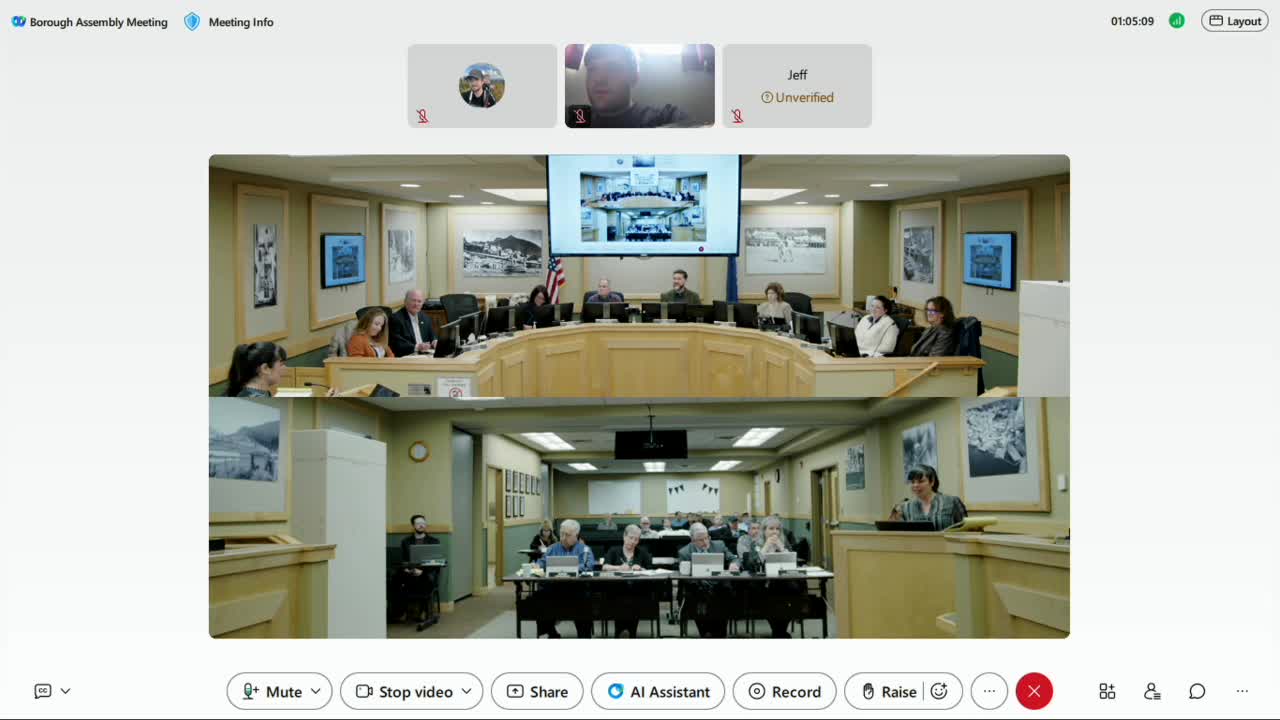
Assembly directs FY‑26 school funding plan, approves FY‑25 supplemental aid and ratifies a district technology lease
Summary
After a lengthy work session on the borough’s budget and school financing, the assembly approved a FY‑25 supplemental funding package for the school district, directed staff on a FY‑26 funding ordinance tied to a 90% BSA figure, and ratified a five‑year lease the district will use to refresh classroom devices.
The Ketchikan Gateway Borough Assembly moved April 7 to give the school district immediate financial certainty while directing staff to prepare a FY‑26 funding ordinance that preserves a local education fund floor and phases funding for the coming year.
In a work session the assembly approved a FY‑25 supplemental funding package the borough will introduce April 21 that provides roughly $453,000 in cash to the school district and an additional in‑kind appropriation (debt forgiveness and accounting treatment) of about $485,000. That supplemental was approved by the assembly at the meeting’s close.
Simultaneously, the assembly directed staff to prepare a FY‑26 school funding ordinance that uses 90% of a $5,960 base student allocation (BSA) for preliminary budgeting — a step the assembly said would preserve the borough’s $2,000,000 local education fund (LEF) floor and allow the borough time to resolve budget risks tied to uncertain state revenues (Secure Rural Schools and other state actions).
Why it matters: the district faces continuing shortfalls and cash pressures that have prompted budget cuts, potential teacher reductions and personnel decisions — including the need for a special school board meeting to decide next year’s operating model. Assembly members and the school board president said the supplemental and the FY‑26 direction give the district clearer revenue assumptions for recruiting, hiring and a superintendent search.
District briefing and public comment: School Board President Catherine Tatsuta told the assembly the district is preparing for an intensive superintendent search, has scheduled public meetings and will weigh two operational plans that differ in personnel reductions and program structure. The board is considering an “elementary school specialization” model and a consolidation model; one option would cut about 12 teachers and paras, the other could require about 17 teacher cuts and a vice principal and a para. The district has scheduled a special meeting to consider final decisions.
Tatsuta also described the district’s efforts to improve communications with the borough and the public and confirmed the district approved a RIF (reduction in force) plan to comply with contractual and statutory deadlines should state funding fall short.
Work‑session findings: finance and public‑works staff told the assembly the LEF faces continued pressure: if the legislature does not restore Secure Rural Schools funding or approve higher base student allocations, the LEF could be dragged toward its reserve floor and beyond. Staff modeled two scenarios: one assuming the legislature leaves a $5,960 BSA in place and another assuming a higher BSA. The assembly approved motions that (a) fund FY‑25 supplemental aid while preserving a $2,000,000 LEF balance and (b) direct staff to draft a FY‑26 ordinance at 90% of a $5,960 BSA so the borough and district avoid a mid‑year crisis and have time to identify longer‑term revenue options (PILT negotiations, reallocation choices, or mill adjustments).
Technology lease ratified: Separately, the assembly ratified a five‑year lease agreement the district negotiated with a vendor to refresh classroom devices (roughly 445 student devices and 45 staff machines). The lease will be financed across five annual payments of approximately $46,000; the assembly was told the arrangement spreads the cost and will be counted against the district’s FY‑26 budget and the borough’s cap calculations rather than as an extra borough contribution. The assembly’s vote to ratify the lease passed 4–3.
Caveats and next steps: borough staff warned the assembly that the school district’s most recent audit highlighted internal control and interfund transaction risks. Several assembly members asked the district to ensure any internal transfers follow board approvals and include explicit repayment plans. The assembly’s funding direction is intended to buy time for the borough, the district and state advocates to seek sustainable revenue changes — including reauthorization of Secure Rural Schools, a potential change to the federal PILT side‑B formula, or other revenue adjustments.
Quotes: “We are accepting applications [for superintendent] and we’re hoping to have finalists for in‑person interviews in May,” School Board President Catherine Tatsuta told the assembly. Assemblymember Glenn Thompson said the FY‑26 direction gives the district breathing room while the borough pursues longer‑term solutions.
Ending: The assembly’s actions provide short‑term cash and a path for FY‑26 budgeting but leave several policy and revenue risks unresolved. Borough staff and the assembly said they expect multiple follow‑up items — including an FY‑26 ordinance, additional budget choices, and continued conversation with lawmakers about state support for rural schools.