Get Full Government Meeting Transcripts, Videos, & Alerts Forever!
Get email alerts on the Permitting Consolidation topic
No spam. Unsubscribe anytime.
Portland consolidates permitting functions into new bureau while warning of $14 million shortfall
Summary
City staff told the Arts and Economy Committee that Portland Permitting and Development (PPD) shows early signs of faster review times after the recent consolidation, but faces a projected $14 million funding gap for FY 2025–26 and the possible elimination of dozens of positions unless new revenue or one-time funds are found.
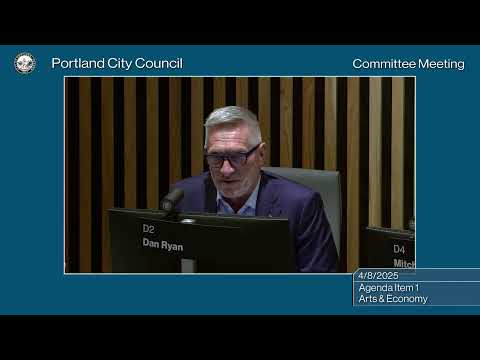
Councilor Ryan, chair of the Arts and Economy Committee, opened Tuesday’s meeting with a review of the multi-year effort to consolidate Portland’s permitting functions and said the city is “on the right track, but we’re at a crucial moment of implementation.”
The committee heard an update on the newly formed Portland Permitting and Development (PPD) bureau, created to centralize review and customer service previously split across seven bureaus. Donnie Olivera, deputy city administrator for economic development, said the new bureau formally launched July 1 and remains early in its implementation year. “This is a big vision that requires a lot of leaning in from staff both in the bureau, but also around the city,” Olivera said.
The presentation, led by Terry Tyson of the Permit Improvement Team (PIT) and David Keenhausen, interim director of PPD, outlined several areas of progress and several unresolved risks. Tyson, who leads the PIT, described customer-focused changes including a single point of contact model, website content rewritten for greater readability, expanded translation options, and a “wizard” tool being tested to help applicants determine whether they need a permit. The city’s 2023 customer survey showed a 13% increase in satisfaction with staff interactions, Tyson said.
Keenhausen and Tyson presented permit-processing metrics for 2020–2024 showing that the city-side review time has decreased even as the number of applications and permit issuances have remained steady. They cautioned that a large share of total elapsed time on many projects is the period in which an application sits with the applicant rather than in the city’s review queue. The staff noted they are disaggregating city review time and applicant response time to target improvements.
Despite operational progress, PPD’s fiscal outlook is strained. Keenhausen told the committee the bureau is facing a projected $14,000,000 funding gap for fiscal year 2025–26, equivalent to roughly 74 full-time positions, and warned that PPD reserves could be depleted in 2026 without intervention. The bureau is funded almost entirely by fee revenue tied to project valuation; only about 2% of its funding comes from the general fund. Keenhausen said large-scale commercial and multifamily new-construction permits — the projects that generate the largest fee revenue — have declined in recent years, while lower-valuation residential and commercial alteration permits have increased.
Keenhausen recounted previous downturns, including near-zero reserves after 2008–09, and reviewed steps the bureau has taken: a business continuity plan with triggers tied to leading indicators, repeated forecasting work with a Financial Advisory Committee, and a series of business process analysis workshops. He said the bureau has already implemented layoffs in 2024 (about 74 positions, roughly 19% of the workforce) and that, absent new revenue, “services and probably entire programs will be cut” in the future.
Staff described other concrete items in process: a code alignment project that will package small code amendments focused on small businesses and small development projects and would be brought to city council for vote in summer 2025; ongoing digital-services work to reduce technology backlog; and a regulatory “grama” (cross-bureau policy review group) to reduce conflicting or redundant code. Tyson said these changes remain iterative and staff-driven and emphasized that improvement work includes follow-up training and repeat measurement.
Public testimony included architect Ian McKenzie, who urged the council to consider a temporary suspension of system development charges (SDCs) on projects that pick up a building permit by a specified deadline, saying those fees can add “tens of thousands of dollars per unit” and that a time-limited waiver could spur projects that are otherwise financially stalled.
Committee members asked staff for more information about fiscal options and expressed support for preserving the PIT’s work. Staff told the committee the PIT currently has four positions; three positions are not funded beyond 06/30/2025 without new one-time funds, and staff urged council consideration of one-time funding to retain the team in order to continue implementation work. Several council members said they want a short, shareable summary for the full council describing the committee’s findings and recommended next steps before the mayor’s proposed budget is released.
No formal action or vote on policy changes occurred at the meeting. Staff said they will continue forecasting with their Financial Advisory Committee, evaluate alternative funding model options for PPD, and return with additional details on potential budget interventions and code amendments.
Portland’s permitting consolidation is presented by staff as an operational reform showing early performance improvements but carrying fiscal risk because the bureau’s fee-based funding model is highly dependent on large projects that have been scarce. Committee members asked staff to analyze both short-term, one-time supports to bridge the bureau through the current downturn and longer-term structural changes to make PPD revenues more resilient.
Looking ahead, staff said they will bring code-alignment proposals to council in summer 2025 and continued modeling of funding alternatives. Councilors also discussed piloting demand-side incentives such as targeted SDC relief and asked staff to present pro forma analyses of the trade-offs before any action.