Get Full Government Meeting Transcripts, Videos, & Alerts Forever!
Get email alerts on the Gaza Humanitarian Crisis topic
No spam. Unsubscribe anytime.
U.N. secretary-general urges immediate ceasefire and unrestricted humanitarian access to Gaza
Summary
The United Nations secretary-general said a month has passed with almost no aid into Gaza, called for a permanent ceasefire, the unconditional release of hostages and full humanitarian access, and cited occupying‑power obligations under the Geneva Conventions.
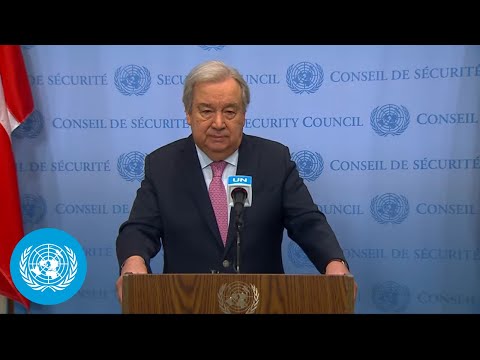
United Nations secretary-general said at a U.N. press conference that more than an entire month had passed with virtually no aid entering Gaza and called for an immediate, permanent ceasefire, the unconditional release of hostages and full humanitarian access.
The secretary-general said the ceasefire that previously held had allowed lifesaving aid and the release of hostages and warned that the shattering of that pause left Gaza "a killing field" with civilians in an "endless death slope." He said crossing points into Gaza are shut, food and medical supplies are running extremely low, and humanitarian capacity has been "strangled." "Assertions that there is now enough food to feed all Palestinians in Gaza are far from the reality on the ground," he said.
The secretary-general framed the situation in legal terms, citing obligations of an occupying power under the Geneva Conventions. Quoting the text, he said Article 55 "provides that the occupying power is the duty of ensuring food and medical supplies of the population," Article 56 "provides that the occupying power as the duty of ensuring hospital establishments and services, public health, and hygiene in the occupied territory," and Article 59 "provides that ... the occupying power shall agree to relief schemes." He said none of those obligations is being met and urged that "medical personnel of all categories shall be allowed to carry out their duties."
He warned against proposed Israeli authorization mechanisms for aid delivery that he said risk "callously limiting aid down to the last calorie and grain of flour," and added: "We will not participate in any arrangements that does not fully respect the humanitarian principles ... humanity, impartiality, independence, and neutrality." He also called for protection of U.N. premises and an independent investigation into the killing of humanitarian workers, including U.N. personnel: "The inviolability of United Nations premises and assets must be respected. And I call once again for an independent investigation into the killing of humanitarians, including UN personnel."
In response to a question about whether proposals to move Gazan civilians to other countries would constitute forced displacement, Shadi Fitchitson of Anadolu Agency asked whether such relocation would be a war crime and whether the U.N. could carry out medical evacuations. The secretary-general replied that "medical evacuations are absolutely essential" and that "to be forced to be moved away is something that is against international law." He repeated his long‑standing call for the immediate and unconditional release of hostages as part of securing a ceasefire.
When asked about the use of the word "genocide" by some observers, Gabriel Elizondo of Al Jazeera English noted the term's widespread use and asked whether the secretary-general understood why people used it. The secretary-general said the question of legal classification is for competent international courts: "There is a competence of the International Court of Justice, and the International Court of Justice was seized exactly in relation to that. And the International Court of Justice is a body of the U.N., and I respect the decisions of the International Court of Justice."
The secretary-general warned of the risk of the occupied West Bank becoming "another Gaza," called the current course "totally intolerable in the eyes of international law and history," and closed by reiterating the priorities of protecting civilians, ensuring life‑saving aid, releasing hostages and renewing a ceasefire.
The remarks combined legal citations to the Geneva Conventions, appeals for immediate humanitarian action, demands for the protection of humanitarian personnel and premises, and deference to international courts on legal characterizations of the situation.