Get Full Government Meeting Transcripts, Videos, & Alerts Forever!
Get email alerts on the House File 2300 topic
No spam. Unsubscribe anytime.
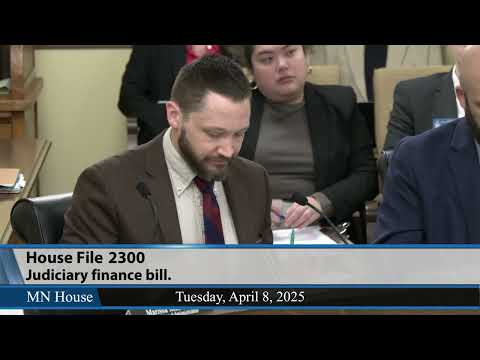
Judiciary finance committee walks through HF2300 DE, staff outline spending plan and witnesses urge more civil legal aid funding
Summary
On April 8 the Minnesota House Judiciary Finance and Civil Law Committee reviewed the DE amendment to House File 2300, heard nonpartisan staff describe funding recommendations and policy changes across articles 1–5, and received testimony pressing for greater state investment in civil legal services.
St. Paul — The Minnesota House Judiciary Finance and Civil Law Committee on April 8 conducted a walkthrough of the DE amendment to House File 2300 (DE A25-61), reviewing funding recommendations for judicial branch agencies and several substantive policy changes, and heard testimony urging additional funding for civil legal aid.
Nonpartisan fiscal staff John Walz told the committee the recommendation meets the committee's $30 million target above forecast for the 2026-27 biennium and carries another $30 million into the 2028-29 biennium. "The total spending for this committee with the base plus increases, is 717,278,000 in fiscal 26," Walz said as he summarized line-by-line items in the spreadsheet provided to members.
Why it matters: The DE merges budget adjustments for the Supreme Court, district courts, appellate offices, the Board of Civil Legal Aid and other judicial entities with a set of statutory and administrative changes across five articles. Committee members and outside witnesses said the bill will shape how courts and legal services operate and how some personal data is handled, while advocates argued the recommended funding still falls short of service needs.
Key budget and agency details
Walz told the committee the Supreme Court has a base of $49 million per year and the DE adds several items, including a $867,000 per-year insurance and compensation increase, a one-time $3.5 million appropriation for cybersecurity, $1,124,000 one-time for digital accessibility, and $4,000,000 for a "justice partner access" request tied to document access. The Board of Civil Legal Aid was described as having a $34 million base with a $1,186,000 annual increase for insurance and compensation.
For district courts, Walz said the base was $384 million and the DE includes an $8.4 million annual increase for insurance and compensation, plus one-time allocations including $10,634,000 for psychological services deficits (available four years), $2,580,000 one-time for interpreter deficits (four years), and $1,576,000 for jury pay deficits (four years).
Walz said several one-time needs are funded in part by cancellations to current biennium balances: $2,000,000 reduction to appellate counsel for parents, $10,000,000 cancellation from the cannabis expungement board, and $11,000,000 from the competency attainment board. He summarized the package as meeting the committee target while relying on those cancellations.
Policy provisions summarized by staff
Nonpartisan staff also walked members through statutory language in the DE.
- Mr. Johnson summarized Article 1 through Article 4. He highlighted section 19 in Article 1, which "authorizes the courts to charge private attorneys a fee for certain access to information and documents through the court's electronic portal," and said this ties to a separate Representative Hudson bill. He summarized other sections drawn from multiple House files, including expanded confidentiality for restorative justice participants, reporting requirements for the Board of Civil Legal Aid and the Guardian ad Litem Board, amendments concerning conservator reports, foreclosure-notice changes effective Aug. 1, 2025, and technical changes tied to the Competency Attainment Board and the Statewide Office of Appellate Counsel and Training.
- Mr. Hopkins walked Article 5 (government data practices). He said the DE contains new language allowing responsible authorities to suspend data requests if requesters fail to inspect produced data; prohibits parents' personal contact information from being designated publicly available directory information under the Government Data Practices Act and FERPA; narrows a real-property privacy mechanism for judicial officials so it does not include employees of the Minnesota judicial branch; and allows EMS to share overdose data with the Washington-Baltimore HIDTA overdose-detection mapping application program.
Testimony: civil legal aid funding and county concerns
Several witnesses urged the committee to increase state funding for civil legal services.
Dan Morris, executive director of Central Minnesota Legal Services, described the statewide civil legal services network and said the system remains unable to meet demand. "Over the last 4 years as a system statewide, we've increased staffing by 10% but yet as of today, we're still only able to serve 45% out of eligible clients that reach out to us," Morris said. He urged continued investment, noting the role legal aid plays in housing stability, child safety and access to benefits. Morris said prior state investments reduced turnover and improved competitiveness for staff pay; he also cited an estimate that "for every $1 invested in civil legal aid, the community sees a return of $4.32."
Jonah Giese, a legal advocate at the Minnesota Disability Law Center and president of Mid Minnesota Legal Aid Workers Union Local 529 (AFSCME Council 5), asked the committee for a larger, transformational investment and asked members to consider funding levels proposed in House File 1373. Giese described staffing strain, burnout, and pay gaps between legal aid and public defenders.
Nathan Zacharias, technology policy analyst with the Association of Minnesota Counties, spoke to the judicial safety provision in Article 5 that would allow certain judicial officials to make personal information in real property records private. Zacharias said counties appreciate narrowing the scope to judges and their families but urged the committee to consider county costs of implementation. He said his office surveyed counties and received estimated redaction or masking costs ranging from about $200 to $3,000 per property and recommended the committee consider offset language or an exclusive remedy to limit county liability.
Committee procedure and next steps
Chairs said no formal action was intended at the April 8 hearing: the session was a walkthrough and public testimony opportunity. Committee staff noted the deadline for member amendments to the DE is 4 p.m. on the following day; the committee expects to adopt the DE and take amendments when it reconvenes. Early in the hearing the committee approved the minutes of April 3 by voice vote; a formal floor vote on the DE was not taken.
What was not decided
Committee members emphasized the hearing did not produce final votes on HF2300. Several members acknowledged the limits of the committee target and said the package tries to distribute scarce resources across agencies rather than fully restoring compensation to all employees.
The committee will take official action, including adopting the DE and considering amendments, at its next meeting.