Get Full Government Meeting Transcripts, Videos, & Alerts Forever!
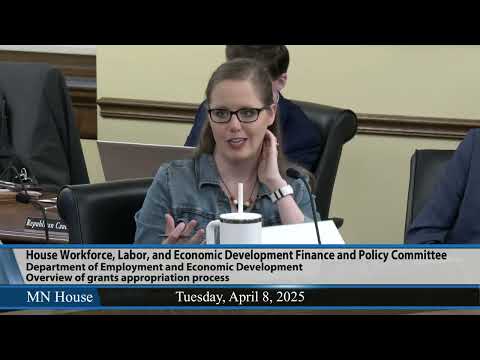
House committee hears OLA critique of DEED grants oversight; DEED says fixes underway
Summary
The Minnesota House Workforce, Labor and Economic Development Finance Policy Committee on April 8 heard a presentation from the Department of Employment and Economic Development (DEED) and an evaluation from the Office of Legislative Auditor (OLA) that together highlighted strengths in broadband contract compliance and shortcomings in DEED’s monitoring and performance measurement for workforce grants.
The Minnesota House Workforce, Labor and Economic Development Finance Policy Committee on April 8 heard a presentation from the Department of Employment and Economic Development (DEED) and an evaluation from the Office of Legislative Auditor (OLA) that together highlighted strengths in broadband contract compliance and shortcomings in DEED’s monitoring and performance measurement for workforce grants.
The OLA told the committee that while broadband grantees largely met contract speed and location goals, DEED failed to comply with several Office of Grants Management (OGM) oversight requirements for the grants the auditors reviewed. OLA staff also concluded that statutory performance metrics for several workforce grants are not useful without measurable performance goals and that DEED did not complete a statutorily required net-impact analysis on workforce programs on schedule.
The findings matter because DEED administers dozens of programs and hundreds of millions of dollars in state grant funding. DEED officials told the committee the agency has administered more than 30 competitive grant programs totaling about $163,000,000 and 136 direct appropriations totaling about $268,000,000 in recent years, and pledged to strengthen monitoring and to work with the Legislature on measurable workforce goals.
DEED presentation and controls
Mark Majors, DEED deputy commissioner for workforce development, told the committee DEED uses a mix of competitive requests for proposals and direct appropriations and follows statutory RFP timelines, community engagement sessions, conflict-of-interest disclosure forms and pre-award risk assessments. “We take our responsibilities very seriously about being good stewards of the taxpayer dollars,” Majors said.
Majors described several elements of DEED practice: community reviewers comprise at least 25% of RFP reviewers and receive conflict-of-interest certifications; a pre-award risk checklist that includes…
Already have an account? Log in
Subscribe to keep reading
Unlock the rest of this article — and every article on Citizen Portal.
- Unlimited articles
- AI-powered breakdowns of topics, speakers, decisions, and budgets
- Instant alerts when your location has a new meeting
- Follow topics and more locations
- 1,000 AI Insights / month, plus AI Chat