Get Full Government Meeting Transcripts, Videos, & Alerts Forever!
Get email alerts on the Grants Management topic
No spam. Unsubscribe anytime.
House committee hears OLA critique of DEED grants oversight; DEED says fixes underway
Summary
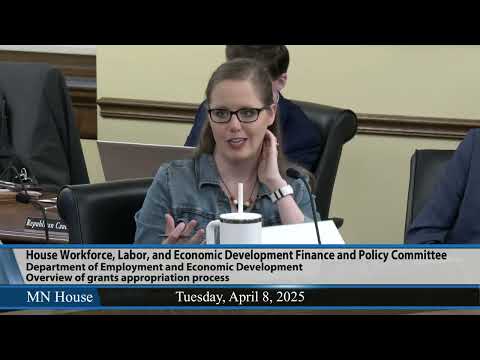
The Minnesota House Workforce, Labor and Economic Development Finance Policy Committee on April 8 heard a presentation from the Department of Employment and Economic Development (DEED) and an evaluation from the Office of Legislative Auditor (OLA) that together highlighted strengths in broadband contract compliance and shortcomings in DEED’s monitoring and performance measurement for workforce grants.
The Minnesota House Workforce, Labor and Economic Development Finance Policy Committee on April 8 heard a presentation from the Department of Employment and Economic Development (DEED) and an evaluation from the Office of Legislative Auditor (OLA) that together highlighted strengths in broadband contract compliance and shortcomings in DEED’s monitoring and performance measurement for workforce grants.
The OLA told the committee that while broadband grantees largely met contract speed and location goals, DEED failed to comply with several Office of Grants Management (OGM) oversight requirements for the grants the auditors reviewed. OLA staff also concluded that statutory performance metrics for several workforce grants are not useful without measurable performance goals and that DEED did not complete a statutorily required net-impact analysis on workforce programs on schedule.
The findings matter because DEED administers dozens of programs and hundreds of millions of dollars in state grant funding. DEED officials told the committee the agency has administered more than 30 competitive grant programs totaling about $163,000,000 and 136 direct appropriations totaling about $268,000,000 in recent years, and pledged to strengthen monitoring and to work with the Legislature on measurable workforce goals.
DEED presentation and controls
Mark Majors, DEED deputy commissioner for workforce development, told the committee DEED uses a mix of competitive requests for proposals and direct appropriations and follows statutory RFP timelines, community engagement sessions, conflict-of-interest disclosure forms and pre-award risk assessments. “We take our responsibilities very seriously about being good stewards of the taxpayer dollars,” Majors said.
Majors described several elements of DEED practice: community reviewers comprise at least 25% of RFP reviewers and receive conflict-of-interest certifications; a pre-award risk checklist that includes verification of unemployment insurance status and Secretary of State registration; reimbursement-focused payments with limited cash advances in emergencies; quarterly progress reporting by grantees (DEED requires quarterly reports even though OGM policy requires at least annual reports); and monitoring visits for larger awards (DEED said it conducts an on-site monitoring visit before final payment for grants over $50,000 and at least annually for grants over $250,000).
OLE/OLA findings on workforce and broadband grants
Jody Munson Rodriguez, deputy legislative auditor, told the committee OLA reviewed select workforce and border-to-border broadband grants. “In this report, we did look at both compliance and performance,” she said. Mariam Nada, the OLA program evaluation manager who led the review, told members that for workforce grants the legislature and DEED have required collection of certain numeric performance metrics but have not set measurable program goals. “Without measurable goals, the metrics that state law requires DEED to report are not useful for measuring program success,” Nada said.
OLA analyzed participant-level data for the grants it reviewed. For about 2,600 participants in Pathways to Prosperity grants the auditors found roughly 63 percent had outcomes the auditors categorized as successful at exit (about 29 percent completed training and earned credentials and about 27 percent obtained new or better employment at exit). For more than 3,000 participants in certain legislatively named workforce grants, auditors found roughly 42 percent had successful outcomes (about 21 percent completed training and about 23 percent had new or better employment at exit). OLA emphasized it could not say whether those outcomes meet legislative intent without measurable program goals and warned that a statutory net-impact analysis intended to estimate program effects relative to nonparticipants was overdue.
On broadband, OLA reported grantees generally met contractually defined location and speed goals; OLA noted DEED contracts with third-party validators that confirmed infrastructure met contract specifications.
Oversight and compliance gaps identified
OLA reported multiple OGM—Office of Grants Management—policy violations in its sample of DEED grants. Key findings presented to the committee include:
- DEED collected only about half of required progress reports for grants in the sample and did not collect required progress reports before some payments.
- OGM policy prohibits payments when progress reports are past due; OLA reported DEED paid at least $5,000,000 to grantees with past-due progress reports in the sampled grants.
- OGM requires annual onsite monitoring for grants over $250,000; OLA found DEED did not monitor any of its 11 broadband grants above that threshold within the first year of the awards.
- DEED did not complete grant closeout evaluations for many of the grants sampled, and those that were completed sometimes lacked required information.
DEED response and committee questions
Majors and other DEED officials acknowledged shortcomings the auditors identified and attributed several gaps to the COVID-era operating environment and to staffing turnover. Majors said DEED had relied more on desk reviews during the pandemic and that the department has hired additional monitoring staff over the last two years, is providing monitoring guides to grantees in advance and is conducting more frequent reviews. On broadband, DEED staff said construction season timing and supply-chain delays affected when monitoring visits could occur.
When asked about the OLA finding that at least $5 million had been paid to grantees despite past-due progress reports, DEED officials said they review invoices against program enrollment records and other documentation before processing reimbursements and that monitoring and reporting practice has tightened since the pandemic-era lapses. Majors told the committee the agency would provide follow-up information when requested.
Several legislators pressed DEED on performance goals and the missed net-impact analysis, and a number urged a collaborative, statutory-level effort to set measurable workforce goals that reflect the different populations served by grants (for example, reentry populations, youth or English learners). Representative Patty Mueller and Representative Jamie Greenman were among members who asked DEED to return with concrete proposals and additional data; DEED officials agreed to work with the committee and stakeholders on goal-setting and to pursue the required net-impact analysis using an external evaluator.
What the committee heard about next steps
DEED told the committee it will:
- Continue to staff up monitoring functions and conduct more on-site monitoring where appropriate.
- Work with the Legislature and community partners to develop measurable performance goals for workforce grant programs, recognizing different populations and program types may require different targets.
- Issue or plan for an RFP or third-party evaluation to complete the overdue net-impact analysis required by statute.
The OLA recommended the Legislature direct DEED to establish measurable goals for workforce grant programs and recommended DEED ensure program staff comply with all OGM monitoring and reporting requirements.
The committee continued its discussion about broader budget pressures and the timing of bills but did not take further formal action on DEED or OLA recommendations at the April 8 hearing. DEED and the OLA staff remained available for follow-up questions after the presentation.
Ending
Committee leaders thanked OLA and DEED staff for the presentations and said members expect DEED to provide follow-up information on monitoring, the overdue net-impact analysis and examples of proposed workforce performance goals before the committee advances related budget or policy changes.