Get Full Government Meeting Transcripts, Videos, & Alerts Forever!
Get email alerts on the Ems Funding topic
No spam. Unsubscribe anytime.
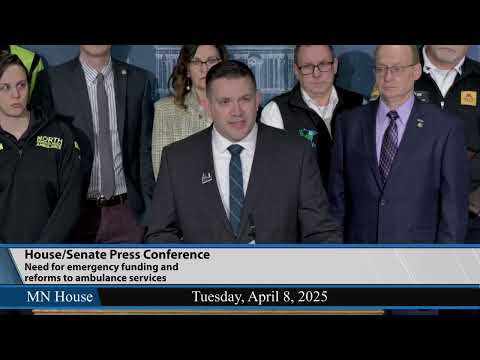
Minnesota EMS leaders push Legislature for roughly $50 million, higher Medicaid rates to shore up rural ambulance services
Summary
Emergency medical services providers, local officials and lawmakers told legislators the state's ambulance system is under severe financial strain and urged roughly $50 million in annual state funding plus higher Medicaid reimbursement and continued workforce scholarships to prevent rural service closures.
Emergency medical services providers, local officials and state lawmakers warned that Minnesota's ambulance system is strained and urged the Legislature to approve roughly $50 million in new annual funding and higher Medicaid reimbursement rates to stabilize rural services.
"These are our neighbors, friends, and family members. Real people in the need, real people in need of help during their most vulnerable moments," Michael Johnson, president of the Minnesota Ambulance Association and community paramedicine coordinator for Mayo Clinic Ambulance, said while outlining the scope of the problem. Johnson said the association represents over 90% of ground ambulance volume in Minnesota and that ground ambulance services served more than 600,000 Minnesotans in 2024.
The ask: short-term emergency funding plus policy changes
Advocates described two central problems: funding and workforce. Johnson said the association's priority this session is "a roughly, $50,000,000 increase [in] Medicaid reimbursement rates to reflect the true cost of providing emergency medical care" and continued support for workforce programs such as EMT and paramedic scholarships, first-responder training and high-school EMS programs.
"This is a moral imperative issue," Sen. Grant Hochschild, who represents a large rural district, said, arguing that rural areas cannot sustain ambulance services under current funding and payer mixes. Hochschild and other lawmakers said they are pursuing both federal advocacy to change Medicare/Medicaid reimbursement and state-targeted aid to shore up rural services if federal rates do not change.
What advocates say is broken
Speakers described a model in which ambulance services are paid primarily when patients are transported to an emergency department, while readiness costs'keeping ambulances, equipment and trained staff available 24/7'are not reimbursed. Becca Huebsch, director of Perham Area EMS, said, "Our model is broken," and explained that her rural service covers about 400 square miles and is paid only for transports even when crews respond, assess or treat on scene.
Advocates cited a 2023 Office of EMS study that identified about $120 million in combined operational deficits and volunteer subsidy value statewide; Johnson said roughly half of that figure was operational deficit reported by services. Last year the state provided about $24 million in one-time rural aid, which speakers said helped but did not address longer-term shortfalls.
Local impacts and programs
Perham Area EMS reported it received about $192,000 from last year's state aid and used it to remount an aging ambulance chassis; Huebsch said the service's need that year was closer to $500,000. Bradley Peterson, executive director of the Coalition of Greater Minnesota Cities, stressed that many ambulance licenses are held by local governments and that unrecovered costs fall on city property taxpayers.
Advocates highlighted workforce programs funded last year.
"The paramedic scholarship that was put out, through higher ed, you can apply for up to $5,000 per year to go to paramedic school as an existing EMT. That program was hugely successful," a speaker representing EMS partners said. Speakers also described new pilot operations: the Sprint paramedic program (described in the discussion as "Sprint Medics") has started operations in Otter Tail and Grant counties and a separate program in St. Louis County; Perham is among seven ambulances participating in a West Central Minnesota pilot and began operations about a week and a half before the meeting.
Concerns about payer mix and private providers
Panelists said government payers (Medicare and Medicaid) have grown as a share of ambulance revenue and that current rates often do not cover costs. Johnson and other speakers said even some urban services are operating on thin margins and that profit in the industry has largely eroded.
"So it's not true anymore that that EMS services are net profit in Minnesota," Scott Sampi, chief of North Memorial Ambulance, said, describing narrow margins even in higher-volume metro operations.
Policy options and legislative hurdles
Speakers and legislators discussed several policy options under consideration: a state-targeted rural aid package, a possible 10% Medicaid rate increase proposal mentioned by advocates, creation of special taxing districts to share costs across service territories, and continued investment in workforce scholarships and training. Senators and representatives acknowledged ongoing negotiations in health and human services omnibus bills and said lawmakers must decide revenue sources and whether ongoing funding will be dedicated.
No formal votes or legislative actions were recorded during the session; participants urged lawmakers to resolve outstanding negotiation "roadblocks" in conference committees so funding can move forward before adjournment.
Why it matters
Advocates said staffing shortages, volunteer declines and underfunding translate to longer response times and greater risk to patients, particularly in rural areas where distances are large and populations skew older and toward Medicare/Medicaid coverage. They urged the state to target aid to rural communities while pursuing federal changes to Medicare/Medicaid reimbursement.
Looking ahead
Speakers said negotiations were ongoing in the Legislature, with competing priorities and limited state revenue requiring difficult choices. They asked for continued state commitment to emergency medical services funding and for lawmakers to weigh targeted rural aid, reimbursement changes and workforce investments in coming budget and policy decisions.