Get Full Government Meeting Transcripts, Videos, & Alerts Forever!
Get email alerts on the Infrastructure Resilience topic
No spam. Unsubscribe anytime.
Ventura county bill requiring water-district preparedness cleared by committee amid cost concerns
Summary
AB 3607 would require water suppliers in Ventura County’s high-fire-risk areas to top tanks during red-flag warnings, have backup generators ready to run pumps and harden pump infrastructure. The committee advanced the district bill despite opposition from water agencies citing cost, operational complexity and liability concerns.
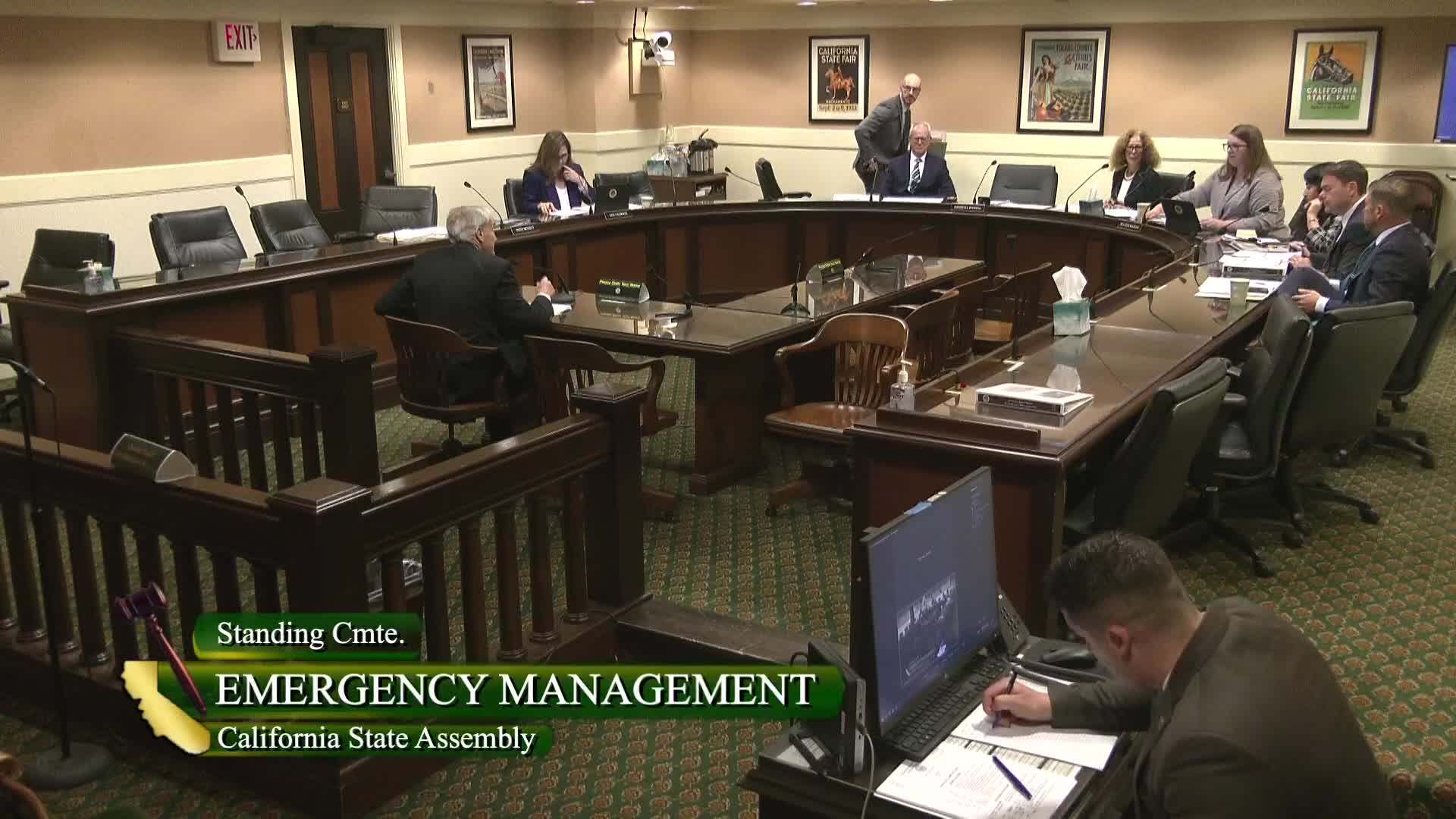
The committee advanced AB 3607, a district bill by Assemblymember Bennett, requiring minimum preparedness steps for water suppliers in Ventura County’s high fire‑risk areas. The measure was approved and referred to the Committee on Utilities and Energy.
Bennett outlined three core requirements: (1) have storage tanks topped when a red-flag warning is issued; (2) maintain backup generators or contracted mobile generation capable of running pumps immediately when power is shut off; and (3) harden pump and generator installations to reduce risk that pumps burn during a wildfire. Bennett said the requirements are aimed at preventing the repeated scenario in which water tanks sit low, pumps cannot run after power loss and spot fires then grow into structure losses.
The author described local experience in the 2017 Thomas Fire, saying tanks were not topped and generators were not staged; he said those failures contributed to homes burning and urged the committee to require the preventive measures for high‑risk districts. He said the bill applies to Ventura County only and that county supervisors and other local legislators supported the measure.
Opposition and concerns: The Association of California Water Agencies (ACWA) and several local water districts opposed the bill as printed, urging amendments. ACWA argued the bill lacks sufficient funding, would in some cases impose substantial generator costs on agencies and customers and could transfer operational decisions away from state‑certified water operators. ACWA noted existing mutual-aid and resource-sharing arrangements for generators and asked that operational flexibility and liability protections be added. The United Water Conservation District voiced similar cost concerns.
Author responses and outreach: Bennett described outreach to local districts and said many districts reported existing generator capacity; he said one district estimated a generator would cost about $250,000 and translate to roughly $2 per month per ratepayer spread over time. Bennett said FEMA mitigation funding could cover some hardening costs and that the bill includes flexibility on timelines and contracting for generators where procurement constraints exist.
Committee deliberations: Members questioned the cost burden on ratepayers and the precedent of imposing state standards on local special districts. One member said she would support a district-specific bill but urged more precise cost estimates and further negotiation with water agencies. Bennett agreed to continue working with stakeholders.
Vote and next steps: The committee recorded the motion as due pass to the Committee on Utilities and Energy; the roll call recorded a 6–1 vote in favor with one member dissenting. The bill will proceed for fiscal and policy review in the next committee.