Get Full Government Meeting Transcripts, Videos, & Alerts Forever!
Get email alerts on the Public Safety Policing topic
No spam. Unsubscribe anytime.
Annapolis police report CALEA reinstatement and arrest in Clay Street homicide; outline Ward 6 crime trends and foot-patrol push
Summary
City police said the department was reinstated by the Commission on Accreditation for Law Enforcement Agencies and reported the arrest of a suspect in a Clay Street homicide. Command staff presented 2024 crime data for Ward 6 and emphasized expanded foot patrols and a tailored crime plan.
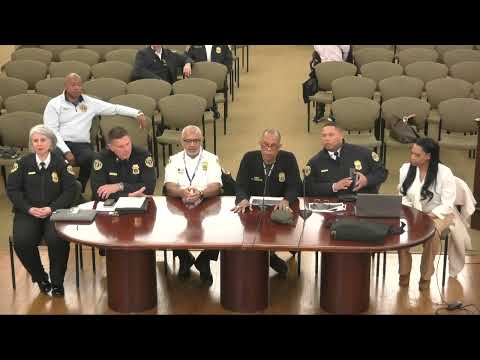
The Annapolis Police Department told the Public Safety Committee on April 2025 that it was reinstated by the Commission on Accreditation for Law Enforcement Agencies (CALEA) in March with no conditions and that detectives, working with federal partners, arrested a suspect in a Clay Street homicide.
Chief Keith, the city’s police chief, said the department was reinstated by CALEA “with no conditions,” and thanked command staff and civilian partners who worked on policy revisions and the accreditation submission. He identified Kayla Ziegler as a newly hired community advocate and singled out officers and staff who received department awards for the accreditation work.
The department also announced the arrest of Roscoe Jerome Jones in the morning hours of the same week. Chief Keith said U.S. Marshals, assisted by the Metropolitan Police Department of the District of Columbia, apprehended Jones “in the front of an apartment complex without incident” and that investigators believe he is implicated in the homicide on Clay Street and in incidents in neighboring jurisdictions. The chief said detectives will now refocus on unsolved cases.
Captain Scott Thacker and Operations Commander Lamar Howard presented crime statistics for Ward 6. They reported that Ward 6 accounted for about 11% of the city’s emergency responses in 2024 and that part‑1 violent crimes in the ward showed a pattern: a large share of aggravated assaults, rapes and some robberies involved domestic or partner-on-partner incidents, and a number of burglaries involved people forcing entry into vacant apartments. The slides shown to the committee listed specific counts (for example, 925 calls for service in Ward 6 in 2024) and identified a corridor near President Street where roughly two-thirds of overdoses and a concentration of other incidents occurred.
Committee members pressed the department on patrol tactics. Chief Keith and Deputy Chief Stan Brantford said they plan to increase visible foot patrols as part of a data‑driven deployment model. “Give me 15, 20 minutes a day to actually walk,” Chief Keith said, describing the operational goal of routinely including short foot‑patrol assignments in officers’ tours of duty and capturing those patrols through body‑worn camera activation and radio check‑ins for accountability.
Alderman Karma O’Neil and Alderman Gay praised recent foot‑patrol activity on Clay Street and elsewhere and urged the department to sustain public communication about patrols. The chief said the department is developing ward‑specific crime plans—tailored responses based on local data—and that the full citywide crime plan will be shared with council leadership when ready.
Committee members also raised domestic violence as a recurring driver of several statistics for Ward 6. Lakisha Blue, who will assume duties for professional standards and internal investigations, said outreach and tailored materials (such as newsletters and safety pamphlets) can help neighbors support at‑risk individuals. The department said it intends to revive community education and targeted outreach around domestic violence and other recurrent problems.
The department briefly discussed technology and interagency partnerships, including drone and AI tools, but said community engagement and traditional problem‑solving remain central. Chief Keith asked the committee for time to review a University of Maryland workload study and to return with recommendations after command staff analysis.
The committee did not take a formal policy vote tied to the department’s crime plan during the meeting; members asked for follow‑up briefings and more detailed materials for public release.