Get Full Government Meeting Transcripts, Videos, & Alerts Forever!
Get email alerts on the Civil Service Appeal Cjis topic
No spam. Unsubscribe anytime.
Milwaukee civil service panel hears appeal of employee’s separation tied to CJIS security clearance
Summary
The Board of City Service Commissioners heard the separation appeal of Antoine Young on April 7, focusing on whether the City Attorney’s Office reasonably concluded Mr. Young could not perform essential duties because he lacked a CJIS security sponsorship.
The Board of City Service Commissioners heard the separation appeal of Antoine Young on April 7, focusing on whether the City Attorney’s Office reasonably concluded Mr. Young could not perform essential duties because he lacked a CJIS (Criminal Justice Information Services) security sponsorship.
The issue before the commission was whether the Department’s decision to separate Young, dated Dec. 11, 2024, was reasonable under the board’s rules and applicable civil service statutes. The City Attorney’s Office said Young’s job required unescorted access to the Police Administration Building and access to databases governed by the FBI’s CJIS security policy; Young’s counsel said the record shows he had performed the job for years and that the separation was pretextual.
Why it matters: The hearing pits the city’s obligation to protect criminal justice data and meet FBI audit requirements against an employee’s appeal of a personnel separation. The case touches on who may be granted access to law‑enforcement databases and what discretion the police department and city attorneys’ office may exercise when sponsoring non‑department personnel for CJIS access.
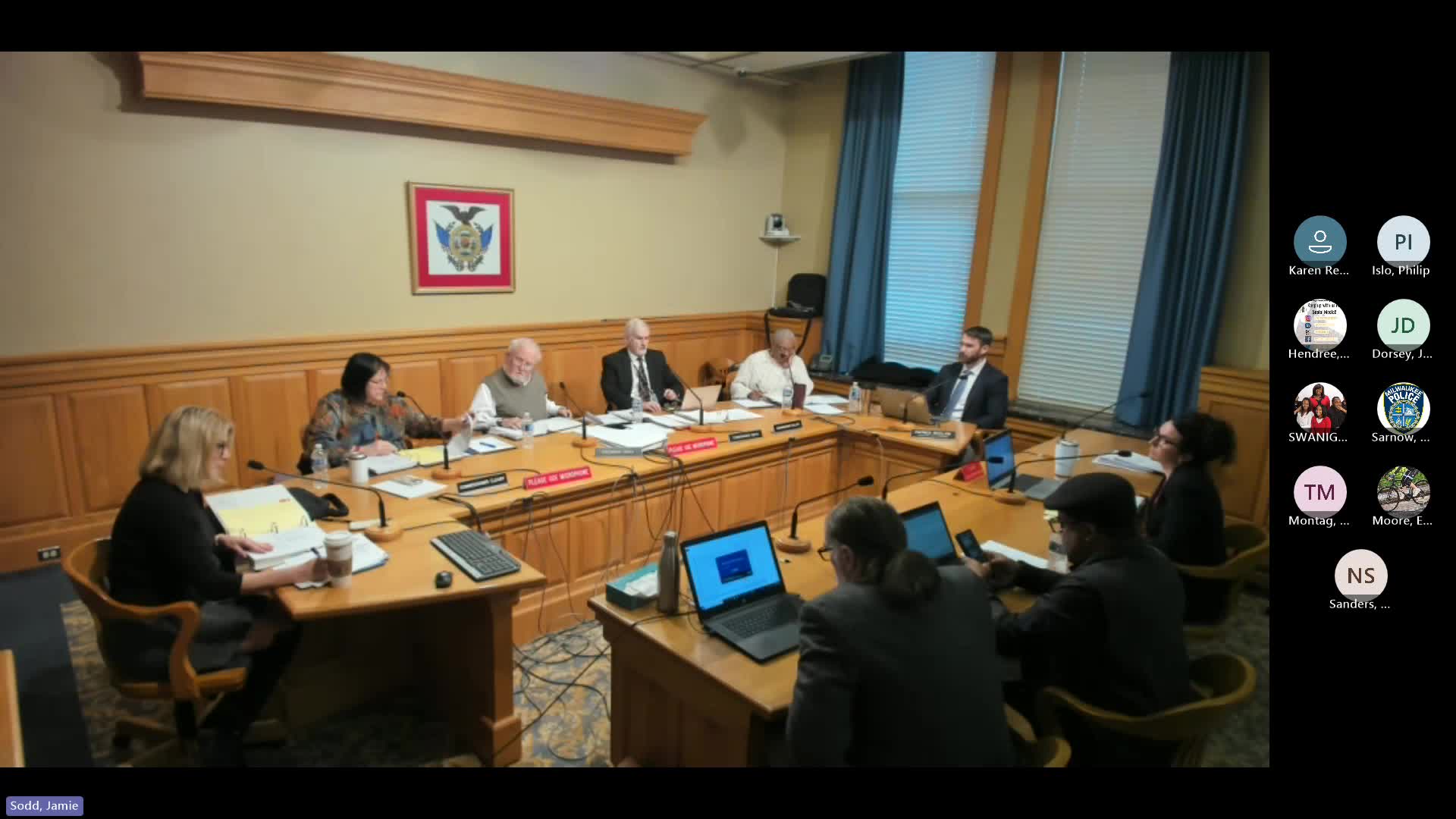
At the outset, President Frank Bach, presiding over the commission, outlined hearing procedure and warned that, "Typically, our deliberations are conducted in closed session, and then our decision is announced in open session." The commission heard argument over multiple exhibits the parties had stipulated and a smaller set they had not.
City attorneys presented evidence the position Mr. Young held — described in the job description as working both in the City Attorney’s main office and in the City Attorney’s Ordinance Enforcement Division (OED) at the Police Administration Building — required secure access and the ability to use specialized prosecutorial software. Assistant City Attorney Catherine Headley told the commission the position entailed functions tied to OED’s tools and that, in her view, those functions could not be performed without the required CJIS tiers of access.
Assistant Chief Craig Sarno of the Milwaukee Police Department testified that the department enforces CJIS requirements and that the FBI posts a CJIS security policy that local agencies must follow. On the policy document shown to the commission, Sarno said, "This is the policy that the FBI has posted on their website," and described the policy as a living document that defines tiers of access (network access, law‑enforcement database access and physical access to secure floors of the Police Administration Building).
Sarno testified he reviewed Young’s criminal record and said the applicant’s record included multiple misdemeanor convictions and several felony charges from earlier years. He told commissioners that, given the number and nature of those records, the department would not have sponsored Young for CJIS access in 2022 and, in his view, would have denied sponsorship if presented the same record today.
Young’s attorney, Ben Hitchcock Cross, countered that Young had performed the duties for roughly three and a half years and described the department’s most recent action as inconsistent. Cross argued the city’s stated rationale was pretextual: "Either it's impossible for him to do his job or it's not. It's just like being pregnant, you can't do it halfway," he told the commission, urging reinstatement.
Procedural rulings and evidence: The commission handled several evidentiary disputes. Attorney Hitchcock Cross objected to the city’s use of a highlighted copy of the FBI CJIS policy, saying the highlights were argument, not evidence: "The highlights are not evidence," he said. The commission deferred authentication of two unstipulated exhibits until a police witness could explain provenance, then called Assistant Chief Sarno to authenticate the CJIS policy and the department’s sponsorship form (a PLAD/PL‑8E form). President Bach ruled the policy exhibit would be admitted for the record; later during testimony he admitted the CJIS policy copies (DU1 and DU1a) into evidence as part of the record.
The commission also admitted a seven‑page decision by a Wisconsin Equal Rights Division hearing examiner concerning a Milwaukee Police Department hiring decision to the record as a nonbinding administrative decision and labeled it as part of the background material; the commission said such administrative decisions are not precedential but may be considered for context.
Witness management: At the appellant’s request the commission ordered sequestration of witnesses (the usual "rule" of excluding witnesses from hearing testimony) and instructed staff to attempt to remove nonessential remote listeners who were identified as potential witnesses. Commissioners discussed practical limits of sequestration in a hybrid meeting; President Bach said sequestration would apply to witnesses but not to parties or certain department designees.
What did the commission decide? No final decision was announced on April 7. Commissioners proceeded through the hearing’s evidentiary and testimonial stages and set ground rules for testimony and evidence handling. The commission did approve routine meeting business earlier in the session — the minutes of the March 25, 2025 meeting were moved, seconded and approved by roll call (Commissioners Miller, Smith and Cleary voting yes). President Bach told the parties that deliberations are normally held in closed session and that any formal outcome would be announced in open session at the conclusion of deliberations.
Next steps: The hearing schedule allows for adjournment at 12:30 p.m. and resumption the following day if testimony continues; the commission indicated it might resume in the early afternoon. The commission has not yet issued a final ruling on whether the department's separation of Antoine Young was reasonable under the rules and applicable statutes.
Speakers quoted or central to testimony in this article are included in the accompanying speaker list and all quoted material is drawn from the hearing transcript.