Get Full Government Meeting Transcripts, Videos, & Alerts Forever!
Get email alerts on the Zoning Text Amendment Rt5 topic
No spam. Unsubscribe anytime.
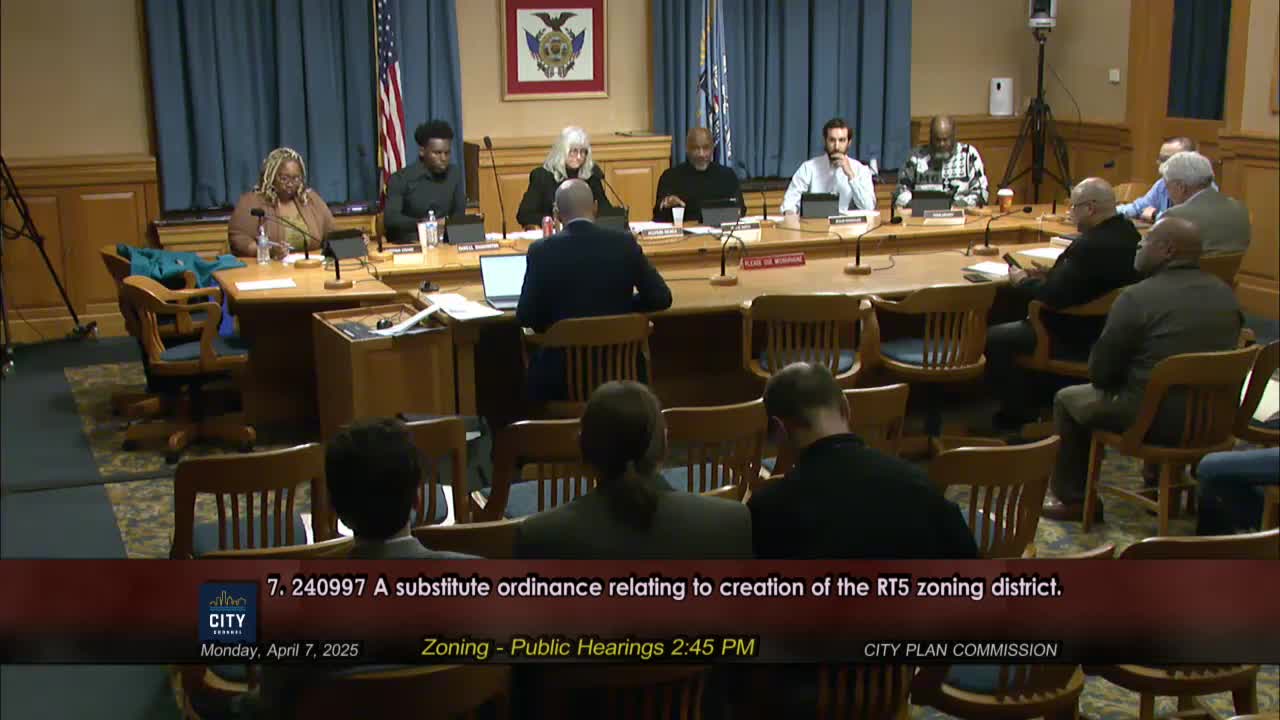
Plan Commission rejects proposal to create unmapped RT5 zoning district after extended public comment
Summary
The commission voted 4–1 to recommend denial of the proposed RT5 zoning-text amendment that would have created an unmapped district allowing up to eight units; the meeting included extensive public comment focused on engagement, displacement risk and access to financing.
The Milwaukee City Plan Commission on April 7 recommended denial of a zoning-text amendment that would have created a new RT5 residential district allowing up to eight dwelling units on qualifying lots. The vote on file 240,997 was 4–1 in favor of denying the ordinance as drafted.
City staff described the proposed RT5 district as similar to RT4 but permitting up to eight units and carrying design controls such as lot-width maxima and limits on driveway curb-cut widths. Staff emphasized that the RT5 district would be unmapped at adoption — meaning the code change alone would not rezone any properties — and that any later rezoning to RT5 would follow the existing map-amendment process and neighborhood notification requirements.
Council President Michael J. Perez and Alderman Ormond Baumann, sponsors of the text amendment, said they view RT5 as a “toolbox” to allow “missing middle” housing on a case-by-case basis. Perez said the district is intended to be used in appropriate locations, such as corners, double lots or walkable corridors, and said changes would still require common-council approval.
The hearing drew extensive public testimony. Dozens of residents and neighborhood representatives spoke, opposing the proposal or urging stronger protections. Speakers raised concerns about insufficient early community engagement, potential for speculative investors to buy and redevelop properties, displacement of long-term residents and uncertainty about how affordable housing or owner-occupancy would be ensured. Several witnesses urged postponement until the city develops paired policies to support local developers and anti-displacement measures.
Commission discussion focused on two themes: the policy merits of creating an unmapped RT5 that could be applied parcel-by-parcel, and whether the plan commission should require additional process protections before the zoning text is adopted. Commissioners acknowledged arguments on both sides. Several commissioners said RT5 has potential value but that the commission lacked sufficient implementation detail and safeguards to adopt it at this time.
Commissioner Jesus Gonzales moved to deny the RT5 ordinance (file 240,997); Commissioner Tariq Moody seconded. Roll call: Renell Washington, Katrina Crane, Tariq Moody and Jesus Gonzales voted to deny; Willie Smith voted no. The motion to recommend denial passed 4–1.
The denial does not change the city’s existing RT4 rules or preclude future proposals; sponsors and staff indicated that any subsequent proposal to map RT5 to a specific parcel would still require neighborhood notice and public hearings under the zoning map-amendment process.