Get Full Government Meeting Transcripts, Videos, & Alerts Forever!
Get email alerts on the Education Funding topic
No spam. Unsubscribe anytime.
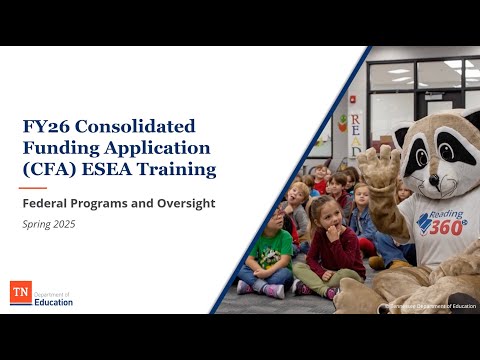
Tennessee Department of Education issues FY26 ESSA consolidated funding application guidance to LEAs
Summary
A Tennessee Department of Education webinar reviewed FY26 consolidated funding application (CFA) rules and platform changes for ESSA grants, covering budget tags, allocation limits, homeless set‑asides and reporting, Title‑specific reminders, and submission deadlines.
The Tennessee Department of Education’s Federal Programs and Oversight Team provided a statewide webinar on the FY26 consolidated funding application (CFA) for Every Student Succeeds Act (ESSA) grants, reviewing budget and submission rules, platform changes in ePlan, and program‑specific requirements for Title I–V programs.
The session summarized new and continuing requirements LEAs must follow when completing the CFA, including the use of budget tags, transfer/consortium rules, administrative cost limits, special set‑asides for homeless students, and documentation and contact requirements for foster care, juvenile justice and private school equitable services. The department noted the CFA opened March 1; CFAs are tentatively due in May and must be approved by the department by July.
Key guidance and changes
Budget tags and platform changes: The presenter said LEAs must assign one budget tag per line item in most grants to indicate an item’s purpose and to enable new filtering and tracking tools in the CFA. Title IV private school instructional funds are an exception; the presenter said private school Title IV items may carry two budget tags. The department added a new budget tag summary page that aggregates tags across the LEA budget.
Transfers and administrative limits: The webinar reviewed the CFA allocation (transfer) page. The presenter said LEAs that use consolidated administration must observe automatic calculations of administrative costs; if not using consolidated administration, LEAs must tag administrative costs in each grant and document them clearly in budget narratives. The presenter stated a 20% limit applies to consolidated administration transfers for several programs and that Title III and Title IV have a 2% direct administrative limit; indirect costs and how they count toward those limits were addressed specific to the grant and noted as a point to document in budget narratives.
Personnel and budget narratives: The presenter emphasized budgets and narratives must be reasonable, necessary and allocable to the program; personnel entries should list position titles (not employee names) and consistent FTEs across CFA pages. Large LEAs may upload personnel via an Excel sheet for the regular school year; if an upload is used, detailed per‑position rows are not required except for summary columns identified in ePlan.
Title I program rules (PPA, set‑asides, homeless students): The presenter reviewed school selection and per‑pupil allocation (PPA) rules, including options for districtwide rank, grade‑span ranking and the 35%/40% thresholds that affect schoolwide program eligibility and waivers. The presenter said no school can receive less than $100 in PPA funding and noted a rule about column G on the PPA page related to remaining balances (the presenter instructed LEAs to follow the numeric constraints shown in ePlan). District set‑asides must benefit Title I schools across the LEA except for the homeless set‑aside; parent and family engagement set‑asides must distribute 90% to Title I schools and may retain 10% at the LEA level.
McKinney‑Vento (students experiencing homelessness): The department explained required homeless set‑asides under Title I Part A and allowable uses aligned with McKinney‑Vento subgrants. A new CFA field will collect the LEA homeless liaison headcount (FTE) and any staff carrying out McKinney‑Vento duties; the department said it must report those FTE counts and that the liaison position may be supported with Title I Part A or other funds. LEAs were asked to document how homeless set‑aside amounts were determined and to list community partners and transportation arrangements for students experiencing homelessness. The presenter noted ePlan will prepopulate homeless student counts from February 2025 data.
Foster care, juvenile justice and other contacts: LEAs must enter a foster care point of contact and the number of students in foster care and best‑interest determinations completed at the time of CFA completion. Juvenile justice points of contact are required for all LEAs regardless of local high school presence; the presenter asked districts to confirm those contacts in the LEA address book.
Title II–V reminders and program specifics: The presenter reviewed Title II requirements for meaningful consultation and high‑quality, job‑embedded professional development; Title III rules that federal funds must supplement (not supplant) state and local funds and that only active English learners (with exceptions for immigrant students) may be served; Title IV requirements that LEAs receiving $30,000 or more must conduct a needs assessment, spend at least 20% on well‑rounded activities and 20% on safe and healthy activities, and dedicate at least 1% to effective use of technology with a cap (the presenter referenced a 15% infrastructure limit within the effective technology portion). The department also reviewed Title V, Part B allowable uses and reminded LEAs these funds must supplement, not supplant.
Private school equitable services: The presenter outlined the CFA pages that summarize nonpublic survey results and said LEAs must complete the private school consultation affirmation or the final agreement; if the final agreement cannot be uploaded with the initial CFA submission, it must be uploaded to the LEA document library by Sept. 15, 2025.
Documentation, timelines and contacts: The presenter repeatedly urged LEAs to provide clear justifications in budget narratives (especially for administrative costs), to remove duplicate student records when uploading eligibility files (student IDs only; no PII), and to follow ePlan’s upload and page constraints. The webinar listed department contacts, including finance consultants and ESSA points of contact, and advised LEAs to contact Leslie Watson for additional assistance on Title I questions. The presenter also directed listeners to the department’s FY26 resources, a federal spending handbook, and an ePlan guide. Finally, the presenter provided a fraud, waste and abuse hotline and website for reporting concerns.
Why this matters
The CFA determines LEA allocations and documents compliance with ESSA and related federal statutes; the department’s clarifications about budget tags, set‑asides, administrative cost calculations, and new data fields for McKinney‑Vento liaison FTEs affect how districts allocate funds and report staff and expenditures. Missing required information or misapplying allocation rules can delay approvals and affect grant spending.
What LEAs should do next
LEAs should review the FY26 CFA guidance in ePlan, confirm contacts and required uploads, apply the correct budget tags, document administrative charges in budget narratives, verify PPA calculations and set‑aside determinations, and submit either the private school consultation affirmation or final agreement by the stated deadlines. LEAs with questions were directed to departmental contacts listed in the webinar.