Get Full Government Meeting Transcripts, Videos, & Alerts Forever!
Get email alerts on the State Government Finance Omnibus topic
No spam. Unsubscribe anytime.
Committee walks through HF 2783 omnibus; agency leaders warn cuts could harm services
Summary
The State Government Finance and Policy Committee met April 8 to walk through House File 2783 (DE2), the state government finance omnibus bill, and heard agency and stakeholder testimony warning that proposed reductions could curb cybersecurity coordination, tax processing and other statewide services.
The State Government Finance and Policy Committee met Tuesday, April 8, for a walkthrough of House File 2783, the state government finance omnibus bill as amended by the DE2, and heard testimony from agency leaders about potential service impacts.
Committee co-chair/acting chair Nash opened the session and the committee adopted the DE2 amendment before the walkthrough. Co-chair Cleburne said the committee would “walk through House file 2,783 as amended by the DE2,” take public testimony and return Thursday to mark up the bill and consider sending it to Ways and Means.
Why it matters: The bill packages funding and policy changes for most statewide central services — from Minnesota IT Services (MNIT) and Minnesota Management and Budget (MMB) to the Department of Revenue and the State Board of Investment. Several witnesses told the committee that reductions in the bill could reduce capacity to carry out cybersecurity coordination, tax processing and fraud prevention, pension reporting, and other functions that support state operations.
Minnesota IT Services: Brandon Hirsch, director of government relations for Minnesota IT Services, told the committee that MNIT’s “general fund base is our most agile and flexible funding source” and warned that reductions “may hinder MNIT’s ability to continue some of those strong leadership functions, including reduced capacity to support some of the cybersecurity coordination efforts that we play across local governments.” He also said cuts could limit the Minnesota Geospatial Office’s ability to provide current statewide datasets.
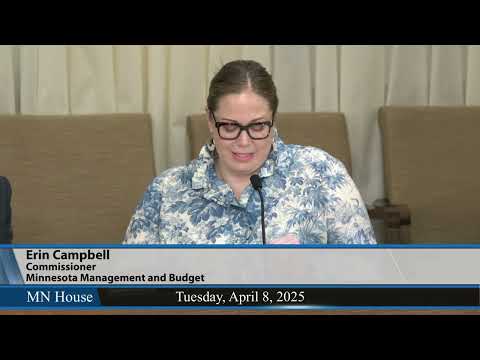
Minnesota Management and Budget: Erin Campbell, commissioner of Minnesota Management and Budget, said the DE2 provides an operating adjustment to MMB of $500,000 per year, below the governor’s proposed $891,000 in FY 2026 and subsequent years. Campbell asked the committee to consider the governor’s recommended levels and emphasized several oversight investments included in the governor’s package — internal controls and accountability, statewide payroll oversight, enterprise labor relations and accounting services — that MMB contends are needed to safeguard public funds.
Department of Administration: Tamara Grumbel, commissioner of the Department of Administration, thanked the committee for funding an increase in in-lieu-of-rent and for extending Capitol Mall design framework funding; she urged the panel to fund Governor Walz’s recommended operating increase so the department can meet growing costs for health care, compensation, utilities and IT. Grumbel also urged policy language to establish a state building renewable energy storage and electric vehicle account to leverage federal funds for upgrades at state facilities.
State employees and operations: Evan Bruce, director of legislative and political affairs for the Minnesota Association of Professional Employees (MAPE), representing about 18,500 state workers, said cuts to Administration and MNIT would “undermine their increased role in preventing fraud in agency and state government programs” and asked that agencies be “fully fund[ed] and equip[ped]” to do required work.
Department of Revenue: Lee Ho, deputy commissioner at the Department of Revenue, noted that the department administers more than 30 tax types that collect over $33,000,000,000 and process “over 6,000,000 transactions.” Ho warned that additional reductions “will impact service levels, state revenues and fraud prevention,” increasing wait times, delaying refunds and reducing audit and collection activities. Ho told the committee the department typically delivers more than $2 in collections for each dollar invested in audit and collection operations.
Attorney General’s antitrust capacity and stakeholders: Justin Stofferon, antimonopoly director at the Minnesota Farmers Union, thanked the committee for protecting recent investments in the Attorney General’s antitrust division and asked that the committee consider the attorney general’s proposed budget to increase antitrust capacity and convert the consumer litigation account to a revolving fund to support multistate litigation moving forward.
State Board of Investment: Jill Schurz, executive director and chief investment officer at the Minnesota State Board of Investment (SBI), asked the committee to reserve a provision from an earlier DE that would align treatment of mortgage- and asset-backed securities with statute for high-yield investments and to allow the board to modernize billing and reporting procedures. Schurz also requested flexibility on an annual report deadline to allow time for audit completion; she said the board’s annual audit often finishes after Dec. 31 and recommended a post-audit deadline rather than the statutory year-end date.
Committee actions and next steps: At the start of the meeting the committee approved minutes from April 3 by voice vote. The committee adopted the DE2 amendment and the amendment was “engrossed,” as noted on the record. Co-chair Cleburne asked that House File 2783, as amended, be laid over; the bill was laid over and the committee will reconvene Thursday to mark up the document and consider sending it to Ways and Means.
Discussion vs. decisions: Most testimony was advisory; commissioners and agency representatives raised potential operational impacts and requested funding or policy clarifications. No final appropriations were enacted at the hearing; formal committee action so far is limited to adopting the DE2 and laying the bill over for mark-up.
Observed concerns and clarifications: Witnesses repeatedly emphasized that reduced operating budgets could weaken fraud prevention, cybersecurity coordination, and customer service. MMB identified a gap between the DE2 operating adjustment and the governor’s recommended level for the agency; Revenue quantified operational scale (annual receipts and transaction counts) and warned of service impacts tied to further cuts. The State Board of Investment requested a statutory fix to align billing/reporting timelines with audit realities.
What’s next: The committee will return Thursday to mark up HF 2783 (DE2). Members said they will use feedback from today’s testimony as they negotiate funding levels in conference with the Senate.