Get Full Government Meeting Transcripts, Videos, & Alerts Forever!
Get email alerts on the Housing Affordability topic
No spam. Unsubscribe anytime.
Council housing committee hears testimony on bills to cap application fees and allow security-deposit installments
Summary
A City Council committee held a public hearing on two bills that would cap rental application fees at $20 and let tenants pay security deposits in four installments. City and tenant advocates praised the intent; city staff and landlord groups warned of unintended effects on small landlords and housing supply. The bills were held for further work.
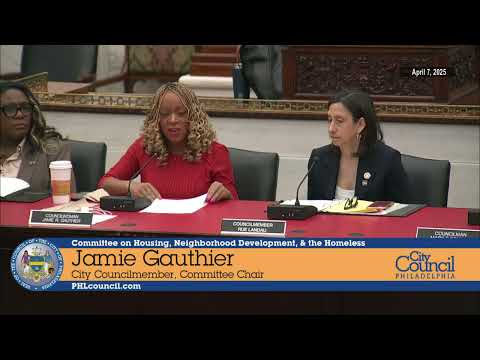
The City Council Committee on Housing, Neighborhood Development, and the Homeless on April 21 held a public hearing on two bills—Bill 250044 and Bill 250045—that would limit upfront moving costs for renters by capping application fees and allowing security deposits to be paid in installments.
The bills are part of what the sponsor described as a "move-in affordability plan" intended to reduce barriers for renters. Vice Chair Landau, the bill sponsor, told the committee the measures "cap application fees at $20 per application" and would let renters pay security deposits "in 4 installment payments," arguing the changes would give renters more financial breathing room and expand the pool of potential tenants.
Why it matters: Testimony showed broad agreement on the problem—many Philadelphians cannot afford the typical upfront costs to move—while revealing sharply different views about the best way to address it. Tenant advocates and organizations serving seniors and young people described how application fees and first-/last-/security-deposit requirements can block stable housing. City staff and landlord groups supported the bills' goals but warned of possible unintended consequences that could reduce rental options if not paired with other measures.
City staff: John Monlack, identified as first deputy chief of staff in the Department of Planning and Development, said the department "appreciate[s] the positive intent of the legislation" but cautioned it could create disincentives for some landlords. Monlack noted that the city recently launched "Fresh Start PHL," a pilot to assist move-in costs, and that the mayor's HOME initiative would propose additional supports. He testified that Fresh Start PHL provides the equivalent of three months' rent and up to $1,000 for relocation costs to eligible households, and he described the program's funding as "in the $17 million to $18 million" range while estimating average incidental moving costs at about $5,000 per household (he offered to provide firmer figures).
Tenant and senior advocates: Witnesses from the Senior Law Center, AARP Philadelphia, TURN (Tenant Union Representative Network), Covenant House Pennsylvania, and other advocacy groups urged adoption of the bills. Vincent Montoya Armanios of the Senior Law Center described clients who could not move because they lacked upfront funds and urged capping move-in costs. Raquan King of TURN said the package would "make housing more accessible to thousands of Philadelphians" and framed housing as a human-rights issue. Covenant House cited data on young adults' wages and said high move-in costs are a barrier to housing for youth experiencing homelessness.
Small and "mom-and-pop" landlords: Multiple small-scale landlords and landlord associations—including testimony from the Building Industry Association, the Pennsylvania Apartment Association, the Apartment Association and HAPCO (representing small owners)—said the bills' mechanics could increase financial risk for smaller owners and could push some out of the market. Those witnesses argued that security deposits provide a practical buffer for unpaid rent and property damage, that application fees cover screening and fraud prevention costs, and that forcing installment plans or capping fees could lead to higher rents, tighter screening standards or property sales to larger, out-of-state investors. Several landlords described long, costly eviction and enforcement processes as additional economic pressures.
Areas of cross-issue concern: Several witnesses and committee members raised three recurring points: • The need to protect small landlords who provide a large share of housing affordable to low- and moderate-income households (witnesses and staff repeatedly noted that roughly 65% of units affordable to households in the 25–80% AMI range are owned by smaller landlords). • The limited and rapidly depleted nature of existing rental-assistance funding, with witnesses saying that outreach and distribution logistics often determine whether someone actually receives help. • The importance of enforcement and outreach on existing laws governing security deposits. Advocates said current protections are often violated and that stronger enforcement or better tenant supports could be combined with any new law.
Committee action and next steps: The committee took testimony from a broad panel of city staff, tenant advocates, senior advocates, housing nonprofits and landlords. No vote to adopt either bill occurred at the hearing; committee leadership announced that the bills were "held" for further work and that council and stakeholders would continue to negotiate amendments and outreach. Committee members asked staff to provide additional details on program funding and delivery, landlord types reached by the Fresh Start program, and data on average move-in assistance amounts.
What the bills would do (as read into the record): Bill 250044 would amend Chapter 9-800 of the Philadelphia Code (Landlord and Tenant) to require landlords who collect security deposits to offer prospective tenants the option of paying the deposit in at least four equal monthly installments. Bill 250045 would amend the same chapter to prohibit fees charged to applicants for rental housing except for a charge up to $20 for a background or credit check.
The committee hearing record includes wide-ranging testimony and several requests for data and clarifications. Committee members and witnesses said they expected ongoing engagement between council staff, the Department of Planning and Development, tenant advocates and landlord groups before any final legislation is advanced to the full City Council.