Get Full Government Meeting Transcripts, Videos, & Alerts Forever!
Get email alerts on the Street Safety Bike Lanes topic
No spam. Unsubscribe anytime.
Council committee hears split views on converting 40th Street to one-way and adding protected bike lane
Summary
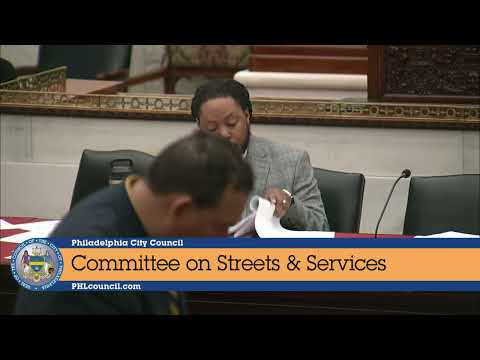
Philadelphia City Council's Committee on Streets and Services heard testimony on two related bills—250266 and 250267—proposing to convert 40th Street to a northbound one‑way street between Kingessing Avenue and Chestnut Street and to install a parking‑protected bike lane along the same stretch.
Philadelphia City Council's Committee on Streets and Services heard testimony on two related bills—250266 and 250267—proposing to convert 40th Street to a northbound one-way street between Kingessing Avenue and Chestnut Street and to install a parking‑protected bike lane along the same stretch.
City transportation staff and the project's consultant said the measures follow about 18 months of community engagement and are intended to improve traffic safety, loading access and school drop‑off conditions. "This project will convert two‑way vehicle traffic to a one‑way northbound on 40th Street... this project was a result of 18 months of community engagement," said Cole Appleman, policy analyst for the Office of Transportation and Infrastructure Systems.
Supporters, including advocacy group Fifth Square, described repeated crashes, speeding and conflicts on the corridor and urged passage. Jared Johnson, a West Philadelphia resident and Vision Zero advocate, said adding protected lanes and changing traffic patterns would reduce dangerous interactions between motorists and people walking or biking.
But multiple residents who live south of Baltimore Avenue opposed the specific design and timing. Teresa Feo, speaking for the 40th/40th Friends group, said the project lacked intersection‑specific traffic studies at busy locations near Saint Francis de Sales Church and its school and warned the proposal could shift dangerous cut‑through traffic onto small side streets. "Otis did not conduct traffic studies at 40th and Springfield, which is one of the busiest and most dangerous intersections in our neighborhood," Feo said.
Virginia Lynn Hogben, a long‑term resident of Windsor Avenue, said the proposed lane reductions would create new visibility and collision risks at uncontrolled side‑street intersections that already concern neighbors. "This is not merely a one‑way and a protected bike lane. This is a one‑lane street. This street is the sole access for two side streets," Hogben said.
Transportation staff said they performed counts at 25 intersections across the study area, reviewed sight lines, and coordinated with schools and loading stakeholders. Christopher Pacholsky of OTIS said the project reduces conflict points at school drop‑off by converting two‑way to one‑way traffic and that the team has been in direct contact with school leaders over the plan.
Council members asked about outreach, parking impacts and mitigation. Appleman and OTIS staff said some parking will be removed to meet sight‑line standards and that the project includes daytime loading zones and signage; they also said the city would continue community engagement ahead of any construction. Council member Ahmad asked OTIS to pursue offset parking options and to monitor parking occupancy patterns.
The bills were read into the record and later included in a committee motion to report multiple bills with a favorable recommendation to council. The motion to report was moved and seconded during the public meeting portion of the hearing; committee chairs recorded that the bills would be reported favorably.
The project remains contested in public testimony: proponents emphasized safety gains and the opportunity to restripe the street as part of a planned repaving this summer; opponents asked for additional intersection‑level studies, adjustments to the lane configuration and more direct solutions for school drop‑off safety.
Looking ahead, staff said additional design and outreach steps remain before physical changes, and council will consider the legislation as it moves to first reading.