Get Full Government Meeting Transcripts, Videos, & Alerts Forever!
Get email alerts on the Workforce And Labor topic
No spam. Unsubscribe anytime.
San Mateo holds AB 2561 hearing on city vacancies; HR outlines hiring challenges and staff retention steps
Summary
City HR reported a 9.8% vacancy rate and cited hiring delays, lengthy external recruitments and competition from higher-paying nearby cities; SEIU urged raises, workforce housing and childcare; staff said they will pursue process improvements and partnerships to reduce vacancies to a 6% target.
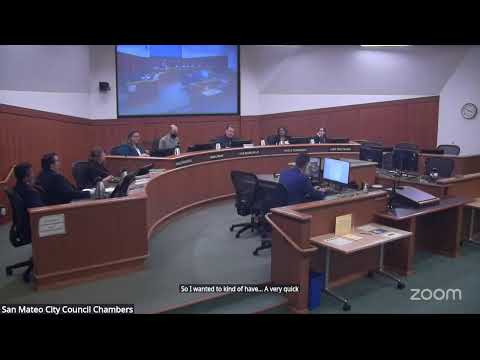
The San Mateo City Council convened a public hearing on April 7, 2025 as required by Assembly Bill 2561 and government code section 3502.3 to present the status of city vacancies, recruitment and retention efforts.
Araceli Esparza, director of human resources, told the council the city has 548 full-time equivalent positions in 68 job classifications and reported an overall vacancy rate of 11.5% as of Jan. 27, 2025 that has since decreased to 9.8%. She said the largest share of vacancies was in Public Works (41% of vacancies) and Parks & Recreation (24%), and that the city filled 140 positions in 2024. “As of 01/27/2025, our vacancy rate was 11.5. I am pleased to report that our current vacancy rate has decreased to 9.8%,” Esparza said.
Esparza outlined steps staff has taken and recommended actions to address hiring challenges: request additional HR staffing, review each phase of recruitment and selection to streamline processes, identify classifications that are hard to recruit and enhance outreach to build candidate pipelines, and continue to use total-compensation survey results during contract negotiations to align benchmark salaries to median where feasible. She also said the city has an internal goal to reduce vacancy rates to 6% within approximately one year.
Esparza described operational bottlenecks in hiring: manual/existing HR systems, background and clearance delays, reorganizations that place positions on hold, and longer timelines for external recruitments (she reported an average of 225 calendar days to fill external/internal recruitments). She explained the city’s hiring flow from requisition to conditional offer, candidate clearance and start date.
Jesse Dolan, speaking for SEIU, urged more immediate pay adjustments and other retention measures. Dolan said median tenure in the represented maintenance unit is short — the union cited a treatment-plant turnover rate near 50% and median lengths of employment of roughly five years. “The two most common reasons people leave the city … are low pay and long commutes,” Dolan said, noting that nearby cities often pay more and that high turnover forces the city to rely on outside contractors. He asked the council to consider a 2.5% salary increase allowed under Article 14 of the parties’ memorandum of understanding and urged the city to explore workforce housing, childcare subsidies and temporary staff housing (“barracks”) to reduce long commutes.
City staff and the council discussed possible next steps. Esparza said staff will pursue the recommended process changes, develop targeted recruitment plans, and meet with bargaining units to agree on future salary-survey methodology. City Manager Alex (given name in transcript) and other staff said they will meet with HEART (the county workforce housing authority) and other partners to explore workforce housing options and will gather details from Redwood City about a child-care stipend model for city employees. Public Works and police staff noted potential temporary-housing options at existing public sites; SEIU and union speakers pointed to an immediate opportunity to repurpose construction trailers at the wastewater treatment plant as near-term sleeping quarters for employees with long commutes.
Public comment included one speaker from the San Mateo Labor Council urging the city to honor the SEIU 2.5% reopener and to convert extra-help roles to full time where feasible.
No formal policy vote was taken during the hearing; the presentation satisfied the AB 2561 requirement to present workforce data and retention plans before the governing body. Staff committed to follow up with additional items and to bring recommended policy changes and any negotiated compensation proposals back through the meet-and-confer and budget processes.
Speakers quoted in this article are listed below.